
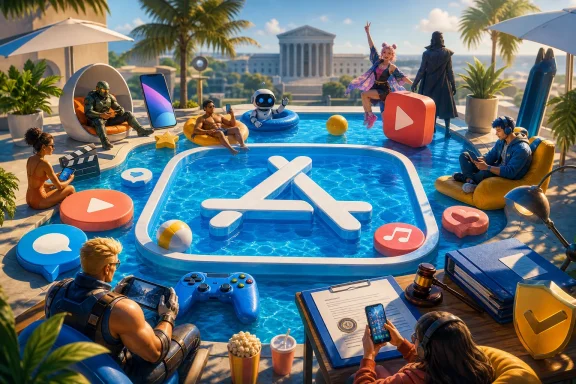
 Overview: Why the Apple App Store ad has sparked legal speculation
The commercial’s visual idea is simple: the App Store is a pool, and the apps and games available through it are the guests. That makes for a bright, immediately understandable summer advertisement. It also means Apple is placing highly protected characters, trademarks, logos, and design language into a single piece of mass-market promotional media.
That is precisely why some social-media users reacted with skepticism. The more famous the property, the more people assume that a corporation using it must either have a complicated rights deal—or be taking an enormous risk.
According to the original reporting, the ad uses a mix of fictional characters and product branding. The commercial was shared with the caption: “The App Store is open all summer. Stay entertained with apps and games we think you’ll love.” That framing matters. Apple is not presenting the campaign as an unaffiliated fan animation or a generic marketplace montage. It is promoting digital entertainment available through its own storefront.
The internet’s “lawsuit waiting to happen” line is therefore better understood as a reaction to the visible density of intellectual property than as evidence of an actual rights dispute. No public claim in the supplied reporting identifies a rights holder objecting to the campaign, threatening litigation, or alleging that Apple used an asset without permission. UNILAD Tech’s coverage documents viewer concern, not a lawsuit.
That distinction is not trivial. In technology reporting, particularly around companies as large as Apple, a viral legal theory can spread much more quickly than the practical explanation: extensive clearance work often happens long before an advertisement reaches the public.
Apple’s “Open All Summer” campaign is built around App Store discovery
Apple’s own App Store editorial material describes Open all summer as a seasonal entertainment guide, positioning the store as a place to discover games, streaming services, reading apps, travel tools, and other leisure-oriented downloads. The campaign text leans directly into the pool-and-hammock imagery seen in the commercial, encouraging users to turn to the App Store when “boredom strikes.” Apple’s campaign page
That campaign structure helps explain why the advertisement is so dependent on familiar brands. A storefront marketing message that simply says “download some apps” is forgettable. A pool filled with recognizable characters and visual shorthand for well-known apps instantly communicates variety:
- Major games can be represented through their characters.
- Entertainment apps can be represented through recognizable logos or interface motifs.
- Family-friendly content becomes apparent without a lengthy explanation.
- The App Store itself becomes the “venue” that brings all those experiences together.
This is a core advantage of the digital storefront advertisement. Unlike a conventional product commercial, Apple does not have to explain one device feature or one subscription tier. It is selling the idea of breadth: there is something to watch, play, read, create, or share during summer downtime.
Apple also actively encourages developers to think about visibility and promotion within the App Store ecosystem. Its developer site says developers can use marketing tools, customized assets, promotional offers, and featured opportunities to help drive discovery and engagement. Apple’s app-promotion guidance even describes opportunities to be featured across App Store and Apple marketing channels.
In that context, an editorially selected group of apps appearing in a seasonal commercial is not unusual in principle. The scale and polish of the creative may be unusual, but the broader goal—using Apple’s channels to surface apps and games—is an explicit part of the App Store’s promotional model.
Why the pool concept works
The pool is doing several jobs at once.
First, it makes the App Store logo visually legible as a location rather than an icon. The triangular “A” shape becomes a stylized pool, which turns abstract platform branding into a scene where characters can interact.
Second, it provides an easy way to combine unrelated intellectual properties. Hulk, SpongeBob, Mr. Monopoly, YouTube, Snapchat, and game characters would have little natural reason to share a narrative universe. A pool party is intentionally loose. Everyone can be present without the commercial implying that the brands exist in the same fictional canon.
Third, it is an efficient metaphor for the App Store’s role as an aggregator. Apple is not claiming to own every character at the pool. It is presenting itself as the platform that hosts access points to their games, apps, or services.
That is a much more defensible creative position than an ad which suggested Apple had created, owned, or exclusively partnered with every brand shown. Still, defensible in concept and cleared in practice are two separate things.
The legal issue is not whether characters are famous—it is whether their use was authorized
The social-media reaction gets one thing right: famous characters and logos are not free visual ingredients. A company cannot assume that something is usable in advertising merely because it is widely known, already sold through an app marketplace, or visible in a product listing.
Under U.S. copyright principles, copyright owners generally have exclusive rights to reproduce, distribute, adapt, publicly perform, and publicly display protected works, while also retaining the ability to authorize others to carry out those uses. The U.S. Copyright Office’s overview specifically notes that owners can authorize third parties to exercise those rights.
For a commercial like Apple’s, the relevant questions would usually include:
- Who owns each character, logo, and visual asset?
- Which entity controls advertising approval for that property?
- Does the app developer possess marketing rights, or do they belong to a separate publisher, franchise owner, studio, or licensor?
- Does the use accurately represent the app available on the App Store?
- Was the final animation approved for the territories, platforms, duration, and media channels in which it will run?
The answers can be far more complicated than viewers might expect. A mobile game may be published by one company, developed by another, and built around a character franchise owned by a third company. The app’s presence on the App Store does not automatically reveal the underlying chain of approvals.
That is why the “Apple can just use whatever is uploaded to the App Store” theory is too broad. Apple’s public developer marketing agreement says that it may use a developer’s name and the name of each app in an index of products or developers that work with Apple-branded products. Apple’s marketing resources and identity guidelines That narrow language is not the same thing as a public declaration that Apple receives unlimited, automatic rights to transform every third-party character, app asset, logo, or franchise element into a global television-style advertisement.
In other words, an app-store listing and a blockbuster marketing campaign are legally different activities.
A marketplace listing is not a blanket character license
This is the key point that is often lost in viral debate. A developer may be entitled to distribute a licensed game through the App Store, while Apple may still need additional approval before using that game’s characters in a broad campaign.
That difference is especially important with properties such as superhero characters, animated series characters, and board-game mascots. These are not simply app icons. They are branded entertainment assets with commercial, contractual, and reputational value.
The U.S. Copyright Office also emphasizes that copyright protection attaches to original expression, while names, titles, short phrases, and certain familiar symbols may instead implicate other rights such as trademarks. The Copyright Office’s explanation of copyright and other IP rights In a real-world campaign, Apple’s legal and marketing teams would be dealing with a layered rights picture: copyright in artwork and animation, trademark rights in logos and source identifiers, contractual restrictions, and possibly publicity or merchandising rights depending on the asset and territory.
That does not make a lawsuit inevitable. It makes rights clearance essential.
Why the “lawsuit waiting to happen” conclusion is premature
A commercial packed with famous IP can look reckless to outsiders because the approvals are invisible. The audience sees Hulk in a pool. Apple’s internal teams may see a spreadsheet of territories, deliverables, asset files, approval timestamps, partner contacts, usage windows, localization requirements, and legal sign-offs.
That work is not glamorous, but it is standard commercial practice. Major advertisements involving recognizable entertainment properties are commonly designed around permissions, licenses, or cooperative marketing arrangements. The fact that an ad appears on Apple’s official channels does not prove the exact structure of those arrangements, but it makes the more ordinary explanation—authorized participation—far more plausible than a theory that Apple casually used a collection of globally valuable franchises without clearing them.
Apple’s developer-facing material also makes clear that the company runs a substantial promotional apparatus. It offers marketing assets, app discovery tools, Apple Ads placements, App Store features, and promotional artwork guidelines for apps being considered for feature placement. Apple’s promotion hub says its App Store teams highlight apps, games, and in-app content across the storefront to support discovery and business growth.
That infrastructure matters. App Store featuring is a professional editorial and marketing function, not merely an algorithmic list of products. Developers whose apps receive major visibility have a reason to participate in a campaign that could produce downloads, subscriptions, in-app purchases, and wider brand recognition.
The online commenters who suggested that Apple likely contacted participating developers or rights holders are therefore pointing toward the most realistic scenario. The reporting on the social response does not publish Apple’s individual agreements, and it should not be assumed that every participant signed the same deal. But a coordinated approval process is a much more credible explanation than the idea that Apple is relying on a hidden App Store clause granting it unlimited promotional control over all uploaded characters.
The commercial’s biggest legal risk would be specific, not generic
If there were a dispute, it would likely turn on a particular asset or a particular use—not on the general fact that several licensed characters appear in the same pool scene.
Potential points of friction in a campaign of this kind could include:
- A character shown in a way the rights holder believes conflicts with brand guidelines.
- A logo or product element used outside an agreed territory or media channel.
- A franchise owner believing Apple’s treatment implies an endorsement that was never approved.
- A licensee participating without sufficient authority from the underlying property owner.
- A campaign continuing after a time-limited promotional authorization expires.
- A visual asset being altered in a way that exceeds the scope of an approved deliverable.
These are all examples of possible clearance problems, not allegations that any occurred in Apple’s “Open All Summer” commercial. The distinction is vital. Public reaction can identify a category of risk without establishing an actual breach.
The stronger criticism is about platform power and curation
The advertisement raises a more interesting issue than whether Apple forgot to ask permission: who gets to be visible in an app-store economy?
The App Store is not merely a catalog. Apple curates editorial stories, offers featured placement, sells advertising inventory, supports custom product pages, and gives developers a collection of tools designed to improve discovery. Apple’s developer guidance describes these mechanisms as part of a broader system for driving engagement.
A glossy commercial featuring established franchises illustrates the upside of that power. A selected app can receive exposure that would be nearly impossible to purchase independently. For a smaller developer, an Apple feature can create credibility as well as visibility.
Yet the same structure also exposes an unavoidable imbalance. Large publishers, globally recognized brands, and apps with pre-existing fan communities are naturally easier to market in a fast-moving thirty-second commercial. A pool scene packed with instantly recognizable characters is memorable because viewers already know the characters.
That creates a marketing advantage for brands that have already cleared the hardest hurdle in entertainment: cultural recognition.
The benefit: a more compelling storefront
For consumers, this can be positive. A polished campaign can make app discovery feel less like scrolling through an infinite software catalog and more like browsing a coherent entertainment destination.
The commercial’s approach has several strengths:
- Instant recognition: Familiar properties reduce the effort required to understand the ad.
- Cross-category appeal: Games, social apps, video platforms, and entertainment services can coexist in one visual scene.
- Seasonal relevance: The pool setting connects naturally to travel, school breaks, and downtime.
- Platform identity: Apple turns a functional store icon into a branded space with personality.
- Potential developer reach: Featured partners may gain meaningful exposure beyond the App Store interface.
For Apple, this is an effective way to promote the storefront as an entertainment hub rather than a utility that users visit only when they already know what they want to install.
The risk: visibility can look like endorsement
The challenge is that audiences do not always separate being on a platform from being selected and celebrated by the platform.
When Apple places an app, character, or logo inside a high-budget App Store commercial, the appearance may function as a soft endorsement in the minds of consumers. That does not mean Apple is legally guaranteeing every app’s quality or safety. But it does mean the creative selection carries reputational weight.
Apple’s App Review Guidelines say misleading app marketing can lead to removal from the App Store or termination of a developer account. Apple’s App Review Guidelines The company’s own standards therefore recognize that promotion is not separate from user trust. If an app is marketed in a way that overstates what it provides, customers can be misled.
For a broad App Store campaign, Apple has a corresponding incentive to feature products that are stable, appropriate for public promotion, and supported by clear rights. The stakes are higher when the creative is designed to reach audiences who may never have searched for those apps in the first place.
What Windows and Microsoft Store users should take from this
For Windows enthusiasts, the Apple ad is a useful reminder that app stores increasingly operate as media businesses, not just download repositories.
The Microsoft Store faces many of the same strategic pressures. A marketplace must balance discoverability, consumer trust, app quality, paid placements, editorial promotion, developer relationships, and platform branding. Simply having a vast software catalog is not enough; users need reasons to browse, discover, and return.
Apple’s summer campaign shows the value of a strong editorial concept. Rather than promoting a technical feature, it presents an emotional use case: summer boredom, leisure time, and a collection of entertainment options waiting in one place.
Microsoft has a different ecosystem and different strengths. Windows remains closer to a general-purpose computing environment, where users may seek productivity software, utilities, PC games, developer tools, hardware companions, and enterprise-adjacent applications. That diversity can make unified brand campaigns more difficult—but it also creates opportunities.
A Windows-focused campaign could emphasize:
- PC Game Pass and gaming discovery.
- Creative tools for students and hobbyists.
- Productivity and collaboration apps for hybrid work.
- AI-assisted utilities and developer experiences.
- Seasonal travel, entertainment, and education bundles.
- Curated collections built around a practical user need rather than a generic app category.
The larger lesson is not that every storefront needs cartoon characters in a swimming pool. It is that storefront curation has become product marketing. The best app-store campaigns make users feel that discovery itself has value.
Conclusion: A viral legal theory, but a conventional marketing reality
The reaction to Apple’s “Open All Summer” commercial is a predictable consequence of seeing so many protected characters and brands gathered in one place. Viewers are right to recognize that intellectual property is involved, and they are right that a less careful company could create real legal exposure by using such material without authorization.
But there is a major difference between identifying that legal principle and concluding that Apple’s commercial is headed for court. The available reporting establishes social-media concern, while Apple’s own App Store campaign and developer-promotion materials show a company with a deeply developed system for editorial featuring and marketing coordination. Apple’s Open all summer feature Apple’s developer promotion resources
The smarter reading is that the commercial makes the clearance work visible by making the brands visible. It is precisely because Hulk, SpongeBob, Mr. Monopoly, Snapchat, YouTube, and other recognizable properties carry value that an Apple-scale campaign would be expected to treat them as deliberate, managed partnerships—not as random decorations.
The real story is not an imminent lawsuit. It is the modern app store’s evolution into a curated entertainment storefront, where brand recognition, rights management, and platform promotion now sit at the center of how users discover software.
