
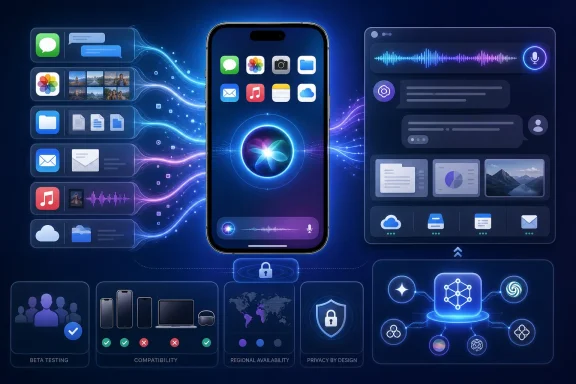
Apple’s Siri AI is already in beta, but the claim that it will reach “millions of iPhone users” in the first or second week of September is ahead of Apple’s own record. Apple has confirmed only that Siri AI will arrive as a beta later in 2026; it has not announced a public release date, rollout schedule, price, or the number of users who will receive it at launch.
The larger correction is that this is not a simple Apple-versus-OpenAI fight. Siri AI is Apple’s attempt to turn the iPhone’s built-in assistant into an operating-system-level interface for personal data and app actions. ChatGPT remains a separate, cross-platform AI service with more mature conversational features and a growing catalogue of business integrations. In iOS 27, those roles may overlap, but they are not interchangeable.
Apple unveiled Siri AI at WWDC on June 8 and opened it to developer testing immediately. A public beta followed in July. Reporting by Bloomberg, later detailed by MacRumors and TechCrunch, had already framed the project as Apple’s first proper chatbot-style Siri overhaul rather than another incremental voice-assistant update.
The distinction matters for anyone deciding whether to wait for Siri AI, deploy ChatGPT in a workplace, or assume that an iPhone upgrade alone buys access to Apple’s new AI features: the iOS 27 update and the Siri AI rollout are not the same thing.
Apple’s own compatibility list undercuts the suggestion that the new assistant will simply arrive preinstalled for the broad iPhone base. iOS 27 itself supports a wider range of devices, but Siri AI and Apple Intelligence require substantially newer hardware.
On iPhone, Apple lists the iPhone 15 Pro, iPhone 15 Pro Max, and iPhone 16 models or later as eligible for Siri AI. That leaves out the standard iPhone 15 and iPhone 15 Plus, along with older devices that may still receive iOS 27. Apple also says the initial beta is for supported devices set to English, with more languages to follow.
There are geographic limits, too. Apple has said Siri AI will not be available initially on iPhone, iPad, or Apple Watch in the European Union, citing the Digital Markets Act. The company also says Siri AI and other new Apple Intelligence features will not initially be available in China while it works through regulatory requirements.
That turns “preinstalled” into a much less decisive advantage than it first appears. Siri remains on older iPhones, but the generative, context-aware Siri AI experience is gated by hardware, language, region, and beta rollout. Apple has not published a count of compatible active devices, so there is no official basis for treating a September launch as a universal or immediate mass deployment.
For IT departments, this is the familiar Apple Intelligence problem in a sharper form: an operating-system upgrade can be broadly available while the feature that matters is restricted to a subset of the fleet. Inventory by model, region, managed Apple ID policy, and language configuration will determine who actually receives Siri AI.
Apple says Siri AI can search personal messages, emails, photos, and files for contextual information. Its examples include finding a hotel confirmation in an old email, locating a restaurant a friend mentioned in Messages, drafting messages in a user’s customary style, and editing or sharing photos through systemwide app actions. It can also answer questions about material currently on screen and, on iPhone, extend those capabilities into a new Camera mode.
This is the practical challenge to ChatGPT. A chatbot can advise a user how to change an iPhone setting; Siri can change it. A chatbot can produce a message draft; Siri can be positioned to place that draft in Mail or Messages, pull relevant details from the user’s local context, and pass it through an app action.
Apple says Siri AI uses a mix of on-device Apple Foundation Models and Private Cloud Compute for heavier requests. That architecture is central to Apple’s privacy pitch, but it does not remove the usual enterprise concerns around personal context. The more useful Siri becomes at joining information across mail, messages, photos, and third-party apps, the more important it becomes to understand exactly which accounts, apps, and device-management restrictions can expose data to it.
Apple’s developer documentation is also revealing here. The company is pushing developers to expose app actions and structured content through App Intents, so Siri, Spotlight, and Shortcuts can work with them. Siri AI’s usefulness outside Apple’s own apps will therefore depend heavily on developer adoption. Apple can provide the interface, but it cannot make every line-of-business app agent-ready on day one.
However, the claim that Siri AI “cannot be interrupted” and is confined to a slow turn-by-turn experience is not established by Apple’s published documentation or the available independent hands-on reporting. Apple describes the new Siri AI as conversational, says it has improved speech understanding, and has added more expressive voice controls. That is not proof it matches GPT-Live’s live conversational behavior, but neither Apple nor reliable hands-on reports support a categorical claim that interruption is impossible.
The gap should be stated more precisely: ChatGPT has a documented, mature live voice mode with interruption handling. Siri AI is still a beta product whose final voice interaction model, latency, and behavior under real network conditions remain unsettled.
ChatGPT’s work-oriented edge is also genuine, though it needs qualification. OpenAI offers web access, file analysis, document and presentation creation, and integrations now called Apps, previously Connectors. Google Drive integration can search and summarize permitted Drive content, while ChatGPT Work can create and edit documents, spreadsheets, and presentations.
But those are not universally available capabilities in every ChatGPT account. Availability varies by plan, workspace type, administrator settings, region, and the third-party permissions a user or organization grants. “ChatGPT connects to Google Drive” should not be read as “ChatGPT can automatically see corporate Drive data.” It requires setup and authorization, which is precisely where enterprise governance enters the picture.
ChatGPT already has an Apple Intelligence integration on current supported Apple platforms, allowing Siri and writing features to hand certain requests to OpenAI when users approve. Bloomberg reported in March that Apple was testing an extension framework that would let users enable other AI services within Siri as well, potentially including Google Gemini and Anthropic Claude. Apple’s public developer materials now say that developers can bring their own model providers into Apple’s AI tools, though Apple has not published a consumer-facing provider list or confirmed the precise final implementation described by Bloomberg.
If that framework ships as reported, Apple will not be trying to displace every chatbot with one all-purpose Siri model. It will be making Siri the front door: the assistant that knows the device state, can execute actions through Apple’s permissions system, and can potentially route broader reasoning requests to an outside model.
That is a more durable position than competing feature-for-feature with ChatGPT. It also means OpenAI’s place on iPhone may shift from privileged partner to one option among several. For users, choice could improve. For OpenAI, Google, Anthropic, and enterprise AI vendors, Apple would become a gatekeeper over a valuable device-level interaction surface.
That is a meaningful product choice, especially as consumer AI companies experiment with more personal voice interactions. But the broader assertion that Siri explicitly tells users it cannot replace a doctor, therapist, or real person is not supported by Apple’s June Siri AI announcement. Apple’s published material focuses on privacy, personal context, app actions, and assistant capabilities. The specific medical and therapy warning described in the comparison should be treated as unconfirmed unless Apple publishes the behavior or it appears in release software.
Apple’s decision to discourage companion-style use does not automatically make Siri AI safer for work or personal information. The operational questions remain familiar: what data is processed on-device, what is sent to Private Cloud Compute, when outside models are invoked, whether an organization can disable integrations, and how reliably the assistant distinguishes an answer from an action.
Siri AI can challenge ChatGPT where iPhone ownership, personal context, and device control matter most. It cannot yet claim ChatGPT’s established advantage in live voice interaction, broad third-party data connections, or professional AI workflows—and Apple has not shipped a stable release that proves otherwise.
For now, the immediate consequence is simpler: organizations and consumers should not plan around a rumored early-September Siri AI launch. Apple has delivered a beta, confirmed a constrained eligibility list, and left the final release date, rollout mechanics, and any paid tier unanswered.
Apple unveiled Siri AI at WWDC on June 8 and opened it to developer testing immediately. A public beta followed in July. Reporting by Bloomberg, later detailed by MacRumors and TechCrunch, had already framed the project as Apple’s first proper chatbot-style Siri overhaul rather than another incremental voice-assistant update.
The distinction matters for anyone deciding whether to wait for Siri AI, deploy ChatGPT in a workplace, or assume that an iPhone upgrade alone buys access to Apple’s new AI features: the iOS 27 update and the Siri AI rollout are not the same thing.
Siri AI is an iPhone feature, but not for every iPhone
Apple’s own compatibility list undercuts the suggestion that the new assistant will simply arrive preinstalled for the broad iPhone base. iOS 27 itself supports a wider range of devices, but Siri AI and Apple Intelligence require substantially newer hardware.On iPhone, Apple lists the iPhone 15 Pro, iPhone 15 Pro Max, and iPhone 16 models or later as eligible for Siri AI. That leaves out the standard iPhone 15 and iPhone 15 Plus, along with older devices that may still receive iOS 27. Apple also says the initial beta is for supported devices set to English, with more languages to follow.
There are geographic limits, too. Apple has said Siri AI will not be available initially on iPhone, iPad, or Apple Watch in the European Union, citing the Digital Markets Act. The company also says Siri AI and other new Apple Intelligence features will not initially be available in China while it works through regulatory requirements.
That turns “preinstalled” into a much less decisive advantage than it first appears. Siri remains on older iPhones, but the generative, context-aware Siri AI experience is gated by hardware, language, region, and beta rollout. Apple has not published a count of compatible active devices, so there is no official basis for treating a September launch as a universal or immediate mass deployment.
For IT departments, this is the familiar Apple Intelligence problem in a sharper form: an operating-system upgrade can be broadly available while the feature that matters is restricted to a subset of the fleet. Inventory by model, region, managed Apple ID policy, and language configuration will determine who actually receives Siri AI.
Apple’s advantage is permission to act, not merely to answer
Siri AI’s strongest feature is not that it can draft an email or retrieve web information. ChatGPT and competing services have handled those tasks for years. Apple’s differentiator is that Siri sits inside the operating system and can combine a user’s current screen, device data, supported app actions, and conversational request.Apple says Siri AI can search personal messages, emails, photos, and files for contextual information. Its examples include finding a hotel confirmation in an old email, locating a restaurant a friend mentioned in Messages, drafting messages in a user’s customary style, and editing or sharing photos through systemwide app actions. It can also answer questions about material currently on screen and, on iPhone, extend those capabilities into a new Camera mode.
This is the practical challenge to ChatGPT. A chatbot can advise a user how to change an iPhone setting; Siri can change it. A chatbot can produce a message draft; Siri can be positioned to place that draft in Mail or Messages, pull relevant details from the user’s local context, and pass it through an app action.
Apple says Siri AI uses a mix of on-device Apple Foundation Models and Private Cloud Compute for heavier requests. That architecture is central to Apple’s privacy pitch, but it does not remove the usual enterprise concerns around personal context. The more useful Siri becomes at joining information across mail, messages, photos, and third-party apps, the more important it becomes to understand exactly which accounts, apps, and device-management restrictions can expose data to it.
Apple’s developer documentation is also revealing here. The company is pushing developers to expose app actions and structured content through App Intents, so Siri, Spotlight, and Shortcuts can work with them. Siri AI’s usefulness outside Apple’s own apps will therefore depend heavily on developer adoption. Apple can provide the interface, but it cannot make every line-of-business app agent-ready on day one.
ChatGPT’s voice lead is real, but the Siri criticism is not fully supported
The supplied comparison correctly identifies one meaningful ChatGPT advantage: OpenAI’s GPT-Live supports full-duplex voice interaction. OpenAI says users can interrupt, continue speaking while ChatGPT responds, ask it to slow down, or change direction mid-answer. That makes spoken interaction feel less like dictation followed by playback.However, the claim that Siri AI “cannot be interrupted” and is confined to a slow turn-by-turn experience is not established by Apple’s published documentation or the available independent hands-on reporting. Apple describes the new Siri AI as conversational, says it has improved speech understanding, and has added more expressive voice controls. That is not proof it matches GPT-Live’s live conversational behavior, but neither Apple nor reliable hands-on reports support a categorical claim that interruption is impossible.
The gap should be stated more precisely: ChatGPT has a documented, mature live voice mode with interruption handling. Siri AI is still a beta product whose final voice interaction model, latency, and behavior under real network conditions remain unsettled.
ChatGPT’s work-oriented edge is also genuine, though it needs qualification. OpenAI offers web access, file analysis, document and presentation creation, and integrations now called Apps, previously Connectors. Google Drive integration can search and summarize permitted Drive content, while ChatGPT Work can create and edit documents, spreadsheets, and presentations.
But those are not universally available capabilities in every ChatGPT account. Availability varies by plan, workspace type, administrator settings, region, and the third-party permissions a user or organization grants. “ChatGPT connects to Google Drive” should not be read as “ChatGPT can automatically see corporate Drive data.” It requires setup and authorization, which is precisely where enterprise governance enters the picture.
Apple’s real strategy may be to control the gateway
The most consequential detail in Bloomberg’s reporting is not that Apple wants Siri to challenge ChatGPT. It is that Apple plans to open Siri to rival AI assistants beyond ChatGPT in iOS 27.ChatGPT already has an Apple Intelligence integration on current supported Apple platforms, allowing Siri and writing features to hand certain requests to OpenAI when users approve. Bloomberg reported in March that Apple was testing an extension framework that would let users enable other AI services within Siri as well, potentially including Google Gemini and Anthropic Claude. Apple’s public developer materials now say that developers can bring their own model providers into Apple’s AI tools, though Apple has not published a consumer-facing provider list or confirmed the precise final implementation described by Bloomberg.
If that framework ships as reported, Apple will not be trying to displace every chatbot with one all-purpose Siri model. It will be making Siri the front door: the assistant that knows the device state, can execute actions through Apple’s permissions system, and can potentially route broader reasoning requests to an outside model.
That is a more durable position than competing feature-for-feature with ChatGPT. It also means OpenAI’s place on iPhone may shift from privileged partner to one option among several. For users, choice could improve. For OpenAI, Google, Anthropic, and enterprise AI vendors, Apple would become a gatekeeper over a valuable device-level interaction surface.
Apple’s safety message has been overstated
Apple has publicly emphasized that Siri AI is intended as a utility rather than an emotional companion. In an interview reported by MacRumors following WWDC, Apple software chief Craig Federighi said the company did not intend Siri to become an “AI girlfriend” or substitute for human relationships.That is a meaningful product choice, especially as consumer AI companies experiment with more personal voice interactions. But the broader assertion that Siri explicitly tells users it cannot replace a doctor, therapist, or real person is not supported by Apple’s June Siri AI announcement. Apple’s published material focuses on privacy, personal context, app actions, and assistant capabilities. The specific medical and therapy warning described in the comparison should be treated as unconfirmed unless Apple publishes the behavior or it appears in release software.
Apple’s decision to discourage companion-style use does not automatically make Siri AI safer for work or personal information. The operational questions remain familiar: what data is processed on-device, what is sent to Private Cloud Compute, when outside models are invoked, whether an organization can disable integrations, and how reliably the assistant distinguishes an answer from an action.
Siri AI can challenge ChatGPT where iPhone ownership, personal context, and device control matter most. It cannot yet claim ChatGPT’s established advantage in live voice interaction, broad third-party data connections, or professional AI workflows—and Apple has not shipped a stable release that proves otherwise.
For now, the immediate consequence is simpler: organizations and consumers should not plan around a rumored early-September Siri AI launch. Apple has delivered a beta, confirmed a constrained eligibility list, and left the final release date, rollout mechanics, and any paid tier unanswered.
References
- Primary source: Times Now
Published: 2026-08-03T14:34:24+00:00
Loading…
www.timesnownews.com - Related coverage: axios.com
Tim Cook: Apple may charge for AI Siri
Heavy users of Apple Intelligence may need an iCloud+ subscriptionwww.axios.com
- Related coverage: bloomberg.com
Loading…
www.bloomberg.com - Related coverage: bloomberg.com
Loading…
www.bloomberg.com - Related coverage: news.bloomberglaw.com
Loading…
news.bloomberglaw.com - Related coverage: apple.com
Apple introduces Siri AI, a profoundly more capable and personal assistant - Apple
Apple introduces Siri AI, a profoundly more capable and personal assistant powered by Apple Intelligence, with personal context, world knowledge, and onscreen awareness.www.apple.com - Related coverage: macrumors.com
Loading…
www.macrumors.com - Related coverage: techcrunch.com
Loading…
techcrunch.com - Related coverage: macrumors.com
Loading…
www.macrumors.com - Related coverage: support.apple.com
Loading…
support.apple.com - Related coverage: sg.finance.yahoo.com
Loading…
sg.finance.yahoo.com - Related coverage: bloomberglinea.com
Loading…
www.bloomberglinea.com - Related coverage: apple.com
- Related coverage: help.openai.com
ChatGPT Voice | OpenAI Help Center
Talk with ChatGPT in a natural, free-form voice conversation.
help.openai.com
- Related coverage: help.openai.com
Loading…
help.openai.com - Related coverage: openai.com
Loading…
openai.com - Related coverage: openai.com
Introducing GPT-Live | OpenAI
A new generation of voice models for natural human-AI interaction, now powering ChatGPT Voice.openai.com - Related coverage: cdn.openai.com
- Related coverage: cdn.openai.com
- Related coverage: go.openai.com
- Related coverage: tomsguide.com
Loading…
www.tomsguide.com - Related coverage: techradar.com
Loading…
www.techradar.com - Related coverage: tomsguide.com
Loading…
www.tomsguide.com - Related coverage: developer.apple.com
Loading…
developer.apple.com - Related coverage: techcrunch.com
Apple opens its new Siri AI to everyone with the iOS 27 public beta | TechCrunch
If you’ve been waiting to try Apple’s revamped Siri without installing a developer beta, you now can. The company on Tuesday released the iOS 27 public beta, giving iPhone owners early access to its AI-powered assistant and other new features before the software’s official launch this fall.techcrunch.com - Related coverage: developer.apple.com
Loading…
developer.apple.com - Related coverage: forbes.com
Loading…
www.forbes.com