

OpenAI released GPT-5.6 on July 9, SpaceXAI followed with Grok 4.5 in mid-July, Moonshot AI introduced Kimi K3 on July 16, and DeepSeek V4 Flash has continued rolling out through providers. Anthropic’s Claude Opus 5 also joined the comparison cycle later in the month. Each company supplied benchmark tables designed to establish leadership, but the figures often describe different model settings, different task harnesses, different token budgets, and different definitions of a successful result.
For Windows administrators and developers deciding what to connect to internal tools, that makes benchmarking firms less of a spectator sport and more of a procurement dependency. The question is no longer simply whether a model can write code or summarize documents. It is whether it completes a company’s actual workflow reliably enough, quickly enough, and at a predictable enough cost to justify changing an existing deployment.
Artificial Analysis is measuring more than a leaderboard rank
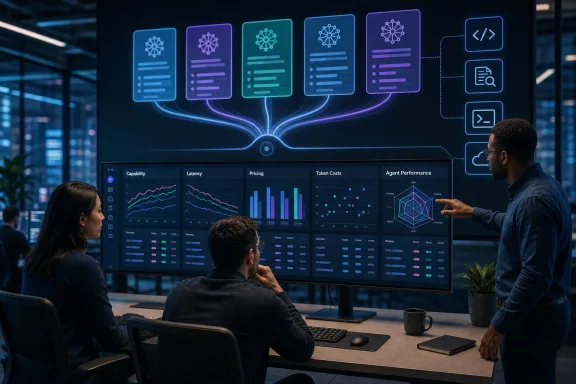
Artificial Analysis has become a prominent stop because it does not limit its comparison to a single “smartest model” score. Its public platform tracks API pricing, output speed, time to first token, context windows, supported features, and results across capability evaluations. That combination matters when two models appear close in a general benchmark but produce materially different operating costs or user-facing delays.
Its current Intelligence Index, version 4.1, combines nine evaluations across four weighted categories: agents, coding, scientific reasoning, and general capability. Agents account for 34% of the index, coding and scientific reasoning each account for 24%, and general capability makes up the remaining 18%. That weighting is an editorial and technical choice: the index is intentionally oriented toward agentic work, where a model must plan, use tools, and finish multi-step tasks rather than answer a static prompt.
Artificial Analysis also publishes separate provider comparisons. Those distinguish a model from the service endpoint used to access it — an important separation that vendor launch material frequently blurs. The same open-weight model can be cheap but slow through one host, or fast but more expensive through another. For an IT team evaluating an AI coding assistant, help-desk workflow, or retrieval system, that can be more actionable than a narrow point advantage on an academic-style test.
The July release wave made those comparisons unusually urgent. OpenAI positioned GPT-5.6 Sol as a high-end reasoning and coding model, while offering Terra and Luna as less costly tiers. Grok 4.5 arrived with aggressive price claims and an emphasis on coding and workplace productivity. Moonshot’s Kimi K3 drew attention as a large open-weight contender from China, and coverage by Nature and the Associated Press documented outside interest in its claimed performance and pricing. DeepSeek V4 Flash added another lower-cost, long-context option in a market where the model name alone no longer tells a buyer much about the service they will receive.
The headline traffic claim is real news, but the number remains unverified
The reported 40% increase in July traffic comes from Pulse, which attributed it broadly to the IT industry rather than to a public web-analytics dataset or a statement from Artificial Analysis. Artificial Analysis has not published a monthly traffic report confirming the number, and no second outlet located by WindowsForum independently reported the same measurement.
That does not undermine the wider premise. The company’s pages show an expanding commercial operation, including paid Pro access, enterprise services, a data API, and comparative data for hundreds of model endpoints. The inference is straightforward: as more models arrive with more tier names, pricing modes, and deployment paths, a standardized comparison layer becomes commercially useful.
But the distinction matters. A temporary increase in visits after a launch frenzy does not prove that benchmark firms have built a durable business advantage, nor does it prove that enterprises are buying their products in equivalent numbers. Attention is not adoption. The traffic report supports a narrower conclusion: July’s release cadence drove more people to seek comparative information, and Artificial Analysis was one visible destination.
That is still a meaningful signal. For much of the last AI cycle, a major vendor could declare a new model “state of the art” using a hand-picked collection of tests, publish an eye-catching chart, and dominate the day’s coverage. The current volume of releases makes that approach harder to sustain. A buyer evaluating GPT-5.6, Claude Opus 5, Grok 4.5, Kimi K3, and DeepSeek V4 Flash cannot make a credible decision from five vendor-authored graphs.
Benchmark scores are becoming a configuration problem
Independent measurement does not turn an AI leaderboard into an objective, permanent ranking. Artificial Analysis is notably explicit that its index has versions and that its methodology changes. Version 4.1, introduced in June, replaced some component evaluations, changed category weights to put more emphasis on agent work, and updated how it represents token and cost metrics.
That creates a practical consequence often omitted from launch coverage: a model’s position can move because the benchmark changed, even if the model did not. A score from a prior index version is not a clean apples-to-apples comparison with a score calculated after revised tasks, new weights, or a new grading approach. IT buyers should record the benchmark version and the model configuration alongside any score they use in a selection document.
The model configuration is equally consequential. Reasoning effort levels, tool access, maximum turns, system prompts, and model fallbacks can transform both completion rate and cost. OpenAI’s GPT-5.6 family, for example, spans Sol, Terra, and Luna, with varying reasoning settings and pricing. A result for Sol at its highest effort level does not describe the experience of an organization using a lower-cost tier or a restricted plan. Similar issues apply to provider-hosted open models, where quantization, hardware, routing, and rate limits can affect latency and throughput.
Artificial Analysis estimates a 95% confidence interval of less than plus or minus 1% for its Intelligence Index based on repeated experiments for the version 4.1 evaluation suite. That is useful disclosure, but it should discourage simplistic readings of tiny gaps. If two models are separated by a fraction of a point, an organization should not treat the ordering as evidence that one is categorically superior for its own use.
Academic work on benchmark contamination adds another warning. When benchmark questions or close variants reach a model’s training data, reported results can overstate generalization. That risk does not mean benchmarks are worthless; it means benchmark results are a screening tool, not a production acceptance test.
Windows and Microsoft 365 deployments need a local evaluation layer
For Windows-centric organizations, the benchmark boom should not result in another external dashboard becoming the sole authority over model selection. It should lead to a more disciplined evaluation process inside the organization.
An IT department considering a model for PowerShell assistance, Microsoft 365 document workflows, internal knowledge search, endpoint troubleshooting, or software development has variables that public benchmarks cannot fully reproduce. These include tenant permissions, identity boundaries, source-document quality, retention requirements, protected health or financial data, network restrictions, tool-call approval gates, and the cost of a confident but incorrect answer.
A useful internal evaluation should therefore measure the work that will actually be deployed:
- Test representative, sanitized tickets, scripts, knowledge-base queries, spreadsheet tasks, and document-generation requests rather than generic prompts.
- Run the same tasks through the exact model, reasoning setting, API provider, region, and tool permissions planned for production.
- Track completion quality, human correction time, first-token latency, total elapsed time, token use, and failure modes instead of preserving only an aggregate “win rate.”
- Require evidence for high-impact actions, especially where a model can propose changes to PowerShell, Intune policy, Exchange configuration, or identity settings.
- Repeat the test after any vendor model update, because a stable API model name does not guarantee stable behavior.
Public benchmark providers can make that process faster by narrowing the field and exposing price-performance tradeoffs that vendors do not emphasize. They cannot decide whether a model handles an organization’s naming conventions, legacy scripts, SharePoint permissions, or security-review requirements.
The lasting opportunity is comparison, not a single universal score
The more revealing development is that AI evaluation is becoming its own layer of the market. Model makers have an incentive to showcase tests that flatter their architectures and product settings. Independent services have an incentive to make those models comparable across the operational dimensions buyers actually face: task completion, cost, throughput, response delay, and tool support.
Artificial Analysis benefits from that mismatch, but it also inherits the responsibility to document methodology, model settings, retest schedules, provider differences, and uncertainty clearly enough that buyers can challenge its results. Its public methodology and version history are more useful than a leaderboard alone because they show that the ranking is constructed, not discovered whole from the model.
July’s model launches did not establish a permanent winner among OpenAI, Anthropic, SpaceXAI, Moonshot, or DeepSeek. They established a more immediate reality for enterprise technology teams: vendor benchmark claims are now too numerous and too configuration-dependent to use without an independent comparison and a local test. The firms that can make those comparisons repeatable are gaining attention because the market has made them necessary.