
This is not a server intended to sit in a conventional small-business rack, nor is it a product that makes sense as an isolated “AI appliance.” The ASRock Rack 4U16X-GNR2 is infrastructure: a dense compute building block designed to become one node in a carefully planned, liquid-cooled AI factory. Its appeal lies not merely in the Blackwell Ultra silicon, but in a system design that treats compute, GPU fabric, networking, storage, management, airflow, and serviceability as interdependent parts of one machine.
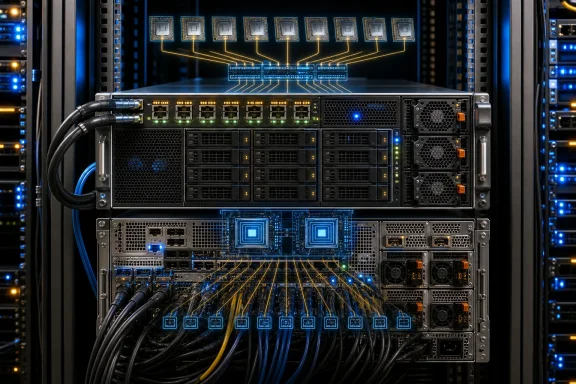 Overview: A Familiar Eight-GPU Formula, Updated for Blackwell Ultra
At the center of the system is NVIDIA’s HGX B300 platform. This is the latest expression of the familiar eight-accelerator HGX concept: GPUs are mounted on a common baseboard and linked internally through NVIDIA’s NVLink and NVSwitch fabric, allowing them to behave more like a coordinated compute domain than eight isolated PCIe cards. NVIDIA describes HGX B300 as an eight-GPU platform using fifth-generation NVLink and NVSwitch, with up to 1.8 TB/s GPU-to-GPU bandwidth and 14.4 TB/s total aggregate fabric bandwidth. NVIDIA’s HGX B300 reference architecture also specifies up to 288GB of HBM3e per GPU, or 2.30TB of GPU memory per node.
That enormous pooled memory footprint matters as much as raw accelerator performance. Modern large-language-model workloads frequently become constrained by model size, context windows, key-value caches, batching requirements, and communication overhead—not just arithmetic throughput. An eight-GPU B300 node gives software a substantial high-bandwidth memory pool while retaining the low-latency links necessary for tensor parallelism, pipeline parallelism, and other multi-GPU execution methods.
NVIDIA’s own DGX B300 configuration illustrates the scale of the underlying platform: eight B300 GPUs, 2.3TB of total GPU memory, two fifth-generation NVLink interconnects, and up to 144 PFLOPS of FP4 inference performance. The DGX B300 documentation is not a specification sheet for ASRock Rack’s chassis, but it provides an important reference point for the capabilities and expectations surrounding the HGX B300 ecosystem.
ASRock Rack’s value is in bringing that common HGX foundation to a system that emphasizes configurable cooling, front-access connectivity, dense storage, and operational flexibility. It is the sort of hardware where a few apparently minor mechanical choices can materially affect rack deployment time, cable management, and service procedures.
Why 4U Density Is a Big Deal
A 4U server may sound physically imposing in a world accustomed to 1U and 2U systems. In the AI infrastructure context, however, fitting eight flagship GPUs and their supporting CPUs, networking, switching, storage, cooling plumbing, fans, and power subsystems into 4U is remarkably dense.
The distinction becomes clearer when comparing liquid-cooled and air-cooled GPU designs. Air-cooled platforms need large heatsinks, massive airflow volumes, and substantial internal clearance. ASRock Rack also showed an air-cooled 8U16X-GNR2 B300 design for facilities that cannot deploy liquid cooling, underlining the physical advantage that direct liquid cooling can offer. ASRock Rack’s announcement of the 4U ZutaCore version explicitly contrasts the 4U liquid-cooled system with an 8U air-cooled HGX B300 alternative.
For data center operators, halving the rack units consumed by a compute node does not automatically halve the total operating challenge. The electrical and thermal load remains immense. But it can improve the amount of GPU capacity available per rack, simplify scale-out planning, and reduce the physical footprint assigned to a cluster—provided the facility can support the liquid distribution, power delivery, and network fabric that such density demands.
That qualification is critical. 4U density is not a free efficiency gain. It shifts complexity away from bulky heatsinks and into coolant loops, manifolds, facility water design, monitoring, leak-detection policy, and operational discipline. The ASRock Rack 4U16X-GNR2 appears built for organizations that already understand that tradeoff.
Direct Liquid Cooling and the ZutaCore Alternative
ASRock Rack offers two liquid-cooled variants of the 4U16X-GNR2. The version highlighted in the review uses a more conventional direct liquid cooling (DLC) approach, with visible inlet and outlet connections for coolant. The front-facing plumbing uses color-coded fittings—blue for incoming coolant and red for warmed coolant leaving the server—which is a straightforward but useful serviceability detail. ServeTheHome’s external hardware overview documents the connections and overall chassis layout.
The alternative is the 4U16X-GNR2/ZC, which uses ZutaCore’s two-phase cooling technology. ASRock Rack says this approach uses a non-conductive, non-corrosive dielectric fluid to remove heat directly at the chip, positioning it as a “waterless” liquid-cooling option for operators reluctant to introduce water into their cooling loops. ASRock Rack’s product announcement frames the system as an effort to address thermal density while reducing the perceived risk associated with liquid near high-value compute hardware.
The distinction is more than a marketing footnote. Conventional direct-to-chip liquid cooling can be attractive where facilities already have mature coolant distribution units and standardized warm-water loops. It can offer a familiar service model and align with existing data center practices. Yet it still places significant responsibility on connector integrity, coolant chemistry, maintenance procedures, and facility controls.
Two-phase dielectric cooling targets a different set of concerns. The promise is compelling: use fluid engineered to be non-conductive, avoid a conventional water loop at the chip, and potentially simplify risk management in deployments where leak anxiety or facility constraints dominate the conversation. However, operators should assess the entire operational chain—not merely the fluid properties. Vendor support, consumables, technician training, warranty procedures, monitoring capabilities, and long-term service access should all be evaluated before treating either cooling approach as inherently simpler.
Cooling Is a Design Requirement, Not an Add-On
With Blackwell Ultra GPUs, dual server CPUs, memory, networking, PCIe switching, and storage concentrated in a 4U envelope, cooling is inseparable from system design. ASRock Rack retains substantial hot-swappable fan capacity despite moving primary heat removal to liquid cooling. The reviewed chassis includes large fan carriers at the sides plus smaller fan modules in the lower center of the system. The review’s rear-chassis examination highlights those hot-swappable fans and the resulting airflow paths.
That is an important reminder for prospective buyers: liquid cooling does not mean a fanless server. Airflow remains necessary for memory, storage, power supplies, network components, and other board-level hardware. The cooling loop addresses the highest-wattage devices, but the rest of the server still requires resilient air management.
Compute: Intel Xeon 6 Provides the Host Platform
The ASRock Rack system combines the eight NVIDIA Blackwell Ultra GPUs with two Intel Xeon 6 Granite Rapids processors. In an HGX server, the CPUs are not the primary AI accelerators, but their role should not be underestimated. They coordinate operating-system services, manage storage and networking I/O, feed data to the GPUs, host control-plane software, and provide the PCIe and memory resources that make the complete node practical.
Intel’s Xeon 6 P-core family is designed for high-performance server workloads, with support for features including AVX-512, Advanced Matrix Extensions, DDR5, CXL 2.0, and large PCIe 5.0 I/O configurations. Intel’s Xeon 6 product brief lists up to 128 P-cores per socket in the broader family, up to 12 memory channels, and up to 192 PCIe 5.0 lanes in two-socket systems. Exact CPU selection, memory capacity, and I/O allocation in an individual ASRock Rack configuration will naturally vary by bill of materials.
For Windows Server administrators and virtualization teams, that host-side flexibility is consequential. AI infrastructure increasingly mixes GPU compute with data preprocessing, storage services, telemetry agents, security controls, orchestration components, and virtualized workloads. The CPU platform determines how gracefully those adjacent functions can coexist without undermining accelerator utilization.
Still, buyers should resist the instinct to judge an HGX B300 server by CPU core counts alone. In this class of machine, the host processors must be sufficiently capable and sufficiently connected; the critical performance story is usually the interaction among GPU memory, NVLink fabric, network topology, storage throughput, software stack, and workload behavior.
A System Built Around Balanced I/O
NVIDIA’s HGX B300 reference design emphasizes a balanced PCIe topology that distributes connectivity across CPU sockets and PCIe root ports. It also defines eight PCIe Gen5 x16 links plus a Gen4 x2 link per HGX B300 baseboard. NVIDIA’s B300 system requirements make clear that the GPU baseboard is only one element in a wider I/O architecture.
This is why the dual-Xeon design remains relevant even in GPU-dominant systems. A poorly designed host platform can create bottlenecks around storage ingestion, management networking, NIC placement, or device locality. A properly engineered dual-socket implementation gives the platform room to keep GPUs supplied and connected without reducing the entire system to a collection of compromised tradeoffs.
Networking: 6.4Tbps on the Front Panel
Perhaps the most visually striking operational detail of the ASRock Rack 4U16X-GNR2 is its set of eight front-mounted OSFP cages rated for 800Gbps connectivity. The review calculates more than 6.4Tbps of aggregate front-panel bandwidth without requiring a separate PCIe add-in network card. ServeTheHome’s report identifies those eight OSFP connections as a defining feature of the chassis layout.
That is not bandwidth for ordinary client traffic. These ports are central to the system’s role as a cluster node. NVIDIA’s HGX B300 design uses eight ConnectX-8 SuperNICs, providing a one-to-one relationship between GPUs and high-speed network adapters, with up to 800Gbps per adapter. NVIDIA’s AI Factory documentation says the configuration is intended to maintain direct, high-bandwidth GPU-to-NIC connectivity for east-west cluster traffic.
In practical terms, that fabric is what separates a serious multi-node AI environment from a collection of powerful but isolated servers. During distributed training, GPUs on separate nodes need to exchange gradients, parameters, and synchronization traffic efficiently. During large-scale inference, high-speed networking supports model sharding, request distribution, storage access, and service scaling. Latency, congestion management, cabling, switch design, and collective-communication tuning can all affect results.
Front-Facing High-Speed I/O Has Real Operational Value
Putting the highest-speed network connections on the front can make cable routing more manageable in some cluster designs, especially where cold-aisle service access and structured front-of-rack cabling are preferred. It also creates a visual separation between AI-fabric connections and rear-oriented power infrastructure.
But front-access OSFP connectivity is not automatically ideal for every facility. Network architecture, overhead tray paths, rack orientation, transceiver choice, fiber bend limits, and switch placement determine whether it simplifies or complicates a deployment. The key strength is not that ASRock Rack declares one cabling direction universally better; it is that the server presents a deliberate, high-density networking layout that planners can incorporate into a broader fabric design.
Storage and Serviceability: Designed for the Physical Data Center
At the front of the chassis, ASRock Rack provides 12 2.5-inch U.2 NVMe bays. According to the review, two drives connect directly to the CPU while ten connect through the PCIe switch complex. ServeTheHome’s storage overview also shows the cabled backplane arrangement.
That capacity will not replace a purpose-built parallel storage system for a major AI cluster. It is nevertheless valuable for local dataset staging, checkpoints, caching, boot images, container layers, logs, temporary training artifacts, and inference model placement. In many deployments, fast local NVMe is essential for avoiding unnecessary pressure on shared storage and network fabrics.
The front panel also includes four USB 3 Type-A ports, VGA output, and a power button. These are not glamorous specifications, but they matter during bring-up, troubleshooting, and field service. A machine built for remote operation still has to survive the moments when an engineer is standing in front of a rack with a crash cart, removable media, diagnostic tools, and limited time.
Flexible Management-Port Placement Is a Quiet Strength
One of the most practical features is the treatment of management and low-speed Ethernet connectivity. The system exposes a management port and two Intel i350-based 1GbE ports at the front, but internal Ethernet cabling permits those connections to be repositioned at the rear. The review notes that customers can use a mixed arrangement—for example, management in front with 1GbE at the rear—by adding or removing the relevant internal cables. ServeTheHome’s chassis walkthrough describes the feature as a way to support multiple data center cabling conventions without requiring separate chassis SKUs.
This is exactly the kind of design decision that tends to be ignored in headline specifications and appreciated by infrastructure teams. Management networks often follow different physical paths, security boundaries, or operational ownership models than data fabrics. Giving customers a means to place those ports where they belong can reduce awkward cable runs and avoid unnecessary procurement fragmentation.
Power, Redundancy, and the Cost of Density
The rear of the platform is populated with ten 3kW 80 Plus Titanium power modules for redundancy, according to the review; its text labels them “CPUs,” but the accompanying context and image description make clear these are power supplies. The original walkthrough should therefore be read as documenting redundant 3kW Titanium-rated PSUs rather than an unusual ten-processor configuration.
The very presence of ten high-capacity power supplies tells the real story. This platform is designed for enormous electrical demand, fault tolerance, and the ability to maintain service through individual PSU failures. It also signals that purchasing the server is only the beginning of the financial commitment.
A successful deployment needs:
- Appropriate rack power distribution, potentially including high-voltage three-phase feeds.
- Power-capacity planning that covers worst-case node behavior, not just average utilization.
- Cooling capacity matched to both liquid-loop and residual-airflow requirements.
- A switching fabric capable of handling 800Gbps-class connections and AI communication patterns.
- Storage infrastructure sized for model data, checkpoints, datasets, and retention policies.
- Monitoring and orchestration tooling that can observe GPUs, thermals, fabric health, power, firmware, and workload behavior.
The power supplies are redundant, but redundancy does not erase dependency. The server’s effectiveness is inseparable from the upstream power and cooling systems around it.
Risks and Deployment Considerations
The ASRock Rack 4U16X-GNR2’s strengths also define its risks. This is an exceptionally capable platform, but it is not forgiving of incomplete planning.
Facility Readiness Comes First
The first risk is treating liquid cooling as an isolated hardware feature. A direct liquid-cooled server belongs in a facility that can supply, monitor, and service the cooling loop correctly. Flow rates, coolant temperatures, water quality, connector procedures, leak response, maintenance windows, and spare-part policies should be planned before a rack is populated.
The ZutaCore variant may appeal to organizations seeking a dielectric, waterless approach at the chip level, but it is still specialized cooling infrastructure. It changes the implementation rather than eliminating the need for operational expertise.
Network Investment Can Rival Server Investment
Eight 800Gbps OSFP connections offer extraordinary potential, but they also create an equally extraordinary infrastructure requirement. The server needs compatible transceivers or cables, high-density switching, sufficient uplinks, congestion-management expertise, and an AI software stack configured to use the fabric efficiently.
A B300 node attached to an undersized or poorly tuned network will not deliver the distributed-workload behavior its architecture is designed to enable. The node’s speed increases the penalty for fabric mistakes.
The Software Stack Remains a Core Part of the Product
NVIDIA’s HGX platform documentation emphasizes not only GPU hardware but NVLink, networking, optimized AI software, fabric management, and virtualization support. NVIDIA’s HGX platform documentation includes dedicated materials for Fabric Manager, NVSwitch bridge patches, and shared-NVSwitch GPU passthrough virtualization. That is a strong indication that operating an HGX platform is a systems-engineering task, not merely a driver-installation exercise.
Windows Server environments can participate in enterprise AI workflows, particularly around management, data preparation, Active Directory integration, file services, developer tooling, and virtualized infrastructure. However, organizations should validate the exact operating-system, driver, container, framework, and orchestration combinations required for their AI applications before selecting an HGX platform. The hardware is powerful enough that software incompatibility, unsupported configurations, or immature operational practices can become the limiting factors.
The Bottom Line
The ASRock Rack 4U16X-GNR2 is an impressive example of what a modern NVIDIA HGX B300 server looks like when density is treated as an engineering objective rather than a marketing statistic. Its eight Blackwell Ultra GPUs, NVLink/NVSwitch scale-up fabric, dual Intel Xeon 6 host processors, 12 U.2 NVMe bays, front-access 800Gbps OSFP networking, configurable management-port placement, hot-swappable fans, and redundant high-capacity power design form a coherent platform for serious AI infrastructure. The original ASRock Rack system review makes that integration visible at the chassis level.
Its most important achievement may be its refusal to treat GPUs as standalone components. The 4U16X-GNR2 recognizes that AI performance is ultimately shaped by the entire node: GPU memory capacity, high-speed interconnects, CPU and PCIe topology, NVMe placement, network bandwidth, thermal design, power redundancy, and the ease with which administrators can deploy and repair it.
For enterprises, cloud providers, research institutions, and AI service operators with the requisite power, cooling, fabric, and software maturity, this is exactly the kind of dense eight-GPU server that can anchor a high-performance AI cluster. For everyone else, it is a persuasive demonstration that the path to Blackwell Ultra performance runs through data center architecture—not just through buying more GPUs.
