

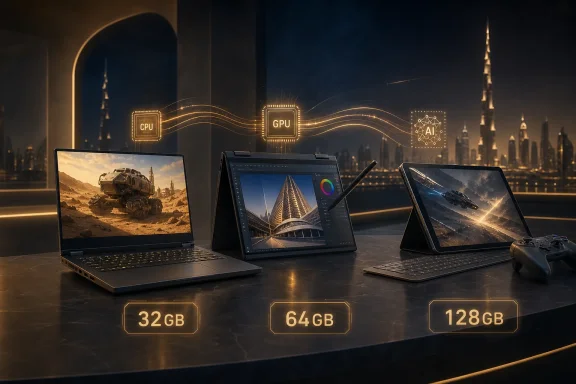
For buyers, the important story is not that all three carry AMD’s Ryzen AI Max+ branding. It is that the same platform produces very different machines, at sharply different memory capacities and prices, while the UAE listings do not always match the headline “up to 128GB” configuration being used to sell the category.
AMD’s Ryzen AI Max+ 392 and 395 chips combine Zen 5 CPU cores, Radeon 8060S integrated graphics and a 50-TOPS XDNA NPU in one package. AMD positions that mix as a way to run GPU-heavy graphics, CPU work and local AI without a discrete GeForce GPU. ASUS is putting that premise into a 1.48kg gaming clamshell, a 13-inch creator convertible and an expensive collectible gaming tablet.
That is a meaningful hardware shift for Windows users who need more graphics memory than an ordinary thin-and-light laptop provides. But the promise depends less on the processor name than on the amount of soldered LPDDR5X memory ASUS puts beside it.
Unified memory is the feature buyers should inspect first
Ryzen AI Max+ uses unified memory: the CPU and Radeon 8060S graphics draw from one shared pool rather than treating system RAM and VRAM as fixed, separate allocations. ASUS says its machines can shift memory toward graphics when a game or creative application needs it, or leave more available to Windows and conventional applications when they do not.
That flexibility has a practical advantage over a typical integrated-GPU notebook. A Windows laptop with 16GB or 32GB of conventional memory can quickly become constrained when a game, a 4K video-editing timeline, a virtual machine and a locally run AI model compete for resources. A 64GB or 128GB shared pool gives the Radeon graphics substantially more room than the small reserved memory allocation common on mainstream integrated GPUs.
It does not, however, turn every Ryzen AI Max+ machine into a 128GB workstation. The number is a platform maximum, not a baseline specification. ASUS’s official TUF Gaming A14 page specifies up to 64GB of LPDDR5X-8000 unified memory. Its current Middle East store listing for the ProArt PX13 shows two Ryzen AI Max+ 395 configurations, both with 32GB of onboard LPDDR5X memory, despite the global product page advertising a maximum of 128GB.
That is the first detail the TahawulTech overview leaves unresolved. A UAE shopper seeing “up to 128GB” alongside the ProArt PX13 could reasonably assume the local store carries that version. At the time of review, ASUS’s Middle East store listed a 32GB PX13 at AED 10,499 as in stock, while another 32GB configuration was marked out of stock. The 128GB figure is real for the global PX13 family, but it is not the memory specification shown for those UAE retail SKUs.
Because the memory is onboard, the distinction is permanent. SSD storage can be replaced or expanded on some of these systems, but a 32GB machine cannot later become a 128GB machine. For buyers focused on local large-language models, heavy Resolve or Premiere projects, large datasets, or several simultaneous professional applications, that configuration check should come before display resolution, NPU TOPS or the “AI PC” label.
The TUF Gaming A14 is the broadest practical option
The ASUS TUF Gaming A14 FA401EA is the most straightforward member of this group. It pairs the 12-core Ryzen AI Max+ 392 with Radeon 8060S graphics, up to 64GB of unified memory, a 14-inch 2560×1600 165Hz display and a chassis ASUS rates at 1.48kg. ASUS also gives it two M.2 2280 SSD slots, which is unusually useful in a compact gaming laptop aimed at users who may carry both a large game library and media-project files.
AMD lists the Ryzen AI Max+ 392 as a 45W-to-120W configurable-TDP processor with 12 cores, 24 threads, 40 Radeon graphics compute units and 50 NPU TOPS. ASUS says the A14 can reach 95W in Manual mode. That power envelope explains why this is not simply an ultraportable with a larger integrated GPU: sustained performance will be determined by ASUS’s cooling profile, fan behavior and power setting.
The A14’s real proposition is avoiding the usual split between an all-day school or work machine and a gaming notebook with a discrete GPU. Its Radeon 8060S graphics share memory with the rest of the system, so games can receive more memory when necessary. ASUS also markets the machine for local AI assistants and image-generation workloads, although users should remember that Windows’ standard Copilot+ experiences do not require 64GB of memory. The larger capacity matters primarily when the owner brings their own demanding software, models or content projects.
Independent reviews collected by ASUS describe the A14 as approaching GeForce RTX 4060-class gaming performance in some circumstances, but that comparison needs restraint. A discrete RTX 4060 laptop has dedicated graphics memory and its own power budget; game results vary with resolution, power limits, driver maturity, upscaling settings and whether a title is optimized for Radeon. The A14’s value is consolidation and portability, not a blanket replacement for every higher-wattage gaming laptop.
The ProArt PX13’s UAE configuration changes the pitch
ASUS announced the 2026 ProArt PX13 in January with the Ryzen AI Max+ 395, a 16-core CPU, Radeon 8060S graphics and up to 128GB of unified memory. The global product material also specifies a 13.3-inch 3K OLED touchscreen, 360-degree convertible chassis, stylus support and an 85W maximum TDP. It is designed for the creator who needs a compact editing system rather than a 14- or 16-inch workstation.
The model listed by ASUS Middle East retains the processor, screen and 50-TOPS NPU, but the local 32GB configurations materially narrow its appeal for the largest local AI and media workloads. Thirty-two gigabytes remains sufficient for photo editing, normal 4K editing, coding, office work and many AI-assisted applications. It is not the same proposition as a 128GB machine that can devote much more shared memory to a demanding model or graphics workload.
There is also a branding detail worth separating. TahawulTech refers to integrated GoPro workflow features when discussing the PX13. ASUS has separately marketed a limited ProArt GoPro Edition PX13 in the United States, with a GoPro Hotkey, GoPro Cloud and 360-degree media support in its StoryCube workflow, plus a bundled GoPro Premium+ subscription. The standard PX13 HN7306 product page in ASUS’s Middle East store does not identify the listed units as the GoPro Edition or list those GoPro-specific extras.
That does not make the standard PX13 a poor creator system. It means UAE purchasers should not infer that every Ryzen AI Max+ PX13 ships with the GoPro-branded package simply because a regional overview discusses GoPro workflows.
The Flow Z13-KJP is a limited edition, not a value alternative
The ROG Flow Z13-KJP is the least conventional and most expensive member of the trio. It is a detachable 13.4-inch Windows gaming tablet built with Kojima Productions, using the Ryzen AI Max+ 395, Radeon 8060S graphics, 128GB of unified memory and a 2.5K 180Hz touchscreen. ASUS’s U.S. specification page also identifies a vapor chamber, liquid-metal cooling, a CNC-machined chassis and a carbon-fiber design.
Unlike the TUF A14, this machine is built as much around its limited-edition identity as around price-performance. Gulf News reported that UAE pre-orders opened on February 24 through the ASUS eShop and Virgin Megastores from AED 14,999, with a carrying case, special packaging, an Armoury Crate theme and a Death Stranding 2: On the Beach PC game code. The August ASUS messaging does not repeat that starting price or clarify present stock, which matters for a device sold as a limited run.
At AED 14,999, the KJP is a specialist purchase. Its 128GB configuration makes the platform’s unified-memory argument tangible, and its tablet form factor is distinctive for Windows gaming, pen work and compact creative tasks. But a buyer choosing it primarily for the processor rather than the Kojima collaboration should compare it against the standard Flow Z13 and the highest-memory PX13 configurations available in their market. The collector treatment carries a premium that raw specifications alone cannot explain.
Perfect Warranty has useful coverage and hard limits
The regional announcement also emphasizes ASUS Perfect Warranty, described as free for a year and valued at up to AED 500. ASUS’s official UAE terms confirm that eligible Zenbook, Vivobook, ProArt, TUF and ROG laptops bought from authorized UAE resellers from January 1, 2026 can qualify after registration within 90 days.
The coverage is more substantial than ordinary defect-only warranty protection: it includes accidental drops, collisions, liquid damage, electrical surges and accidental breakage. But it is not blanket insurance. It excludes theft, loss, natural disasters and intentional damage; it permits only one claim in the first year; and, where multiple components are damaged, ASUS says it will repair only the most expensive part. Claims and repairs are also limited to the UAE.
For someone buying an imported unit or planning to travel with it, that territorial limit deserves more attention than the promotional AED 500 valuation. Registering the laptop under the correct UAE region and retaining purchase documentation is part of the practical cost of relying on the protection.
ASUS has assembled a credible Ryzen AI Max+ range, but the August campaign smooths over the differences that determine whether these devices make sense. The TUF A14 is the portable gaming-and-work machine with upgradeable storage and up to 64GB memory; the UAE PX13 listing currently sells the 32GB version of a family advertised globally at up to 128GB; and the Flow Z13-KJP is a premium 128GB collectible whose UAE pre-order price began at AED 14,999 in February. For Windows buyers, the processor is the common denominator. The memory configuration, local price and actual stock are the decision.