
That distinction is more than medicolegal boilerplate. Australia’s Therapeutic Goods Administration now draws a firm line between a tool that transcribes and summarises a consultation, and one that interprets it by producing a diagnosis, differential diagnosis or treatment recommendation. The first may sit outside medical-device regulation; the second must meet device requirements and be listed on the Australian Register of Therapeutic Goods before supply.
For Windows users and practice IT staff, this makes AI adoption a procurement and workflow problem as much as a clinical one. A microphone, a browser tab and a Microsoft 365 or Google Workspace subscription are enough to put generative AI in front of staff. They are not enough to establish that the vendor’s data handling, product claims, integrations and retention practices are suitable for a consultation room.
 The scribe is the sensible first use — with a limited job description
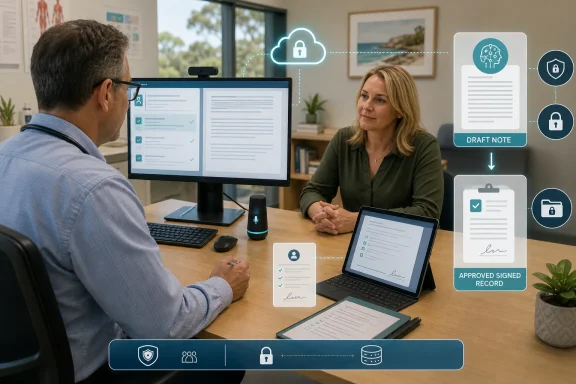
InSight+ is right to identify ambient documentation as the most immediately useful AI workflow for general practice. An AI scribe can listen to a consultation, turn speech into a structured draft, and spare a clinician from splitting attention between the patient and the keyboard. That is an administrative task with a clear final human checkpoint: the GP reads, corrects and signs the note.
The published evidence supports that limited use case, though it does not prove that a scribe will save every GP time. A 2025 JAMA Network Open quality-improvement study of 263 ambulatory clinicians at six US health systems found self-reported burnout fell from 51.9% to 38.8% after 30 days using one ambient AI platform. Participants also reported less after-hours documentation and lower note-related cognitive load.
Those figures deserve their proper weight. The study was voluntary, based on before-and-after surveys, ran for 30 days and was conducted in US academic and community settings; it was not a randomised Australian trial. It shows a promising association with less administrative strain, not that an AI scribe independently cured burnout or will produce the same result in a small Australian practice using a different product and clinical information system.
A second large implementation study, reported by Kaiser Permanente and published in NEJM Catalyst, tracked use across roughly 2.5 million encounters. Almost 3,500 physicians had used the scribe in at least 100 encounters, and high-volume users reported more personal and effective patient interactions alongside reduced after-hours administrative work. Scale makes that operational evidence valuable, but it remains evidence from one integrated US health system and its selected software deployment, not a vendor-neutral safety certification.
The RACGP’s own 2026 comparison points to the harder truth: quality varies by product. In four simulated general-practice consultations, several AI-generated notes scored better than the human-generated note across some documentation domains, while one AI scribe produced the most hallucinations. There was no statistically significant overall difference between the five scribes tested, and the products were not named. A practice therefore cannot responsibly convert a general finding that “AI scribes work” into a purchasing decision for a particular scribe.
The GP’s review is where the claimed time savings meet clinical accountability. If the system omits a negative finding, attributes a family member’s symptoms to the patient, invents a medication change, or converts ambiguity into certainty, the signed record is still the practitioner’s record. The RACGP explicitly warns that physicians may become over-reliant on the output and that the clinical thinking involved in writing documentation may itself be valuable.
A scribe should produce a draft, not an autopilot chart. Practices should build the review step into appointment time and measure whether the time spent correcting, filing and adding examination findings actually produces a net benefit.
The regulatory boundary moves when the product starts “helping”
The most important technical question for a practice is not whether a product calls itself an “AI scribe.” It is what the software is intended to do and what it actually does in the workflow.
The TGA’s January 2026 guidance says a digital scribe used only to transcribe or translate clinical conversations into written records does not have a therapeutic purpose and is not a medical device. Once it analyses or interprets the conversation to generate diagnostic, prognostic or treatment content not already stated by the clinician, it crosses into medical-device territory and requires ARTG inclusion.
That creates a practical trap for products marketed as all-in-one assistants. A documentation tool that also proposes a differential diagnosis, recommends treatment, flags a supposed disease risk, or turns an encounter into clinical decision support is no longer merely a note-taker for regulatory purposes. The marketing page, product prompt library and configuration settings matter, not just the name on the invoice.
The same caution applies to imaging and diagnostic tools discussed by InSight+. Software that assesses skin lesions, mammograms, chest X-rays or CT images is closer to clinical decision support than clerical transcription. It should be evaluated as a medical product with evidence of intended use, performance, population fit and regulatory status — not as another generative-AI add-on.
Billing suggestions occupy a different but still consequential lane. InSight+ notes that some products listen to consultations and recommend Medicare Benefits Schedule items. A suggested item number does not transfer liability for the claim. If the documentation does not meet the descriptor, or the service was not clinically provided, the fact that a model proposed it will not protect the practitioner using the provider number.
Practices should prohibit automatic posting of notes, referrals, orders, diagnosis codes or MBS claims generated by an AI tool. Draft-and-review is a defensible model. Silent background automation is not.
Consent and data handling cannot be delegated to the vendor’s settings page
The most serious implementation failure is treating “no permanent audio recording” as equivalent to “no privacy risk.” It is not.
The RACGP says GPs must obtain patient consent before using an AI scribe, and notes that recording private conversations without consent can be a criminal offence in some Australian jurisdictions. Consent needs to cover everyone whose words may be captured: the patient, a parent or carer, a family member, an interpreter, a student, a trainee, or another clinician in the room. It must also be meaningful enough for the patient to understand that software will process the conversation and that another documentation method is available if they decline.
The TGA similarly says health professionals are responsible for informed consent and for checking information placed into the clinical record. The Department of Health’s FOI material adds an uncomfortable operational detail: it found significant variation in how clinicians and practices were obtaining consent for AI scribe use. A poster at reception and a generic privacy policy may help inform patients, but neither is a reliable substitute for a documented consent step at the beginning of each affected consultation.
Data governance needs equal precision. The RACGP advises practices to check where captured audio, transcripts and generated documents are encrypted, stored, destroyed and otherwise handled; whether data is processed overseas; and whether it can be used for secondary purposes such as model improvement. The Office of the Australian Information Commissioner’s guidance is blunter for public generative-AI services: organisations should not put personal information — especially sensitive information — into publicly available tools because privacy risks are significant and complex.
That warning reaches beyond the consultation room. InSight+ suggests using ChatGPT, Claude, Microsoft Copilot or Google Gemini to summarise documents, draft reports and analyse spreadsheets. That can be a reasonable administrative starting point only if the data is genuinely non-sensitive or the practice has an approved enterprise service with contractual controls. A spreadsheet can reveal patient identity through dates, rare diagnoses, postcodes, appointment patterns, provider names or small-cell financial data even after obvious identifiers have been removed.
“De-identified” is therefore not a magic word. Removing a name and date of birth from a transcript may leave enough context for re-identification. Public AI chatbots should be off-limits for patient material; practice-owned or enterprise services require a documented assessment of retention, training use, access controls, audit logging, breach notification and Australian privacy obligations.
A Windows-first rollout needs controls before licences
For a small practice, the responsible rollout is not a six-month transformation programme. It is a limited pilot with controls that can be checked by the practice manager, clinical lead and IT provider.
- The practice should approve specific products and forbid staff from using personal accounts or unapproved browser-based AI tools with practice or patient data.
- The vendor review should establish where audio and text are processed, whether either is retained, whether the vendor or subcontractors can use data for training, and what happens to the data when the contract ends.
- Windows devices used in rooms should have separate staff accounts, supported operating-system builds, disk encryption, automatic locking, endpoint protection and multifactor authentication for the scribe and clinical-record systems.
- The practice should test the scribe on a supervised set of real consultations with documented consent, checking omissions, hallucinations, speaker attribution, abbreviations, local medication names and integration with the existing clinical information system.
- The pilot should define a fallback process for network outages, microphone failure, vendor downtime and a patient declining AI use. The fallback is ordinary documentation, not a cancelled consultation.
- The clinical lead should audit a sample of generated notes after launch and record errors, correction time, consent compliance and whether promised time savings materialise.
This is where the technical and clinical views converge. A cloud-connected scribe needs reliable internet, clear audio and a usable screen layout, but its operational success depends on whether it reduces the final workload after review. A tool that creates lengthy drafts requiring substantial correction can move administrative work rather than remove it.
Australian GPs do not need to wait for a perfect AI rulebook before using documentation assistance. They do need to keep the scope narrow: capture the conversation, draft the record, require consent, secure the data and make the clinician review unavoidable. Once a product starts offering diagnoses, treatment suggestions or automated claims, the practice is no longer trialling a scribe — it is deploying clinical software with a different regulatory and patient-safety burden.
