

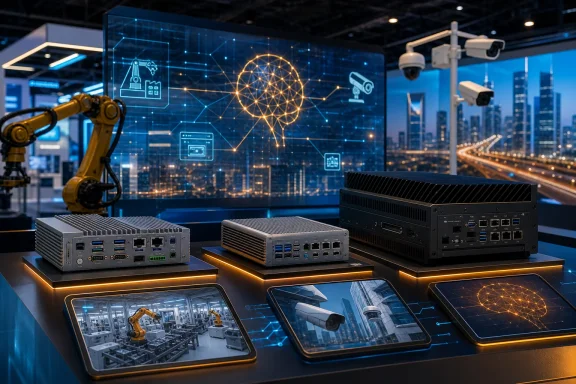
Tech Critter carried BIOSTAR’s announcement that the company will exhibit at DeepFest Hall 5, booth H5.C28, at the Riyadh Exhibition and Convention Center in Malham. BIOSTAR’s own 2026 exhibition calendar independently lists the same LEAP dates and booth location, while LEAP confirms that DeepFest is co-located with the broader technology event. The dates matter: this is a future event, beginning on August 31, 2026, rather than a product shipment notice effective today.
BIOSTAR says it will target smart manufacturing, smart cities, and retail deployments with platforms based on Intel Panther Lake, Intel Wildcat Lake, NVIDIA Jetson Thor, NVIDIA Jetson Orin, and MemryX acceleration. That description covers substantially different compute classes, operating systems, thermal envelopes, and integration methods. Enterprises evaluating the display should treat them as separate building blocks rather than assume that “Edge AI” means one consistent hardware or software stack.
The headliners are Jetson Thor systems, not generic IPCs
The EdgeComp MS-NAT5000 is BIOSTAR’s highest-specification system listed for LEAP. It incorporates NVIDIA’s Jetson T5000 module, which uses a Blackwell GPU, a 14-core Arm Neoverse-V3AE CPU, and 128GB of LPDDR5X memory. NVIDIA rates the module at up to 2,070 FP4 sparse TOPS-equivalent TFLOPS for AI work, with a configurable 40W to 130W power range—figures designed for large transformer models, multi-camera vision, sensor fusion, and robotics rather than conventional HMI or light gateway duties.
BIOSTAR’s published MS-NAT5000 specifications also explain why it is more than a compact AI PC. The unit includes two 5GbE ports, a QSFP28 connector capable of breaking out to four 25GbE links, PCIe 5.0 NVMe storage support, 4G/5G and Wi-Fi expansion, serial interfaces, and four CAN FD interfaces. That I/O mix is a direct fit for machines that must ingest multiple camera or sensor feeds while communicating with industrial controllers, automated guided vehicles, or robotic subsystems.
The MS-NAT4000 takes the same basic approach at a lower tier. BIOSTAR introduced it on July 7 with NVIDIA’s Jetson T4000 module: 64GB of LPDDR5X memory, a 12-core Arm CPU, up to 1,200 FP4 sparse TFLOPS, and support for three 25GbE links through its QSFP28 connection. NVIDIA confirms that the T4000 and T5000 share a physical module family, which gives manufacturers a useful path to common carrier-board designs, but the lower model carries a 40W-to-70W power envelope and reduced GPU, CPU, memory, and networking capacity.
For buyers, the implication is straightforward: the two systems are intended for workloads where the physical installation needs to make machine decisions locally. A production-line inspection station, mobile robot, or traffic-monitoring installation may need to process camera feeds and act before a cloud round trip completes. But the headline performance figures are FP4 sparse AI numbers, not a general indication of Windows application speed, CPU throughput, or sustained performance in a sealed factory cabinet.
The lineup spans three very different deployment tiers
At the other end of the list is the EdgeComp MU-N150, an Intel Twin Lake N150 appliance. It is a fanless system built around a four-core processor with a 6W TDP, up to 16GB of DDR5 memory, dual 2.5GbE Ethernet, M.2 NVMe storage, and HDMI, DisplayPort, and USB-C display outputs. BIOSTAR positions it for kiosks, signage, lightweight automation, and HMI duties, where silent operation, space constraints, and reliable networking are likely to matter more than running a large vision-language model.
Unlike the Jetson Thor machines, the MU-N150 has a published Windows 11 64-bit support statement alongside Ubuntu compatibility. That makes it the clearest fit in this announcement for Windows-focused operators maintaining digital signage, point-of-sale peripherals, factory control displays, or compact network appliances. Its triple-display capability and dual 2.5GbE ports may be more operationally useful to a Windows deployment than the marketing language around AI.
The distinction becomes more important when BIOSTAR groups Jetson Thor and Jetson Orin under one edge AI label. The two MS-NAT systems named in the announcement are Thor systems, not Orin systems. NVIDIA’s Jetson product family includes Orin hardware, and BIOSTAR has sold Orin-based appliances, but the supplied LEAP lineup does not identify a specific Orin model. Anyone planning a deployment should request the actual SKU, module type, JetPack release, supported camera interfaces, power profile, and long-term availability commitment rather than rely on a family-level platform name.
BIOSTAR will also exhibit industrial motherboards based on Intel Panther Lake and Wildcat Lake. Intel has now branded Panther Lake as Core Ultra Series 3, including versions certified for embedded use cases such as extended temperature ranges, deterministic performance, and continuous operation. Wildcat Lake is Intel Core Series 3, a lower-cost adjacent platform rather than another Core Ultra tier; Intel’s own documentation makes that distinction clear.
That naming nuance changes how the motherboard story should be read. Panther Lake-based industrial boards can provide CPU, integrated graphics, and NPU resources for a broad Windows or Linux IPC build. Wildcat Lake offers a lower-power, lower-cost Intel foundation. Neither is a substitute for the Jetson Thor systems where high-density multimodal inference and sensor networking are the requirements, and neither should automatically be priced or provisioned as one.
The MemryX model needs a specification check
The most opaque machine in the LEAP announcement is the EdgeComp MT-N150-MX3, described as a MemryX-equipped system. MemryX’s MX3 M.2 accelerator is designed as a small, low-power inference add-in, with the vendor citing average consumption of roughly 0.6W to 2W per chip depending on model and configuration. In principle, that approach can make sense for a fanless Intel appliance that needs efficient neural-network inference without adopting the cost, thermals, and Linux-centric software environment of a Jetson platform.
But BIOSTAR’s earlier Secutech 2026 material identified a different MemryX product: the MT-N97-MX3. It did not publish the MT-N150-MX3 name in the searchable product documentation available before this LEAP announcement, nor does the announcement disclose the number of accelerator chips, supported models, memory configuration, operating temperature, operating system support, or expected availability. The N150 and N97 are both efficiency-class Intel processors, but they are not interchangeable identifiers.
That is a small naming discrepancy with a potentially large procurement consequence. A system integrator choosing an accelerator-equipped unit needs to know whether the unit is a new platform, a renamed configuration, or an error in promotional material. It also needs to know whether the MemryX module is validated for the customer’s inference runtime and models, because accelerator support is not universal merely because the host is x86.
The company has not announced pricing for any of the systems appearing at LEAP, regional distribution plans for Saudi Arabia, lead times, service arrangements, or a software-support lifecycle. Those omissions are normal for a trade-show preview, but they leave the actual procurement story unresolved.
Windows administrators should separate x86 IPC from Jetson deployment
The LEAP lineup has value for Windows environments, but it is concentrated on the Intel side. BIOSTAR explicitly lists Windows 11 support for the MU-N150, and its Intel industrial boards are the natural candidates for a conventional Windows-based IPC estate. These systems can support familiar fleet-management, endpoint-security, remote-access, and line-of-business application practices, subject to the individual board’s driver and lifecycle documentation.
The Jetson Thor models are different machines with different assumptions. BIOSTAR’s published MS-NAT5000 specifications point to Linux, NVIDIA JetPack 7.1, kernel 6.8, and Ubuntu 24.04 support; the company does not present Windows support for that Arm system. An organization can integrate a Jetson appliance into a Windows-managed network, feed its results into Windows applications, and manage surrounding services from Windows infrastructure, but the inference appliance itself belongs in a Linux and NVIDIA software workflow.
That separation should shape the conversation at the booth. The questions worth asking are not simply whether a system can “do edge AI,” but which models it runs, whether it uses TensorRT, OpenVINO, MemryX’s runtime, or another stack; how updates are delivered; which storage components are field-replaceable; and what happens when a module or accelerator reaches end of life. For industrial deployments, these details decide whether the box remains supportable after the trade-show demonstration ends.
BIOSTAR’s LEAP presence will therefore be useful as a portfolio validation exercise: the MS-NAT5000 and MS-NAT4000 show how far its Jetson Thor hardware reaches into robotics and vision systems, while the MU-N150 and Intel motherboard range represent the more familiar IPC path. The key information still missing is the one buyers need before placing an order—exact configurations, software commitments, availability, and price.