
In its review published August 26, IT Pro tested a £3,656-excluding-VAT configuration with 32GB of DDR5, a 2TB Micron 3500 NVMe SSD and the 65W EPYC 4545P. The attraction is straightforward: a server that can live in a shallow wall rack or cramped comms room without giving up the parts that separate a server from a repurposed workstation—hot-swap bays, a dedicated management interface, ECC-capable memory support and out-of-band remote control.
The caveat is equally concrete. This is Broadberry’s implementation of the Asus ExpertCenter Pro ER100A B6, an AM5-based platform using AMD’s entry-level EPYC 4004 and 4005 families. AMD specifies the EPYC 4545P as a one-socket, 16-core/32-thread processor with two memory channels, 28 PCIe 5.0 lanes direct from the CPU, and 89.6GB/s of maximum memory bandwidth. Those are useful figures for Windows Server, virtual machines, web services and local line-of-business applications, but far below the memory and I/O headroom associated with higher-end EPYC 8004 or 9000 systems.
For small IT teams, the practical value is not that Broadberry has somehow compressed a data-center server into 1U. It is that the EP1-102A offers real remote recovery capability and modest expansion in a space-constrained chassis, where the alternative is often a desktop system with no BMC or an older, louder rack server.
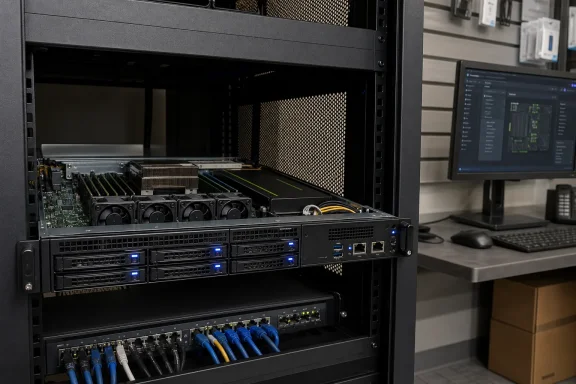 The short chassis is the actual differentiator
IT Pro describes the CyberServe as an ultra-short-depth 1U system and reports that it ran quietly under its test configuration. That is an important operational point for offices, retail sites and branch locations: a server that can physically fit in a shallow rack but creates persistent fan noise can still be a deployment failure.
The underlying Asus platform has a three-fan central cooling arrangement, a separate fan for the expansion area and a 500W Gold-rated ATX power supply. It is designed around processors up to 120W TDP, while the reviewed EPYC 4545P has a 65W default TDP. That helps explain why the review unit was quiet, but it also means the noise observation should not automatically be carried over to every configuration. A hotter 120W CPU, populated storage bays and a GPU card will change the thermal profile.
The form factor has a more important constraint than acoustics: there is no redundant hot-swap power supply. For a branch server with sensible backup and recovery planning, that may be an acceptable trade. For a host running services that cannot tolerate a single PSU failure, it is a hard limitation rather than a feature to configure around.
Broadberry markets the system with a three-year warranty, and its U.S. ordering page directs buyers to request a quote. The £3,656 figure from IT Pro therefore should not be read as a current U.S. price or a comparable base-system price. It reflects one reviewed UK configuration, including its particular CPU, memory and NVMe drive.
EPYC branding does not erase the platform limits
The EPYC 4545P is a compelling processor for its class: 16 Zen 5-era server cores, 32 threads, a 3GHz base clock, boosts up to 5.4GHz and a comparatively low 65W TDP. AMD lists its suggested 1,000-unit price at $549, which puts the processor in a very different economic category from the multi-thousand-dollar EPYC parts commonly found in enterprise servers.
But the 4005-series designation matters. It runs on AM5 and exposes two memory channels, not the larger memory-channel counts offered by AMD’s mainstream enterprise EPYC platforms. Asus specifies four DDR5 UDIMM slots in the ER100A B6 and a 192GB maximum configuration, which works out to four 48GB modules.
That capacity is ample for a modest Hyper-V host, Windows Server file and application server, remote desktop deployment with a limited user base, or small database workload. It is less persuasive for memory-dense virtualization, VDI, large SQL Server instances, or consolidation projects where RAM—not cores—usually becomes the first resource constraint.
There is also a documentation discrepancy worth resolving before purchase. Broadberry’s online product page says the system supports “DDR5 ECC Registered Memory,” while Asus’s official ER100A B6 specifications identify the supported memory as ECC or non-ECC UDIMM. Registered DIMMs and unbuffered DIMMs are not interchangeable categories. Since Asus is the platform manufacturer, buyers should request a written bill of materials that names the exact DIMM type, speed and capacity supported by the selected CPU and BIOS revision rather than relying on Broadberry’s generic configurator language.
That is not a minor procurement detail. A company standardizing on RDIMMs from existing server inventory may discover that those modules cannot be reused here.
Storage is flexible, but the hot-swap layer is narrow
The CyberServe has two front-facing hot-swap 2.5-inch SATA bays. IT Pro installed two WD Red SATA SSDs and used AMD RAIDXpert2 to build a mirrored array under Windows Server, while AMD confirms that the EPYC 4545P platform supports RAID 0, 1, 5 and 10 through that utility.
For a compact Windows Server deployment, two mirrored SATA SSDs are a sensible fit for the operating system, a small file share, or an application that has independent backup and storage replication. Broadberry also allows buyers to use their own storage devices without voiding the warranty, according to IT Pro, a potentially meaningful difference from systems whose support terms steer customers toward vendor-branded drives.
The storage expansion story becomes more nuanced behind the front bezel. The Asus chassis has an internal tray for two additional 2.5-inch SATA or U.2 NVMe drives, plus an M.2 PCIe 5.0 slot. The reviewed machine used that M.2 slot for its 2TB Micron 3500 boot or application drive.
Asus’s own platform documentation says that installing the first and second U.2 NVMe drives disables support for the third and fourth SATA positions. In other words, the system can offer a useful mix of front hot-swap SATA, internal SATA or U.2, and M.2 NVMe—but it is not an all-options-at-once storage server. Buyers planning four 2.5-inch drives should decide in advance whether the internal pair must be NVMe, because that selection changes the available SATA topology.
The other limitation is serviceability. Only the front pair is hot-swappable. The internal tray and motherboard M.2 socket require chassis access, which is normal for a short 1U machine but makes this a poor choice for workloads whose storage design requires frequent physical-drive replacement or expansion.
The BMC is the strongest server-grade feature
The most persuasive part of the EP1-102A specification is its AST2600 BMC with a dedicated 1GbE management port. IT Pro found a web interface for sensor monitoring, event logs, firmware updates, remote power controls, threshold alerts and firewall rules, along with OS remote control and virtual-media features.
That is a material advantage over a typical small-business tower or workstation. If Windows Server fails to boot after a bad driver, storage-controller change or patching problem, an administrator can attach remote media, use the remote console and investigate without travelling to the site. The value is particularly high for unattended edge installations.
Asus also bundles support for Asus Control Center Express, its centralized management software. Asus says the product provides dashboard monitoring, inventory information, deployment tools, remote control and management functions across supported systems. IT Pro reports that BMC monitoring appeared not to require a license, while agent deployments did require licensing; Asus’s own documentation confirms that license keys govern deployment capacity.
Administrators should separate the two management layers during evaluation. The BMC is the essential out-of-band interface for this specific server. Asus Control Center Express is optional fleet-management software that may be useful when an organization has several compatible Asus systems, but it adds a management server, agents and licensing considerations. It should not be confused with a replacement for Microsoft’s Windows Admin Center, Hyper-V management tools, or established infrastructure monitoring.
GPU support is useful for visualization, not a broad AI strategy
Broadberry and Asus both list support for a single low-profile Nvidia RTX A1000 or RTX A400 card. That gives the system a credible role in GPU-assisted visualization, video work, small inference tasks or applications needing professional Nvidia drivers without occupying a full-depth chassis.
It does not turn the CyberServe into a serious training server. The physical format allows one PCIe 5.0 x16 slot, and the chassis cooling is designed for low-profile cards. There is no room for multiple accelerators, no indication of redundant power, and no high-bandwidth networking as standard beyond dual 2.5GbE.
Broadberry offers 10GbE, 25GbE and 100GbE adapters, according to IT Pro, but choosing one consumes the system’s only PCIe expansion slot. That produces a simple planning decision: use the slot for a GPU, or use it for faster networking. A buyer that genuinely needs both should look at a larger server chassis with more PCIe slots rather than attempting to turn this platform into something it is not.
The CyberServe EPYC EP1-102A makes the strongest case for a compact Windows Server or Linux host that needs remote hands capability, a modest virtual-machine footprint, local SSD storage and quiet operation near users. Its constraints—two memory channels, two front hot-swap bays, one expansion slot and a single PSU—are not hidden, but they set a firm boundary around the workloads it should carry.