
The company’s workflow is more substantial than asking a model to write a Playwright script. Canary says it parses routes, controllers, validation logic, API schemas, and the PR diff to infer intent—then maps the change to user journeys and executes checks in parallel browser sessions. Y Combinator’s company profile and Canary’s own launch material describe the same sequence, while AI for Automation independently reported that the product requires a preview or staging deployment and currently targets web applications.
That makes Canary a potentially useful addition to a modern GitHub-based delivery pipeline. It does not, despite some of its front-page language, make conventional testing dispensable.
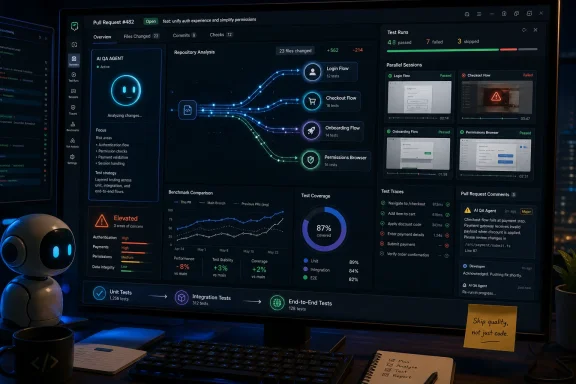 Canary’s actual job is PR-level behavioral verification
Canary is designed for a particular gap in software delivery: a pull request can look coherent in a diff, pass unit tests, and still break a checkout, login, onboarding, permissions change, or AI-assisted workflow once it meets a running application. Static code review and isolated tests rarely reconstruct the full user path through routing, state, data setup, browser behavior, and external services.
The company’s approach is to use the repository as a map rather than treating the browser page as the sole source of truth. In its Y Combinator launch post, Canary says it reads the changed code, identifies affected components and flows, generates tests for those flows, and runs them against the preview app. A failed run produces a PR comment with the result and a recording or replay intended to show where the journey failed. Developers can also request a specific test run through pull-request comments, and successful PR checks can become recurring regression checks.
This is a sensible distinction from a recorded-click test suite. Traditional end-to-end tests often depend on selectors, page structure, and carefully maintained fixtures. Those systems can become fragile as a UI evolves, even when the product behavior has not materially changed. Canary’s stated advantage is that it can start from the code change and business path, then use the browser to verify the result.
For Windows developers and IT teams running internal web portals, administration consoles, SaaS dashboards, or commerce applications, the strongest use case is not replacing every test framework. It is testing high-risk workflows that humans otherwise sample manually just before release: account creation, sign-in, role changes, purchase completion, document upload, form validation, and key back-office tasks.
The prerequisite is important. A tool that runs user journeys against a preview app needs a testable environment, usable authentication, appropriate seed data, and controls around payment providers, email, APIs, and destructive actions. Teams without reliable ephemeral environments will not get the promised “test every PR” experience merely by installing a GitHub app.
The “43% incident” argument has been stripped of its context
Canary and Y Combinator frame the product around a striking claim: customer-facing incidents are up 43% year over year, while AI coding tools have made developers dramatically faster. The first half of that sentence traces to a real PagerDuty survey, but the combined claim says more than the source establishes.
PagerDuty’s 2024 automation survey of 500 IT leaders and decision-makers at organizations with at least 1,000 employees in the United States, United Kingdom, and Australia found that 59% of respondents said customer-impacting incidents had increased, by an average of 43% over the preceding 12 months. The study attributed the rise to greater complexity, expanding digital services, and insufficient infrastructure maintenance. It did not determine that AI-written code caused those incidents, nor did it measure the defect rate of code produced by Cursor, Windsurf, Claude Code, or any other assistant.
That does not undermine Canary’s premise that QA capacity can become a bottleneck. It does mean the marketing shorthand turns a broad 2024 operations survey into a more specific causal story about AI coding that the survey itself did not make. Engineering leaders should treat the 43% figure as evidence that production reliability remains costly, not as proof that an AI QA agent will reverse the trend.
Canary’s more defensible argument is operational: when code volume rises and PRs grow, manual exploratory testing does not scale linearly. A system that recognizes that a change to shared authentication, routing, validation, or a reused component could touch multiple user journeys may find regressions that a reviewer focused on the immediate diff misses.
The outcome still depends on whether the agent can identify the right flows, run them deterministically, and tell a real regression from a broken test environment. That is the difficult part of automated QA, and it is where Canary’s public evidence remains preliminary.
QA-Bench shows a promising workflow, not production-proof defect detection
In March, Canary published QA-Bench v0, its own evaluation of code-verification systems on 35 frontend-affecting pull requests from Grafana, Mattermost, Cal.com, and Apache Superset. The company compared its agent with GPT 5.4, Claude Code using Opus 4.6, and Sonnet 4.6. It reported that Canary scored 84.5 on its coverage metric, compared with 73.2 for GPT 5.4 and 66.3 for Claude Code.
The useful finding is narrower than the headline score. Canary’s multi-stage process—identify changed components, map all connected user flows, then generate a test plan per flow—appears better suited to broad regression analysis than a one-pass prompt that asks a general model to write tests. In the company’s examples, the value comes from tracking secondary effects and shared components rather than merely restating the feature under review.
But QA-Bench v0 does not show that Canary catches more real, executable defects in production-like environments. Canary’s own methodology says the output under evaluation was often a high-level test plan, while the general-purpose baselines produced more concrete test scripts. The vendor also acknowledges that its benchmark used an Opus 4 model as judge, covered only 35 PRs, and has not yet moved to human evaluation or a pass/fail test based on deliberately injected defects.
That limitation matters. Listing more plausible user journeys is not identical to successfully executing them through an application with messy test data, conditional UI, feature flags, external identity providers, third-party APIs, timing variability, and access-control boundaries. Canary scored below all three general models on its own coherence measure, which assesses whether tests are clear, complete, and actionable. The company says its next benchmark will use bug injection and human evaluation; that is the milestone that could turn an interesting internal-style evaluation into evidence an engineering manager can use to set merge policy.
Until then, the benchmark supports a claim that Canary may generate broader PR-focused test coverage than the specific configurations it compared. It does not establish that Canary is ready to serve as an autonomous release gate for every application class.
Canary’s marketing promise and contract language point in different directions
Canary’s public site says the product “eliminates” unit testing, integration testing, Playwright testing, and manual testing in production. Its Terms of Service say almost the opposite in the place that matters legally: Canary’s findings are advisory; customers remain responsible for their own code, deployments, and releases; and the service does not replace a customer’s testing, review, or release processes.
The terms are the realistic position. Browser-driven, code-aware exploration can complement unit tests and integration tests, but it cannot absorb their jobs wholesale. Unit tests provide fast and deterministic checks for local business logic. Integration tests validate contracts and service boundaries. End-to-end checks validate a small number of critical paths at realistic cost. A browser agent can help generate or prioritize the latter, but it cannot offer a blanket replacement for the first two without creating slower, more expensive, and less diagnosable feedback loops.
Canary’s site also promises early access rather than a public self-service rollout, while Y Combinator says the company is working directly with engineering and product teams to adapt the product to their codebases. No public pricing is displayed. That suggests the product should be evaluated as an early-stage, hands-on service rather than procured as a mature drop-in testing platform with published capacity, supported frameworks, service-level commitments, and independently validated reliability.
There is a material data-handling consideration as well. Canary’s privacy policy says the GitHub integration receives connected repository metadata, including PR titles, descriptions, diffs, and commit metadata, and clones source repositories into isolated, single-use sandboxes for each test run. It says source code is destroyed at the end of a run, but generated checks, findings, logs, screenshots, and screen recordings are retained for the subscription term. Those artifacts can contain sensitive application state, customer-like test data, internal URLs, or UI evidence; a production pilot should use sanitized test tenants and review retention, deletion, access control, and subprocessor terms before connecting a sensitive repository.
Treat Canary as an extra reviewer with a browser, not a replacement QA department
Canary’s clearest contribution is moving exploratory browser testing closer to the pull request and grounding that exploration in source-code context. That could be valuable where AI-assisted development has raised the volume of small but consequential changes faster than a team can write and maintain end-to-end coverage.
A disciplined adoption path would keep existing unit, integration, security, and deployment checks intact; point Canary at a non-production preview environment; begin with a short list of critical user paths; and measure the results. Teams should track whether Canary finds defects their existing pipeline missed, how often its failures are actionable, whether it increases PR noise, and whether its recordings shorten time to diagnosis.
The product’s central idea deserves attention, especially for web applications where broken journeys cost more than an imperfect code diff suggests. But the evidence available on August 4, 2026 supports using Canary to expand pre-merge verification—not trusting a startup’s browser agent to declare the rest of QA obsolete.
