
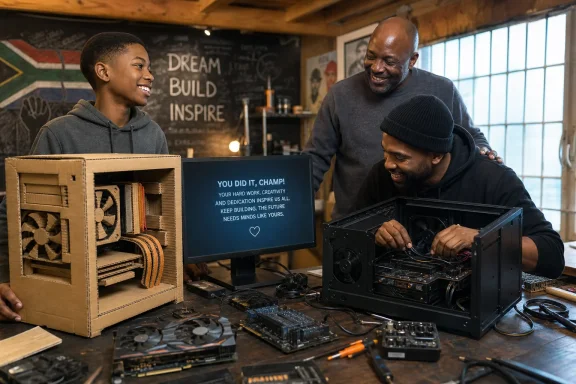
 A Dream PC Built From What Was Available
The basic facts are simple, but their impact is not. The young PC enthusiast did not merely draw a computer on paper or build a cardboard box shaped like a tower. According to the original report, he recreated the major ideas of a modern desktop system: a case, memory modules, and a CPU socket mechanism, among other parts.
That distinction matters. The project demonstrates more than a desire to own gaming hardware. It shows an instinct to understand it.
For experienced builders, a motherboard is a familiar object: a dense PCB with sockets, headers, power delivery components, and delicate connectors. To a newcomer, it can be intimidating. Recreating its parts from paper and cardboard turns an expensive, abstract product into something observable and manageable. The builder has to think about where a processor belongs, why RAM slots sit where they do, how a graphics card occupies space, and what a chassis does beyond simply looking impressive on a desk.
In that sense, the cardboard PC was already an educational project before a single retail component entered the picture.
Just Jean reportedly recognized that difference. Rather than treating the cardboard build as a novelty made for social media, he described it as the work of someone driven to translate an idea into a physical object despite the limits around him. Good Things Guy reported that Jean saw a familiar kind of childhood imagination in the project—and chose to respond with more than praise.
He had accumulated PC components that he had originally intended to sell. Instead, he decided to put them toward building a real system for the teenager. Another enthusiast, Dwarte, stepped in to provide the remaining hardware required to complete the machine. The report does not publish a full specification list, component values, or a total cost, so it would be wrong to present the build as a benchmarked gaming configuration. But the missing specification sheet does not dilute the important detail: the boy received a complete PC he helped assemble himself.
The Surprise Was Designed as a Real Build Lesson
The most thoughtful part of the story is not simply that hardware changed hands. It is the way the handover happened.
The teenager and his father were invited to Jean’s studio under the impression that they would be building a gaming PC for a client. The boy then installed components, handled the assembly process, and worked through the mechanics of putting a desktop system together. According to the account, he had no idea that the rig in front of him would become his own.
Only once the PC was assembled and powered on did the reveal arrive. A custom wallpaper on the display told him what was really happening: the computer was not for a customer. It was his.
That structure transformed a giveaway into an apprenticeship-sized experience.
Why Building the System Matters
A prebuilt PC can be life-changing for a young person without access to one. It creates a gateway to games, communication, research, schoolwork, coding, video editing, digital art, and a huge range of other interests. But a prebuilt system arrives as a finished object. Its inner logic can remain hidden.
Building a machine changes the relationship.
The young builder reportedly:
- Installed parts into the case.
- Took part in the component assembly.
- Routed cables.
- Saw the computer move from disconnected hardware to a working system.
- Took ownership only after understanding, at least in practical terms, how the system came together. Good Things Guy
That is an unusually strong outcome for a first PC. The teenager did not just receive a machine that he may eventually need to troubleshoot. He had an opportunity to see its construction from the beginning.
For Windows users, this has practical benefits. A person who has installed RAM, connected storage, mounted cooling hardware, and traced power cables is better positioned to understand what happens when a system fails to boot, when a display does not receive signal, or when an upgrade requires a compatibility check. That does not make anyone an instant technician, but it replaces some of the mystery with confidence.
A Better Kind of First-Day Experience
The surprise also avoided a common weakness in public hardware giveaways: the recipient is placed at the center of a spectacle but remains passive in the actual technical process.
Here, the build was not framed merely as content. It was participation.
There is a meaningful difference between being filmed receiving a large box and being trusted with the pieces inside it. The latter says, you are capable of learning this. It validates the interest already visible in the cardboard project.
That is why the reveal has resonated. The finished PC is the headline, but the underlying recognition is what gives the moment its staying power.
The Cardboard Build Was Not “Just” a Craft Project
Hardware enthusiasts sometimes reduce entry-level PC interest to performance questions: Which GPU? What refresh rate? How much RAM? Is the CPU current enough? Those questions are valid, especially for buyers trying to spend limited budgets intelligently. Yet they are not the beginning of the story for every future builder.
For this 13-year-old, the beginning was form, function, and imagination.
The cardboard computer represented a personal model of a PC ecosystem that he wanted to access. That model may not have run a game, but it was an act of design thinking. He had taken a technology product normally separated from him by price and reconstructed it with materials he could obtain.
That is not a substitute for digital access. It should never be romanticized as one. A cardboard system cannot complete homework, access online services, run a creative app, or connect someone to a wider learning community. But it can reveal a level of motivation that a community, school, family member, or local creator can help turn into a real opportunity.
The story’s strongest message is therefore not that deprivation makes people more creative. It is that creative potential deserves resources once it becomes visible.
Imagination Does Not Eliminate the Digital Divide
It would be easy to turn this story into a feel-good argument that passion automatically overcomes affordability. That would miss the point.
The boy’s cardboard PC was imaginative precisely because a real computer was out of reach. The material limitation was real. The eventual donation did not prove that access barriers do not matter; it showed what can happen when someone with resources responds meaningfully to a young person who has been shut out of a hobby by cost.
This matters at a time when the baseline definition of a usable PC is more complicated than it once was. Microsoft’s current Windows 11 requirements include a compatible 64-bit processor with at least two cores, 4GB of RAM, 64GB of storage, UEFI with Secure Boot capability, TPM 2.0, and a DirectX 12-compatible graphics solution. Microsoft also notes that application requirements may exceed the operating system’s minimum specifications. Microsoft’s Windows 11 requirements page makes clear that the real-world cost of joining the modern PC ecosystem includes more than simply finding an old tower that powers on.
A PC capable of booting Windows is not necessarily a PC that can comfortably handle current games, learning tools, browser-heavy workloads, video calls, creative software, or future updates. The best donation is therefore not necessarily the most expensive-looking machine. It is one that is balanced, dependable, secure, serviceable, and suitable for the recipient’s actual needs.
No detailed part list was published for this particular surprise build, so readers should avoid assuming its gaming performance, Windows version, monitor setup, or long-term upgrade path. The available report focuses on the build experience and reveal rather than a technical bill of materials. That is a sensible editorial choice for a human-interest story, but it also creates a useful lesson for anyone inspired to replicate the gesture: plan for the entire computing experience, not just the tower.
What a Responsible First PC Gift Should Include
The Just Jean and Dwarte collaboration succeeded because it met the essential emotional need: it gave a determined young builder a real opportunity. But the broader PC community can take the idea further.
A complete first-PC experience should consider the following.
1. A Balanced, Tested System
A donated computer should be tested before delivery. That means more than reaching the BIOS screen.
A responsible checklist includes:
- Stable boot behavior.
- Current BIOS or UEFI configuration where appropriate.
- Memory stability testing.
- Storage health checks.
- Reasonable CPU and GPU temperatures.
- Verified display output.
- Functional USB ports, Ethernet, Wi-Fi, and audio.
- A properly installed, activated operating system where licensing permits.
- Updated graphics, chipset, and network drivers.
- A clean malware-free installation.
The recipient should not be handed a “free PC” that instantly becomes a repair project because of an aging power supply, failing SSD, unstable overclock, or mismatched memory kit. A project machine can be valuable—but only if it is honestly presented as one and accompanied by support.
2. Peripherals and Connectivity
A desktop without a monitor, keyboard, mouse, audio option, or working internet connection is only a partial solution.
For a young person receiving a first system, the practical bundle may need to include:
- A display with the correct cable.
- Keyboard and mouse.
- Headset or speakers if communication or gaming is part of the goal.
- Wi-Fi capability or Ethernet access.
- A surge protector where electrical conditions make it sensible.
- Basic cable management materials.
- Access to trusted support if something goes wrong.
This is where the community’s expertise can add genuine value. A modest monitor, good mouse, reliable SSD, and healthy power supply often matter more to daily ownership than a flashy case or a decorative lighting setup.
3. Guidance on Safety, Privacy, and Accounts
A young recipient also needs support beyond physical hardware.
Modern Windows setup can involve online accounts, privacy settings, parental controls, game launchers, browser safety, password management, driver updates, and scam awareness. Microsoft states that Windows 11 Home and Windows 11 Pro for personal use require internet connectivity and a Microsoft account during initial setup, while updates and certain features also depend on internet access. Microsoft’s requirements documentation makes it clear that owning a compatible PC is only one piece of participation in the Windows ecosystem.
The best handover includes a short orientation:
- Explain the difference between administrator and standard accounts.
- Enable automatic updates and show where Windows Update lives.
- Install a reputable browser and teach safe downloading habits.
- Discuss phishing, suspicious Discord messages, fraudulent game-key offers, and fake “driver updater” tools.
- Set up backups for important schoolwork and personal files.
- Provide a path for help that does not require sharing passwords or personal information publicly.
These steps are not glamorous. They are also what turn a donated PC from a short-lived thrill into a durable resource.
Mentorship Is the Most Valuable Component
The hardware itself may be the most visible gift, but mentorship is arguably the more scalable one.
The teenager at the center of this story has already demonstrated curiosity. The day spent assembling the PC added a real-world learning opportunity. If that experience becomes an ongoing relationship with building, troubleshooting, research, and digital creativity, its value could compound for years.
Research summarized by the U.S. Consumer Financial Protection Bureau argues that direct, hands-on experience can support young people’s confidence and decision-making skills, particularly when it combines guidance, reflection, planning, and repeated practice. The CFPB’s youth capability guidance is written about financial education, but the broader principle fits the PC-building context remarkably well: learning becomes more durable when a young person actively makes decisions rather than simply observes them.
A future-focused extension of this surprise could include:
- A follow-up session on PC maintenance.
- An introduction to component compatibility research.
- Lessons on safe cleaning and dust management.
- A basic explanation of temperatures, fan curves, and power limits.
- Advice on saving for a future storage or RAM upgrade.
- Exposure to coding, 3D modeling, graphic design, streaming, video editing, or game development.
- Participation in a local repair, maker, or LAN community.
The CFPB similarly identifies project-based learning, real-world tasks, mentoring, and opportunities to compare options as useful ways for young people to build decision-making skills. Its educational guidance emphasizes that hands-on work is most effective when learners are trusted to explore real problems and reflect on outcomes.
The key point is not that every young builder must become an IT professional. The PC hobby is valuable even when it remains a hobby. But a teenager who can build a cardboard PC from scratch has already shown the kind of curiosity that can travel in many directions.
The Risks of Turning Generosity Into Content
There is one important caveat in stories like this: generosity involving minors must be handled carefully.
The published account presents the surprise as a positive, father-accompanied experience, and the boy’s reaction appears to have been sincere. Good Things Guy reported that his father was present during the studio visit and that the reveal came only after the system was built. That context matters.
Still, creators, sponsors, and communities should remember that a heartfelt viral video can create pressure on the young recipient. Privacy, consent, school details, location information, online harassment, and expectations from strangers should all be considered before and after publication.
The most ethical version of this format follows a few principles:
- Obtain appropriate consent from a parent or guardian.
- Avoid exposing unnecessary personal details, including home address, school location, account credentials, or sensitive financial information.
- Do not demand a particular reaction from the recipient.
- Do not frame poverty as entertainment or as a condition for receiving help.
- Provide aftercare, including technical help and a point of contact.
- Be transparent if brands, sponsors, or advertising arrangements are involved.
- Keep the recipient’s interests ahead of the content calendar.
Just Jean’s decision to make the teenager part of the build rather than simply the subject of a reveal is a positive model. It gives the young person agency. The lesson for the broader creator economy is to preserve that agency after the cameras stop recording.
A Reminder of the PC Hobby at Its Best
PC building is often presented through premium upgrades, benchmark charts, launch-day graphics cards, and carefully staged desk setups. Those parts of the hobby can be exciting. They are also not its foundation.
At its best, the hobby is about making technology feel approachable. It is about learning what each component does, solving problems when something fails, sharing advice without gatekeeping, and recognizing that a modest system assembled with care can be more meaningful than the most expensive showcase build.
This story cuts through the usual product-cycle noise because the original cardboard PC expressed that spirit so clearly. The teenager did not wait until he had ideal components, a sponsor, or an audience. He built the version he could build.
Jean and Dwarte then responded in the most constructive way possible: they did not merely replace the cardboard creation with a finished product. They gave him access to the real process and let his own hands bring the system to life. The surprise, as documented by Good Things Guy, ended with a custom wallpaper and an unexpected answer to the question of why anyone would do this for a stranger.
Because many PC enthusiasts remember being that kid.
They remember staring at hardware catalogs, watching build videos, comparing specifications they could not yet afford, or imagining a desk setup that existed only in sketches. The cardboard PC is powerful because it makes that private memory visible. The completed gaming rig is powerful because it proves that a community can respond with something better than applause: access, trust, instruction, and a genuine place in the hobby.
That is the surprise of a lifetime. More importantly, it may be the beginning of one.
