
The post arrives three weeks after OpenAI began rolling GPT‑Live‑1 out on July 8, 2026, first as the default ChatGPT Voice model for paid consumer accounts and GPT‑Live‑1 mini for Free users. TechCrunch independently reported the July 8 launch, while OpenAI’s current Voice documentation confirms that “Live” is now the latest voice mode. This is therefore a postmortem-style systems report on a deployed product, not a launch announcement.
The most consequential disclosure is also the least glamorous: OpenAI abandoned the separate turn detector that older systems used to guess whether a person had finished speaking. In a conventional voice stack, the system waits for a detector, transcribes audio, asks an LLM for text, and synthesizes speech. Each component can be individually quick and still create a conversation that feels slow or prone to interruptions. GPT‑Live instead treats audio as a continuous bidirectional stream and gives the voice model the responsibility for deciding whether to continue listening, acknowledge, speak, pause, or hand work to another model.
That removes one bottleneck but replaces it with a much harder operational requirement: every audio frame has a deadline. A sluggish database query, a busy event loop, a distant inference cluster, or a model-state transition cannot be allowed to block the media path. OpenAI’s report is valuable because it identifies the production engineering required to make that condition hold — and because it exposes several measurements and safeguards the company still has not published.
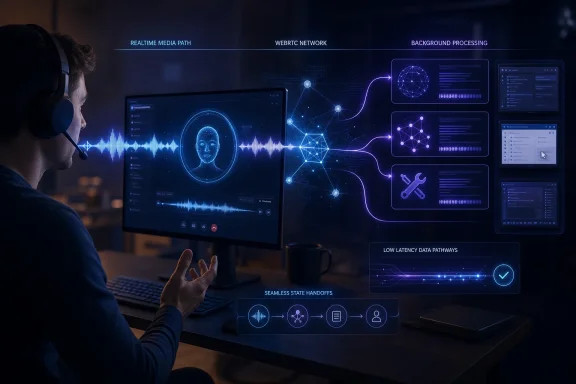 The voice model is no longer the sole latency story
OpenAI describes GPT‑Live as a full-duplex speech-to-speech model. The practical distinction is that it can receive new audio while generating its own response, rather than waiting for a hard conversational boundary. A user can interrupt, hesitate, or add clarification without forcing the system into the familiar “wait, transcribe, think, answer” cycle.
However, the system does not perform all work inside that live model. GPT‑Live can delegate web search, reasoning, and tool activity to a frontier model — OpenAI identifies GPT‑5.5 as the model used at launch — while the voice system maintains the conversation. That is a sensible division of labor. Voice interaction needs a fast decision loop; deep research, long tool chains, and agent tasks need more compute and can take materially longer.
The consequence is that responsiveness now depends on whether GPT‑Live can successfully mask the time taken by delegated work. The voice model can offer a brief acknowledgement, ask a follow-up, or keep a conversation moving while the larger model searches or reasons. It cannot conceal an indefinitely slow task. OpenAI acknowledges this by describing routing, prompt processing, inference, tool calls, tool schemas, output limits, and model-to-tool round trips as part of the same “responsiveness budget.”
For ordinary ChatGPT Voice use, that should make interruptions and mid-sentence corrections less awkward. For the Windows desktop app, the stakes are higher. OpenAI announced on July 23 that ChatGPT Voice in Work and Codex can control the computer and coordinate activity across multiple agents, conversations, and projects. A voice interface that merely sounds responsive but pauses whenever it checks the status of an agent would be a poor control surface. The asynchronous design is intended to let the user redirect or interrupt background work while it continues.
OpenAI has not published the end-to-end latency target, median response time, interruption rate, or failure rate for that workflow. Its public claim is sub-second responsiveness, but a broad description is not enough for administrators evaluating whether voice is suitable for operational tasks. There is also no published breakdown of how often a GPT‑Live session delegates, how long delegated answers take, or what happens when the background model or a connected tool fails after the voice model has acknowledged the request.
Go, WebRTC, and the decision to isolate the media path
The strongest systems decision in OpenAI’s design is the separation between the real-time audio path and application logic. Media flows from client to voice model through a dedicated fast path; policy evaluation, persistence, tools, and delegation sit behind an asynchronous RPC boundary. A slow backend service can delay its own result, but it should not stop audio from arriving at the voice model or speech returning to the listener.
This matters for enterprise deployments because every additional integration normally creates another way to damage an interactive experience. Connected services, DLP checks, audit logging, agent orchestration, web search, and document tools all introduce variable latency. OpenAI’s architecture attempts to contain that variability away from the part of the stack where missed deadlines become gaps, stutter, or a talking assistant that reacts too late to a user interruption.
OpenAI says it rewrote the media frontend and inference logic from Python’s asyncio framework to Go. Its reported result is striking but incomplete: the new system’s p95 frame-delivery performance matched the earlier platform’s p50. In plain terms, a bad-but-typical case under the Go implementation was roughly as smooth as a middle-of-the-road case under Python.
The company does not disclose the actual frame-delay figures, frame size, hardware profile, regional conditions, or test population behind that comparison. That leaves readers unable to determine whether the gain is tens of milliseconds or a far larger improvement, and whether it persists on consumer Wi‑Fi, corporate VPNs, mobile hotspots, and long-lived enterprise sessions. Still, the direction of the change is credible: realtime media services are unusually vulnerable to scheduler jitter, garbage collection pauses, queue buildup, and head-of-line blocking.
WebRTC remains the transport foundation. That is a pragmatic choice for browser and app compatibility, NAT traversal, media timing, packet loss, reconnect behavior, and audio jitter handling. OpenAI says late packets can be absorbed by subtle playback stretching and then caught up through brief acceleration, preserving continuity rather than exposing every network hiccup as silence.
The larger lesson is that a voice assistant’s perceived intelligence may depend as much on transport discipline as model quality. A model can make excellent conversational decisions and still feel unconvincing if the network delivers those decisions half a second late.
Long sessions require invisible state transfers
Full-duplex voice also introduces a problem that text chat mostly hides: a session can remain active while both its model context and its in-memory inference state grow continuously. OpenAI’s answer is to hand an ongoing conversation from one model instance to another without interrupting audio.
The reported process warms a replacement instance, prefills it with the active conversation context, runs the original and replacement instances in parallel, and cuts over once the new instance is ready. OpenAI uses the same mechanism for context compaction. Instead of stopping a conversation when its accumulated context approaches the model limit, it summarizes or compacts older material on a separate path, prepares a new instance with the revised context, and switches sessions only after that instance is ready.
This is an important design choice for the desktop-agent use case. A short voice query can tolerate a reconnect or a fresh prompt. A multi-hour session supervising research, coding, desktop tasks, and follow-up corrections cannot. OpenAI’s own current documentation sets a two-hour maximum for a single Live conversation, so the handoff mechanism is not simply a theoretical answer to unlimited session duration. It is part of keeping even bounded sessions stable as user context, tool state, and transcripts accumulate.
There is a tradeoff. Compaction necessarily changes the model’s working representation of earlier conversation. OpenAI says it preserves continuity by moving the heavy processing off the live path, but it does not explain what material is discarded, summarized, or retained; whether tool results and user corrections receive special treatment; or how users can inspect the compacted context. Those omissions matter more when voice becomes a way to direct actions on a Windows PC rather than simply ask questions.
The transcript pipeline has a related complication. GPT‑Live is continuous, but ChatGPT’s UI, analytics, safety systems, and tool infrastructure still need discrete messages. OpenAI says its application server builds provisional messages from partial transcripts and timing signals, then finalizes them only after it can reliably assign the speaker and conversational floor.
That means the live transcript can change: its text, timestamps, and speaker attribution may be revised while the conversation is in progress. OpenAI explicitly maintains a speculative view for the UI and an authoritative record for logging. This is the correct engineering response to overlapping speech, backchannels such as “mm-hmm,” and mid-sentence interruption. But it also means organizations should not assume the words appearing live in a ChatGPT window are the same record eventually retained for analytics or review.
OpenAI has not described how that distinction is presented in Work or Codex audit trails, or how administrators can reconcile a provisional spoken instruction with a final record when a user directs a computer action. For voice-controlled agent workflows, that is a missing governance detail rather than a minor implementation footnote.
WARP is a real standards effort, but it is still a draft
OpenAI also describes two startup optimizations: Instant Connect, its internal method for pre-negotiating session parameters before the first media packet, and WARP, short for WebRTC Abridged Roundtrip Protocol. The aim is to remove signaling from the critical path and cut the setup work needed before audio can flow.
The technical premise checks out. The IETF record shows that the WebRTC Abridged Roundtrip Protocol was published as draft-uberti-tsvwg-warp-00 on July 22, 2026, with OpenAI’s Justin Uberti and Meta’s Philipp Hancke listed as authors. The proposal says conventional WebRTC setup can require six round trips before media and data channels are fully usable, while WARP’s combined changes target two round trips.
OpenAI’s July 29 post says that WARP support has already been added to libwebrtc and Pion, and that work is underway elsewhere. The IETF document confirms the protocol exists and is intended for standards-track work, but it remains an Internet-Draft, expiring January 23, 2027. It is not an approved IETF standard, and the current public record does not establish broad browser, operating-system, or enterprise-network interoperability.
That distinction is worth making because OpenAI calls WARP “a set of open specifications.” It is open in the sense that the draft is public and being advanced through the IETF process. It is not yet a settled interoperability guarantee that Windows administrators can expect to see uniformly across browsers, proxies, firewalls, or WebRTC clients.
For now, OpenAI’s own Instant Connect mechanism appears more immediately relevant to ChatGPT. It is designed to run beside normal signaling and fall back without extra delay if pre-negotiated parameters are invalid. That design avoids making a faster startup path an all-or-nothing compatibility bet.
OpenAI’s six-month build report shows why GPT‑Live should be understood as a new realtime platform rather than a voice skin over a text chatbot. The company had to solve continuous model inference, state handoffs, transcript finalization, transport startup, regional capacity, observability, and failure containment before its full-duplex model could feel conversational under real traffic.
For Windows users, the practical result is already visible in the ChatGPT desktop app: voice can remain active while Work or Codex agents progress, and a user can intervene without waiting for a rigid turn boundary. The unresolved operational issue is the record around that interaction — particularly the final transcript, delegated tool actions, and audit controls — as voice moves from conversation into direct computer control.
