
Cherny’s reported comparison of a new model generation to a living creature is deliberately provocative, and it should not be read literally. A language model does not independently develop a personality after deployment. But the engineering point beneath the metaphor is sound: a new set of model weights can respond differently to identical prompts, tools, context layouts, and stopping rules. For a team that has spent weeks refining a system prompt or agent workflow, that can turn a “drop-in” model upgrade into a quiet regression.
The bigger problem is that the reporting provides no primary interview link, interview date, host, or transcript. OfficeChai is currently the only identified outlet carrying Cherny’s quoted remarks about models behaving differently by generation, prompts needing deletion, and evaluations lasting only a few model cycles. That makes the quotes attributable to OfficeChai rather than independently verifiable as a complete interview record. The underlying engineering thesis, however, is supported by Anthropic’s own recent record.
Anthropic publicly documented one example on April 23, 2026, after Claude Code users reported a quality decline. The company said it had added a system-prompt instruction on April 16 intended to reduce verbosity; combined with other prompt changes, that instruction harmed coding quality and was reverted on April 20. In other words, a piece of instruction-layer tuning designed to improve one trait impaired the outcome users actually cared about: the code.
That is the important news buried inside Cherny’s “organic” framing. AI-agent engineering is less like compiling a stable program and more like maintaining a service against a changing dependency whose behavior is learned through repeated tests.
 Claude Code’s April regression is the concrete proof
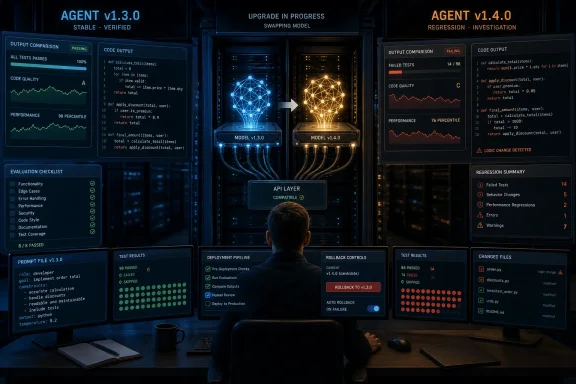
Anthropic’s April postmortem is unusually useful because it does not blame a vague model failure. It identifies a specific system-prompt instruction, a specific intended effect, a specific regression, and a rollback. The episode demonstrates that the harness around an AI coding model—the system prompt, tool instructions, context-management rules, permissions, retry behavior, and output checks—can become harmful even when every piece of ordinary software around it continues to function.
This is familiar territory for Windows administrators, except the failure mode is different. A Windows servicing update may change an API, driver behavior, policy interaction, or security baseline; an administrator expects to test it before broad deployment. With an AI coding agent, the interface may remain available and every command may still execute, while the agent becomes less reliable at planning, editing, or recognizing when it has made a mistake.
A conventional regression is often crisp: an application crashes, a script returns an error, a service fails to start. Agent regressions can be plausible. The assistant may produce clean-looking code that misses a repository convention, alters an adjacent component unnecessarily, or stops after passing a narrow test while violating the actual requirement. That is why treating an agent model replacement as an invisible backend change is a governance mistake.
Anthropic’s own Claude Code guidance also points in this direction. The company describes project instruction files such as CLAUDE.md as part of the prompt delivered to the model, and recommends refining them as frequently used prompts. That advice is useful, but it has an operational implication: repository instructions are configuration with behavioral consequences, not durable documentation that can be written once and forgotten.
For IT teams, this means prompt files, agent policies, and tool permissions belong in change control alongside scripts, CI definitions, infrastructure-as-code, and endpoint-management policies.
“Delete the prompt” does not mean discard the process
According to OfficeChai, Cherny argued that teams seeking frontier capability must be willing to delete code and system prompts tailored to an older model. That sounds wasteful only if the prompt is treated as the product. It is not. The durable asset is the evidence showing which tasks matter and what a correct result looks like.
A system prompt can contain valuable institutional knowledge—build commands, coding standards, deployment boundaries, approved tools, prohibited actions, and escalation rules. Removing it wholesale because a newer model is stronger would be reckless. The lesson is narrower: remove instructions that exist only to compensate for a particular model’s weakness, verbosity, tendency to over-explain, tool-use habits, or old failure pattern.
There is a material distinction between these two types of prompt content:
- A statement such as “Never modify the production deployment manifest without explicit approval” is a policy requirement and should remain independently of model generation.
- A statement such as “Before every edit, repeat the user’s task in exactly three bullets and explain your plan in 200 words” may have been an old workaround for weak planning behavior and can become counterproductive with a later model.
- A statement such as “Run the unit tests and report failures before proposing a merge” is a verification requirement, but its wording and placement may still need testing after an upgrade.
The error many teams make is layering compensating instructions indefinitely. Each prior failure adds another rule. The prompt expands; the model receives more competing constraints; cache behavior, token cost, and context pressure change; then the team can no longer tell which rule protects quality and which one causes friction.
Anthropic’s April incident shows why this cannot be resolved by intuition alone. “Be less verbose” looks harmless. In a coding agent, it can affect whether the model investigates a problem sufficiently, documents uncertainty, uses available tools, or spends enough effort validating a change. The line between an instruction that makes an agent efficient and one that makes it shallow is usually visible only in measured outcomes.
Evals have a shelf life, but they are still the control plane
OfficeChai reports that Cherny sees evaluations as longer-lived than the harness, although even they can saturate within one to three model generations. The recent benchmark record supports the second half of that claim.
Artificial Analysis announced on June 15 that it had removed IFBench, an instruction-following benchmark, from version 4.1 of its Intelligence Index because frontier models no longer separated sufficiently on it. The company replaced and upgraded several other tests, shifting more emphasis toward agentic workloads such as terminal tasks and longer-running work. Stanford’s 2026 AI Index similarly reported that evaluations intended to stay difficult for years are being saturated in months.
This does not mean teams should give up on evaluations because benchmarks age. It means public leaderboards are not a substitute for a local regression suite. A generic benchmark may tell you whether a model is broadly competitive. It cannot tell you whether the model can safely modify your PowerShell modules, honor your internal change-management rules, correctly work around a legacy line-of-business application, or avoid touching a configuration file that would break a Windows deployment ring.
A useful internal evaluation set should be small enough to run before every model or harness change, yet grounded in failures the team has actually seen. It should include representative tasks, expected artifacts, automated checks where possible, and review criteria for the failures that cannot be reduced to a unit test.
For a Windows-focused engineering or operations team, that could include:
- A task that updates a PowerShell automation script while preserving approved error handling, logging, and credential practices.
- A task that changes an Intune or Configuration Manager deployment definition without widening the target group.
- A task that diagnoses a failed Windows servicing installation from supplied logs and differentiates a known error from an unsupported guess.
- A task that edits a deployment workflow but must not bypass code signing, rollback steps, or peer review.
The objective is not to prove that one model has a higher abstract intelligence score. It is to expose the mistakes that would cost the organization a failed deployment, an insecure script, an unnecessary outage, or hours of human cleanup.
The upgrade runbook needs to look more like release validation
The operational consequence of Cherny’s argument is straightforward: do not promote a new AI model in production merely because it is advertised as more capable, cheaper, or faster. Treat it as a release candidate.
Start by freezing a known-good sample of real tasks before changing the model, prompt, or agent framework. Run the old and new configurations against the same cases. Compare completion quality, test pass rates, unintended-file edits, tool-call patterns, latency, token consumption, and the amount of human correction needed before merge. A model that solves more difficult tasks may still be the wrong production choice if it creates more risky changes in the workflows that dominate your day.
Then separate stable controls from model-specific scaffolding. Keep hard policy enforcement outside natural-language instructions whenever possible. Use repository permissions, branch protection, CI gates, code owners, secrets boundaries, least-privilege tokens, sandboxed execution, and mandatory test commands. A system prompt can remind an agent not to do something; an enforced permission boundary can stop it.
Anthropic’s documentation on Claude Code worktrees makes the same practical case from a different angle. Separate worktrees allow parallel sessions to work without directly overwriting one another’s changes. That is helpful isolation, but it does not remove the need to evaluate what each session produced. Parallelism increases the number of candidate patches; it does not turn generated patches into reviewed ones.
Cherny’s reported call to build evaluations by using the product is also more demanding than it sounds. Teams should capture production misses, near-misses, rejected pull requests, and repeated human corrections as candidates for new tests. If an agent repeatedly mishandles Windows event logs, invents PowerShell parameters, ignores a deployment ring, or modifies files beyond its assigned scope, that failure should graduate from anecdote to regression test.
The enduring artifact is not the exact prompt that worked with one model. It is the discipline that detects when the next one no longer does.
