
The other four recommendations are more directly relevant to Claude Code: Jesse Vincent’s Superpowers workflow package, language-server plugins such as Pyright and TypeScript LSP, Anthropic’s Frontend Design skill, and Upstash’s Context7 documentation server. Anthropic’s own plugin documentation confirms the basic distinction behind the list: plugins package skills, agents, hooks, and MCP servers, while language-server plugins enable Claude Code’s built-in code-intelligence tool.
That architecture matters more than the hype around “vibe coding.” A plugin does not make Claude a better programmer in the abstract. It either gives the agent a disciplined workflow, a semantic view of a project, current external information, or extra tools with which to act. Those are different interventions, with different failure modes and security consequences.
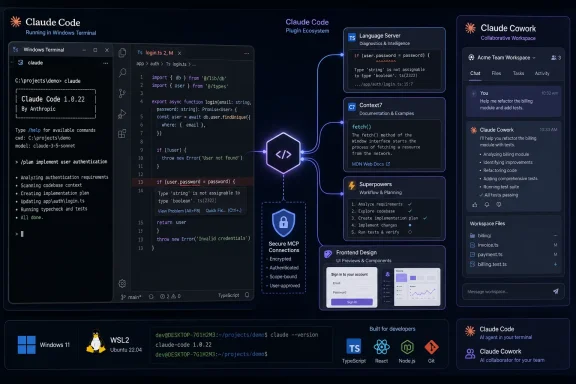 The “five” are really four plugins and one platform feature
How-To Geek groups language-server plugins into one of its five picks, but that is a category rather than a single install. A Python repository needs pyright-lsp; a TypeScript project needs typescript-lsp; Rust uses rust-analyzer-lsp; C and C++ use clangd-lsp. Anthropic’s official marketplace documentation lists additional options for C#, Go, Java, Kotlin, Lua, PHP, Swift, and more.
For working developers, this is probably the most valuable item in the article. Claude Code’s language-server integration provides diagnostics after edits, navigation to definitions, reference searches, type information, symbol lists, implementation lookups, and call-hierarchy tracing. In practical terms, Claude can discover a missing TypeScript import or a Python type error immediately after its edit rather than waiting for a build, test, or frustrated human review to catch it.
There is a setup catch that should be treated as a requirement, not fine print. The Claude Code plugin configures the connection, but it does not contain the language-server executable. The associated server must be installed on the Windows machine or inside the WSL distribution where Claude Code is running, and it must be available on that environment’s PATH.
That distinction can become confusing on Windows. Claude Code supports WSL and native Windows use through Git Bash, but a language server installed in Windows is not automatically available to a Claude Code session running in Ubuntu under WSL, and the reverse is also true. A pyright-langserver or typescript-language-server “executable not found” error in Claude Code’s plugin manager means the plugin is present but its dependency is absent from the active shell environment.
For IT teams, language-server plugins also carry a resource cost. Anthropic warns that servers including Pyright and Rust Analyzer can consume significant memory on large projects. On a large monorepo, install them selectively and confirm the workspace configuration is sound; otherwise, unresolved internal-package imports can generate a stream of false-positive diagnostics that distract both the agent and the developer.
Superpowers adds process, not intelligence
Superpowers is the most ambitious recommendation in the How-To Geek list. Its GitHub repository describes it as a software-development methodology composed of skills and initial instructions, and it is available through Anthropic’s official marketplace as superpowers@claude-plugins-official. Its approach is familiar to experienced engineers: clarify requirements, work from a plan, use test-driven development, investigate root cause before changing code, and review work through subagents.
That is a meaningful intervention in agent behavior. An LLM will often produce a plausible patch quickly because that is the shortest path to satisfying a prompt. A workflow that requires a failing test before an implementation, or evidence of a root cause before a fix, makes it harder for the agent to paper over symptoms. It does not prove that the fix is correct, but it creates artifacts a reviewer can inspect: a test, a plan, a diagnosis, and a change set.
How-To Geek calls Superpowers “non-negotiable,” but that is overstated. It is a community project maintained by Jesse Vincent and collaborators at Prime Radiant, not an Anthropic-authored engineering standard. Its value depends on whether its prescribed workflow fits the repository and the task. A small script fix may not warrant a full brainstorming-and-plan cycle; a production database migration almost certainly warrants a more formal process than a plugin prompt can impose.
There have also been plugin-loading complaints in Superpowers’ public issue tracker, including reports of incomplete cached installs and skills that did not reliably activate. Those reports do not establish a universal Claude Code defect, but they underline a useful operational rule: after installing any workflow plugin, verify that Claude Code has actually loaded the skills before assuming the agent is following them. A plugin that silently fails is worse than a plugin that is absent because it gives the team a false sense that safeguards are in place.
Frontend Design fixes a recognizable default, not a product-design gap
Anthropic’s Frontend Design plugin tackles a real and increasingly visible problem: unprompted AI-generated interfaces converge on generic layouts, familiar system fonts, gradients, rounded cards, and predictable component grids. Anthropic has publicly described that tendency as a statistical consequence of models sampling toward common patterns in their training data.
The plugin directs Claude to establish a page’s purpose, audience, and aesthetic direction before it produces frontend code. Its marketplace description explicitly encourages distinctive typography, color choices, motion, asymmetry, layered visual depth, and styles ranging from brutalist to retro-futuristic. It is an Anthropic Verified Claude Code plugin, and the skill activates when a user asks Claude to build a frontend.
That makes it useful for prototypes, internal tools that need to feel intentional, and early design exploration. It is less useful as a replacement for a design system or accessible product requirements. A deliberately unusual interface can still have poor contrast, confusing focus order, inaccessible motion, bad keyboard navigation, or components inconsistent with the rest of an organization’s application.
The practical consequence is that Frontend Design is best used to widen the first draft, then constrained by the real product rules: approved fonts, brand tokens, responsive breakpoints, accessibility acceptance criteria, and existing component libraries. It can make Claude less visually repetitive; it cannot decide whether an unconventional interface is appropriate for a bank, hospital, enterprise admin console, or public-sector service.
Context7 reduces stale API guesses, but only when invoked
Context7, made by Upstash, is a more targeted answer to a core coding-agent weakness: language models routinely generate code for APIs that have changed since their training data was collected. The plugin is an MCP server that retrieves current, version-specific documentation and examples from source repositories. Its two advertised tools resolve a library identifier and query that library’s documentation.
That is valuable when working with rapidly changing stacks such as Next.js, React, Cloudflare Workers, Supabase, or vendor SDKs. Instead of stuffing a broad documentation dump into every session, Claude can request material for the particular framework and version at issue. The approach can reduce hallucinated methods and outdated configuration patterns, but it does not absolve the developer from checking the result against the project’s installed dependencies and its lockfile.
The How-To Geek article says Context7 will correct Claude after it makes a mistake. That may happen, but it should not be the expected workflow. Upstash’s own usage guidance tells users to include “use context7” in requests when current documentation is needed. The reliable instruction is therefore explicit: tell Claude to use Context7, name the library, and specify the version when it matters. Treating the server as an automatic fact-checker invites precisely the stale-answer problem it is meant to solve.
For corporate codebases, administrators should also consider what is leaving the machine. Context7’s privacy materials say it processes and serves indexed, publicly available documentation from open-source projects and official library sources. That is a narrower concern than uploading a proprietary repository, but teams still need to review MCP permissions, network paths, and their own AI-tool policy before rolling it into managed developer environments.
Productivity belongs in Cowork today
The sharpest discrepancy in the roundup concerns Anthropic’s Productivity plugin. How-To Geek presents it as an official Claude Code plugin that creates a local TASKS.md, two-tier memory, a visual dashboard, and a command-driven way to consolidate information from Slack, Asana, Notion, and Gmail.
Anthropic’s current plugin directory still describes those same broad features: Markdown task management, workplace memory, a dashboard, /start, /update, and optional connections to chat, email, calendars, knowledge bases, and project trackers through MCP. But the directory labels its installation target as Claude Cowork and reports zero installs, rather than Claude Code. Anthropic’s broader plugin overview similarly describes Productivity as part of its internally built plugin collection without establishing it as a terminal Claude Code package.
That may reflect an unfinished rollout, a product repositioning, or a listing problem. What it does establish is that the article’s installation guidance should not be treated as verified for Claude Code on August 4, 2026. Users looking for it in the /plugin terminal interface may not find a supported package, and Windows admins should not deploy instructions that assume access to employee email, chat, and project-management systems without confirming the exact product, entitlement, and connector permissions first.
This is more than naming trivia. Claude Code is a developer agent that operates on local projects and command-line tools; Cowork is aimed at broader work coordination. A local TASKS.md is low-risk. Connecting an agent to Gmail, Slack, calendars, and project trackers creates a different data-access and audit problem entirely.
Marketplace status is not a blanket security review
How-To Geek correctly advises readers to inspect plugins obtained outside built-in marketplaces. Its suggestion that marketplace plugins are “generally vetted,” however, needs tightening. Anthropic says it performs basic automated review before adding community plugins to its directory. Plugins bearing the Anthropic Verified badge receive additional quality and safety review. Anthropic also says those reviews have limits and advises users to install plugins only from developers they trust.
That warning is particularly important with MCP-based plugins. A plugin can load remote MCP servers, local MCP servers, and other local software. In effect, it may give an agent new access to services, files, shell commands, credentials, or network resources. The security decision is not whether a plugin has a polished marketplace page; it is whether its source, dependencies, requested permissions, update path, and data access are acceptable for the machine and project involved.
For a sensible Windows setup, start with the language-server plugin for the language your repository actually uses. Add Context7 for work involving changing third-party APIs, and invoke it explicitly. Trial Superpowers in a noncritical repository if the team wants more rigorous planning, debugging, and testing behavior. Add Frontend Design only where a distinct visual direction is part of the assignment. Leave Productivity out of a Claude Code deployment plan unless Anthropic formally exposes it for Claude Code and the organization has approved the connected-data scope.
The result is less glamorous than installing five “must-have” packages, but it is the setup that changes outcomes: semantic code intelligence for correctness, current documentation for API accuracy, and deliberately chosen workflows where their cost is justified.
