
 Mythos Changes the Cybersecurity Planning Assumption
Claude Mythos was introduced as a high-capability model for cybersecurity and scientific research, with Anthropic initially restricting access to vetted partners through its Project Glasswing program. Anthropic has described Mythos Preview as particularly strong at identifying vulnerabilities in real software, and says it used the model to help surface large numbers of security issues across open-source projects. Anthropic’s Mythos capability assessment Anthropic’s coordinated vulnerability disclosure dashboard
That defensive potential matters. The security industry has always needed more help identifying flaws before malicious actors find them, especially in widely used libraries, infrastructure components, operating-system-adjacent software, and complex enterprise applications. A model able to analyze code, generate hypotheses, validate attack paths, and assist in producing proofs of concept could greatly compress the work of legitimate vulnerability researchers.
The same features create a serious dual-use problem. A tool that can rapidly locate weaknesses does not inherently know whether it is being operated by a trusted security team, a criminal group, or a state-backed intelligence service. Anthropic itself acknowledges that Mythos-class cybersecurity capabilities pose a meaningful misuse risk, which is why the company has emphasized trusted-access programs and separate safeguards for more broadly available products. Anthropic’s Mythos and Fable announcement
The Federal News Network commentary’s central warning is therefore not that identity controls, endpoint protection, patch management, detection engineering, or threat intelligence have suddenly become irrelevant. They have not. The issue is that AI-assisted attackers can compress the interval between weakness, access, reconnaissance, exploitation, and lateral movement so dramatically that a security program built around stopping every initial compromise becomes an increasingly fragile proposition. Federal News Network
That is a critical distinction. The goal is not to abandon prevention. It is to stop treating prevention as the one safeguard that must always succeed.
Zero Trust Was Never Supposed to Be a Magic Shield
The argument that “zero trust alone is not enough” can sound provocative because zero trust has become the defining cybersecurity modernization theme across the U.S. federal government. But properly understood, it is less a rejection of zero trust than a demand for a more complete implementation of its underlying philosophy.
The National Institute of Standards and Technology defines zero trust as an approach that removes implicit trust based on network location or ownership. It shifts the focus away from a broad, trusted internal network and toward specific users, devices, applications, data, and resources, requiring authentication and authorization before access is established. NIST SP 800-207
That remains the right direction. Traditional perimeter security assumed that an organization could build a hardened boundary around a relatively stable corporate network. Remote work, cloud services, software-as-a-service platforms, contractor access, mobile devices, and hybrid infrastructure have made that concept inadequate. A user may be outside the building, an application may run in a public cloud, and data may transit through several providers before it reaches its destination.
Federal zero trust guidance recognizes this reality. CISA’s Zero Trust Maturity Model frames zero trust around pillars that include identity, devices, networks, applications and workloads, and data, with visibility, automation, and governance acting as cross-cutting capabilities. CISA’s Zero Trust Maturity Model
The problem arises when organizations reduce zero trust to a narrow identity project:
- Enforce multifactor authentication.
- Deploy conditional access.
- Improve privileged-access management.
- Reauthenticate users more often.
- Segment applications around identity-aware gateways.
All of those investments are valuable. Yet a sophisticated attack can still begin with a compromised device, stolen session token, abused service account, malicious OAuth grant, vulnerable remote-management appliance, poisoned software dependency, exposed cloud credential, or a flaw in the identity infrastructure itself.
Microsoft’s account of the Storm-0558 intrusion illustrates the limits of relying on a single control plane. The threat actor obtained access to email data at approximately 25 organizations by using forged authentication tokens associated with an acquired Microsoft consumer signing key. The lesson is not that identity is unimportant; it is that highly capable adversaries will seek weaknesses around, below, and inside the systems used to establish trust. Microsoft’s Storm-0558 mitigation report
A mature zero trust architecture should restrict the damage that a compromised credential can cause. NIST explicitly notes that a properly developed implementation should prevent a compromised account or asset from accessing resources outside its normal patterns and purview. NIST SP 800-207 But that still leaves a hard operational question: what happens when an attacker compromises a legitimate account, device, workload, or administrative workflow that does have legitimate access to something consequential?
That is where the Mythos-era architecture debate begins.
AI-Powered Attacks Make Time a Defensive Liability
Security teams have long relied on a chain of protective activities:
- Identify a vulnerability.
- Assess whether it applies to the environment.
- Prioritize remediation.
- Test a patch or configuration change.
- Deploy the fix.
- Watch for indicators of exploitation.
- Respond if an intrusion is detected.
This workflow was already under pressure before frontier AI models entered the picture. Large enterprises can have tens of thousands of assets, sprawling cloud accounts, inherited applications, undocumented dependencies, and business constraints that make emergency patching difficult. Federal environments add mission continuity requirements, accreditation processes, classified networks, partner dependencies, and legacy systems that cannot be replaced overnight.
AI changes the economics of offense by automating portions of the work that historically required scarce technical expertise. Anthropic’s own research says Mythos Preview was able to identify significant vulnerabilities and make progress on exploit-development tasks that newer models had begun to handle more effectively. Anthropic’s exploit-development evaluation Its vulnerability disclosure program also demonstrates the volume problem: human triage and responsible disclosure, rather than the model’s ability to generate findings, became the limiting factor. Anthropic’s coordinated vulnerability disclosure dashboard
For defenders, that gap is uncomfortable. An attacker does not need to operate a responsible disclosure process. They do not need to wait for maintainers, coordinate a patch, validate regression risk, or communicate with customers. Their objective may simply be to find one path that works before a defender can close it.
This does not mean every AI-produced finding will be valid, exploitable, or useful. AI systems can hallucinate, misread code, produce brittle exploit attempts, and waste an operator’s time. Skilled attackers still need operational discipline, infrastructure, target intelligence, stealth, and post-compromise tradecraft. Those limitations are real and should temper sensationalism.
But the strategic risk remains. Even imperfect automation can be powerful when it lets an adversary try more hypotheses, analyze more code, test more configurations, and iterate faster than a human-only team. Security operations centers already struggle with alert volume; an attacker with AI assistance may create a different kind of overload by multiplying the number of plausible attack paths that must be defended.
The Federal News Network analysis puts the issue plainly: as exploitation timelines shrink, detection and response become increasingly important but less reliable as the primary safety net. Federal News Network A detection system can buy time. It cannot retroactively prevent the theft of data that has already crossed a boundary or reverse a destructive action against an operational system.
The Better Objective: Assume Breach, Protect Consequence
The more resilient architecture is not based on the expectation that every laptop, collaboration tenant, endpoint, cloud workload, or identity will remain uncompromised. It is based on the assumption that some will fail.
This is not defeatism. It is a disciplined approach to risk. NIST’s zero trust guidance already assumes that attackers may be present within an enterprise network and emphasizes authenticating connections, encrypting traffic, and limiting implicit trust. NIST SP 800-207 The next step is applying that assumption to architecture at a larger scale.
Organizations should identify their true crown jewels before discussing tools. These are not necessarily the systems that executives mention most often. They are the resources whose compromise would create intolerable mission, safety, intelligence, financial, legal, or national-security consequences.
For a defense organization, crown jewels may include:
- Mission-planning data and operational orders.
- Intelligence sources, methods, and analytic products.
- Cryptographic key material and key-management systems.
- Identity-provider administration and privileged directory controls.
- Classified collaboration repositories.
- Software-signing environments and build pipelines.
- Industrial control systems or operational technology.
- Sensitive research, weapons-system engineering data, or targeting information.
- Backup infrastructure and recovery credentials.
- Security telemetry platforms that an adversary could manipulate to blind defenders.
Once those assets are identified, the core architectural question becomes: Can a compromise of ordinary enterprise computing directly reach them?
If the answer is yes, the environment may have good access controls but still carry unacceptable concentration of risk. A phishing compromise should not become a privileged administration event. A stolen cloud session should not become a path to classified analytics. A malicious attachment on a productivity endpoint should not become a method for extracting key material or accessing mission systems.
The Three-Tier Model That Deserves Renewed Attention
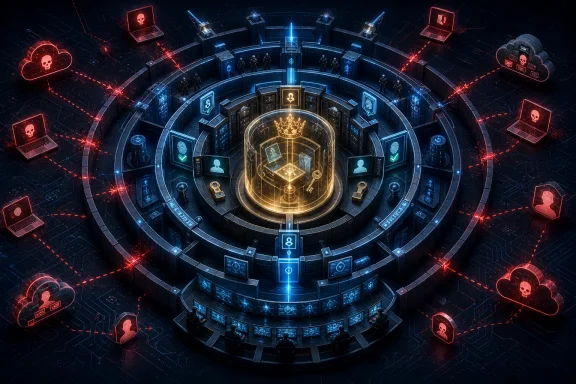
Stoyanov’s proposed direction centers on three principles: treat outer tiers as likely to be compromised, make boundaries between tiers enforce policy based on the data being moved, and protect crown jewels using enforcement that does not fail in the same way as the outer environment. Federal News Network
That model deserves careful consideration because it addresses a weakness in many modern security programs: the tendency to apply similar identity and software-mediated controls everywhere, creating common modes of failure.
Treat the outer tier as contested terrain
The outer tier includes the assets that must interact with the broadest and least predictable threat surface:
- End-user laptops and mobile devices.
- Email and collaboration platforms.
- Internet-facing services.
- Standard enterprise SaaS tools.
- Development workstations.
- General-purpose cloud environments.
- Contractor and partner access points.
These systems still need robust protection. Phishing-resistant multifactor authentication, rapid patching, device-health checks, endpoint detection and response, least privilege, application control, secure configuration baselines, and strong logging all remain necessary. CISA continues to recommend zero trust and granular enforcement as part of a broader approach to protecting data and services. CISA’s StopRansomware Guide
However, the outer tier should be designed as a place where security controls can delay, expose, and contain an adversary—not as the only place where an adversary must be stopped. That means keeping highly sensitive data out of ordinary productivity systems wherever possible and sharply limiting the authority that standard user endpoints can exercise.
Make transfer boundaries enforceable and observable
The boundary between a lower-trust and higher-trust environment is where architecture can create leverage. Rather than allowing broad, transparent connectivity between tiers, agencies should require clearly defined transfer paths with narrowly scoped permissions.
A well-designed enforcement point should do more than examine a user’s identity. It should evaluate:
- What data is moving?
- Where did it originate?
- What classification, handling, or sensitivity labels apply?
- What format and content does it contain?
- Is the destination authorized to receive it?
- Is the transfer consistent with an approved workflow?
- Is the action fully logged and reviewable?
This is especially important for cross-domain and cross-enclave movement. A trusted identity alone cannot answer whether a file contains restricted data, hidden content, malicious code, embedded credentials, or information that should not enter a higher-trust environment.
The architecture should also make bypass difficult. If users can move data around an official inspection point through unmanaged storage, unmonitored APIs, ad hoc file-sharing services, or privileged remote access, the boundary is more policy aspiration than technical control.
Build different protections around the crown jewels
The final principle is the most important: crown-jewel systems should not depend solely on the same credentials, endpoint posture signals, cloud tenancy, or administrative tooling used across the outer enterprise.
This is a case for architectural diversity. If a compromised workforce identity can unlock a sensitive application, the attacker has defeated one class of control. If access to a crown-jewel environment requires a separate hardware-backed credential, dedicated privileged workstation, isolated management plane, independent policy decision point, controlled data-transfer mechanism, and explicit mission workflow, the attacker must defeat multiple different defenses.
That does not make a high-value enclave invulnerable. Nothing does. But it changes the attacker’s task from exploiting one successful foothold into breaking through several monitored, deliberately distinct barriers.
Anthropic’s own engineering discussion of AI agent security uses similar logic when it distinguishes between supervising what an agent does and limiting what it is able to do through containment, including sandboxes, virtual machines, and egress controls. Anthropic’s containment engineering report The principle applies equally well to human-operated or AI-assisted intruders: reduce the blast radius of inevitable mistakes and successful compromises.
What Federal IT Leaders Should Change Now
A response to AI-powered attacks cannot be a single procurement. It is an architecture, governance, and operations program. Agencies that are still early in modernization should avoid treating the task as a checklist exercise aimed only at satisfying zero trust milestones.
Start with consequence mapping, not product selection
Inventorying assets is useful, but it is not sufficient. Leaders need a map of how sensitive outcomes could occur:
- Which systems can access crown-jewel data?
- Which identities can administer those systems?
- Which endpoints can use those identities?
- Which APIs, network paths, and integrations can carry sensitive data?
- Which shared services create hidden dependencies?
- Which controls would fail together if a central identity, cloud, or management platform were compromised?
This exercise exposes common-mode failure risk. It also reveals whether segmentation is genuine or merely an arrangement of virtual networks governed by the same administrative plane.
Separate user productivity from privileged administration
Administrative workflows should not happen casually from the same laptop used for browsing, email, conferencing, and document editing. Privileged roles should use dedicated devices, hardened access paths, time-limited credentials, and tightly controlled management interfaces.
This is not an argument for making administrators less productive. It is an argument for matching security friction to consequence. A user resetting a password and an engineer changing a production security policy should not have the same assurance requirements.
Treat data controls as first-class controls
Identity answers who or what is requesting access. It does not independently determine whether a data transfer is appropriate. Agencies should invest in reliable data classification, labeling, content inspection, encryption, policy enforcement, and logging across sensitive workflows.
CISA’s maturity model explicitly treats data as a zero trust pillar, including data inventory, categorization, encryption, key management, and availability. CISA’s Zero Trust Maturity Model This is not secondary work. In an AI-assisted threat environment, it is central to containing the consequences of an outer-tier breach.
Rehearse the “identity is compromised” scenario
Too many incident-response exercises assume the organization will recognize an intrusion quickly enough to stop it. Instead, agencies should run tabletop and technical exercises based on tougher assumptions:
- A user identity has been compromised.
- A privileged session token has been stolen.
- A managed endpoint is under adversary control.
- The attacker has valid credentials and knows internal workflows.
- Detection is delayed.
- The attacker is using AI to enumerate options and adapt to obstacles.
Then ask whether crown-jewel systems remain protected. If the answer depends on detecting the adversary in minutes, the architecture may not be strong enough.
Zero Trust Still Matters—But It Must Be Part of a Layered Design
The most useful reading of the Mythos warning is not “zero trust failed.” It is that zero trust needs to be implemented as one layer in a deliberately resilient security architecture.
NIST’s work is clear that zero trust is designed to protect resources, minimize uncertainty in access decisions, and limit lateral movement. NIST’s zero trust overview Its more recent implementation guidance shows that there are multiple practical ways to build a zero trust architecture across on-premises, cloud, hybrid-work, and partner-access environments. NIST SP 1800-35
That flexibility is a strength. It means federal agencies do not need to wait for one perfect blueprint. But it is also a risk if “zero trust” becomes a label attached to familiar identity and network products without confronting deeper questions about isolation, administrative concentration, data movement, and recovery.
AI-powered cyber capabilities make those questions more urgent because attackers will have more opportunities to turn small gaps into operational access. Defensive teams should expect adversaries to become faster at discovery, more persistent in testing, and better able to adapt after a failed attempt. The proper answer is not panic, nor an endless race to add detection rules. It is to ensure that compromise of an ordinary part of the enterprise does not automatically become compromise of the mission.
The security posture that holds up best in the Mythos era will be one that assumes breach, limits reach, inspects sensitive transitions, separates high-value systems from common failure paths, and preserves independent barriers around the assets that cannot be lost. Zero trust remains foundational to that strategy. It simply cannot be the last line of defense.
