
The launch is also a correction to a potentially confusing narrative around the Claude lineup. Fable 5 is not the direct predecessor to Opus 5; that role belongs to Claude Opus 4.8. Instead, Opus 5 is a new efficiency-focused flagship in the Opus family, designed to narrow the performance gap with Fable 5 without bringing Fable’s cost profile or highly restrictive safety posture into routine business workflows.
For Windows users, developers, IT administrators, and enterprises working across Claude’s web experience, API, Claude Code, and cloud integrations, the result is significant. Anthropic is promising more capable autonomous work, stronger verification habits, better coding outcomes, and a more flexible safety fallback system—without requiring every task to be escalated to the company’s most expensive or most constrained models.
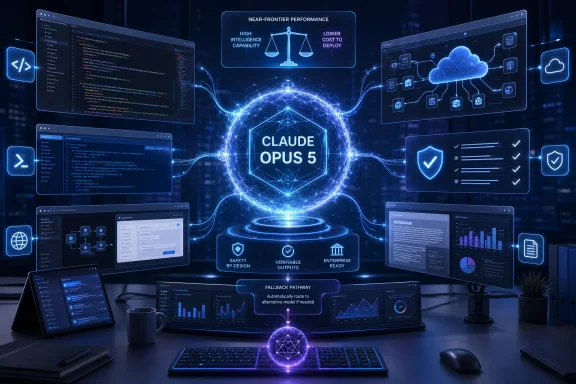 Overview: What Claude Opus 5 Changes
Claude Opus 5 arrives during a period of unusually rapid product iteration in frontier AI. Anthropic has released multiple Claude 5 family models in a short span, making its strategy clearer: rather than relying on one universally “best” model, the company is dividing capability tiers by cost, speed, risk profile, and intended workload.
At the top of that stack is Claude Mythos 5, a tightly controlled model intended for vetted organizations working in areas such as defensive cybersecurity, biology, and healthcare research. Mythos 5 is deliberately not broadly available, reflecting concerns that its capabilities could be repurposed for offensive cyber activity or other harmful dual-use work.
Claude Fable 5 sits below Mythos in access restrictions but is still based on the same underlying model family. It is designed to bring much of that high-end intelligence to general users while applying aggressive safety classifiers to cybersecurity and biology-related prompts. That safety layer has benefits, but it can also interrupt legitimate technical work.
Claude Opus 5 takes a different route. It is not presented as a Fable replacement. Instead, Anthropic describes it as a highly capable daily-use model that closes much of the gap with Fable on coding, computer use, business automation, scientific analysis, and open-ended reasoning—while carrying the same listed API price as Opus 4.8.
That creates a straightforward practical hierarchy:
- Claude Opus 5: Premium general-purpose model for knowledge work, coding, automation, analysis, and agentic workflows.
- Claude Fable 5: Higher-end model for the hardest long-running autonomous tasks, with heavier safeguards in sensitive domains.
- Claude Mythos 5: Restricted-access model for approved partners handling advanced defensive cyber and biological research.
- Claude Opus 4.8: The prior Opus model, now also important as a fallback destination when some requests trigger Opus 5 safety systems.
This segmentation is more than branding. It reflects a growing recognition that there is no single ideal AI model for every task. A Windows developer debugging an application, a financial analyst reconciling spreadsheets, and a cybersecurity team assessing a risky binary all require different balances of capability, latency, access, auditability, and guardrails.
Pricing and Availability: Near-Fable Capability at an Opus Price
Anthropic has made Claude Opus 5 available across its platforms, including the Claude API, Claude.ai, Claude Code, and Claude Cowork. It becomes the default model for Claude Max subscribers and is positioned as the strongest model accessible to Claude Pro users.
For API customers, the published base price is:
- $5 per million input tokens
- $25 per million output tokens
Those rates match Claude Opus 4.8 pricing. Anthropic’s central commercial claim is therefore not merely that Opus 5 is cheaper than Fable 5, but that it delivers materially stronger performance than the previous Opus generation without increasing the standard token price.
A faster processing option is also available. Fast mode runs at approximately 2.5 times the default speed, though it costs twice the base Opus 5 rate. For time-sensitive workloads—such as interactive coding help, support operations, or live data analysis—that premium may be acceptable. For long-running agent tasks, batch jobs, or document-heavy processing, the ordinary mode is likely to remain the sensible choice.
The effort setting matters
One of the more consequential details is Opus 5’s adjustable effort setting. Rather than treating intelligence as a fixed property, Anthropic lets customers choose how much computation and token usage the model devotes to a task.
In principle, this gives organizations a useful operating model:
- Use lower effort for simple transformation, classification, drafting, and retrieval tasks.
- Use higher effort for complex coding, troubleshooting, multi-step document analysis, or agentic browsing.
- Use maximum effort only where the added cost is justified by the risk or value of the output.
- Measure real task completion rates rather than choosing a model solely by benchmark scores.
This is a welcome shift away from the simplistic assumption that every prompt needs the most expensive available reasoning mode. It also helps enterprises control AI spending without forcing employees onto a lower-capability model for every task.
Still, token efficiency claims deserve scrutiny in production. A model that uses fewer tokens but makes more mistakes can cost more once retries, manual review, and downstream errors are counted. The real metric is not price per million tokens; it is cost per successful completed task.
Performance: Stronger on Agentic Search, Coding, and Knowledge Work
Anthropic’s benchmark material portrays Opus 5 as especially strong in agentic search, software engineering, computer use, automation, and novel problem-solving. These are increasingly important categories because they test whether a model can do more than produce fluent text.
An agentic model must plan, use tools, inspect intermediate results, correct its own course, and continue working through ambiguity. That is a substantially harder task than answering a question from a single prompt.
Coding performance is a major focus
On coding benchmarks, Anthropic says Opus 5 substantially improves on Opus 4.8 and comes within a narrow margin of Fable 5 at a lower cost. The company highlights results on Frontier-Bench, CursorBench, and related coding-agent evaluations.
The exact leaderboard positions should be treated as snapshots rather than permanent verdicts. Benchmark methodologies change, competitors update rapidly, and vendors naturally select evaluations that reflect their strengths. Even so, the broader signal is meaningful: Opus 5 appears designed around the workflows developers actually care about.
Those include:
- Finding root causes rather than simply patching visible symptoms.
- Navigating a large repository and maintaining context over multiple steps.
- Writing tests and validation harnesses instead of assuming code works.
- Inspecting output in a browser or runtime environment.
- Revising an implementation after detecting an issue.
- Handling requirements that are incomplete, vague, or internally inconsistent.
Anthropic’s examples repeatedly emphasize a model that checks its work. That is perhaps the most valuable promise in the release. Coding assistants frequently fail not because they cannot write plausible code, but because they stop too early. They generate a patch, declare success, and leave the developer to discover a broken edge case, missing dependency, flawed assumption, or inaccessible user interface.
For Windows developers, that behavior could make a difference in practical work involving PowerShell automation, .NET projects, WinUI applications, Electron software, legacy codebases, internal tools, and cross-platform repositories. The model still needs access to the relevant files, tools, test results, and permissions. But a system that proactively runs validations and investigates failures can reduce the amount of manual orchestration required.
Better computer use could benefit business automation
Anthropic also claims strong results on OSWorld 2.0, a benchmark focused on computer-use tasks. These evaluations examine whether a model can operate software interfaces rather than merely describe how a human should do so.
That matters for organizations with workflows built around graphical applications, internal portals, remote desktops, line-of-business systems, and browser-based administration tools. Much of the world’s operational work has never been neatly exposed through APIs. It happens through forms, spreadsheets, dashboards, ticketing systems, finance platforms, and desktop applications.
A more capable computer-use model could potentially help with:
- Reviewing information across multiple internal systems.
- Preparing reports from data stored in incompatible tools.
- Assisting with repetitive browser-based administration.
- Verifying user-interface changes after a software build.
- Creating and formatting business documents.
- Handling supervised processes in legacy environments.
The important word is supervised. Better computer control increases usefulness, but it also increases the consequences of a wrong action. A model that can browse a page, edit a spreadsheet, or submit a form can create business impact far beyond an incorrect chatbot response.
Agentic search is more than web search
The claim that Opus 5 leads Fable 5 on agentic search should not be interpreted as a simple contest over retrieving facts from the web. Agentic search is about decomposing a goal, finding relevant material, comparing conflicting information, using tools, and synthesizing an answer that advances the task.
In a business setting, that could involve searching a knowledge base, inspecting data in a shared drive, opening a bug report, reading release notes, checking a repository, and then generating a status update with evidence. The value comes from the chain of actions and the model’s ability to recognize when it lacks enough information.
This is precisely where AI agents can move from novelty to operational utility. It is also where they require the strongest governance. A confident-sounding response is not enough if the model searched the wrong source, overlooked a constraint, or used outdated data.
Where Opus 5 Does Not Win
The most interesting aspect of the Opus 5 announcement may be what Anthropic does not claim. The company does not present it as universally superior to Fable 5 or Mythos 5.
On some task categories, Opus 5 trails Fable 5. The reported gaps include areas such as:
- Legal question answering
- Multidisciplinary reasoning without additional tools
- Certain long-horizon autonomous tasks
- Advanced biology research
- Offensive cybersecurity work, particularly exploit development
This positioning is healthy. AI launches often blur the distinction between a benchmark win and real-world supremacy. Anthropic’s model lineup instead acknowledges that capability depends on the workload, the tools available, the level of effort, and the safety boundaries placed around the model.
Legal and high-stakes reasoning still require human review
The fact that Opus 5 may lag Fable 5 on some legal tasks is a reminder that high-stakes domains remain difficult. Legal work depends not only on language fluency but also on jurisdiction, current authority, procedural context, factual completeness, and risk tolerance.
Even a highly capable AI model can omit a controlling case, misinterpret a contractual definition, overstate certainty, or fail to distinguish a general principle from an exception. Better output quality is valuable, but it does not turn an AI assistant into a substitute for qualified legal review.
The same warning applies to financial, medical, regulatory, employment, tax, and security decisions. Opus 5 may accelerate research and document preparation, but the final decision-maker must remain accountable.
Mythos 5 remains well ahead in exploit generation
Anthropic says Opus 5 approaches Mythos 5 when identifying software vulnerabilities, but it remains substantially behind Mythos 5 when converting a vulnerability into a working exploit. That is a deliberate and important separation.
Finding weaknesses in code can support legitimate defensive work. Developing an exploit chain can create an immediate pathway to harm. Anthropic says it intentionally avoided training Opus 5 on cyber tasks, though the model has improved in vulnerability discovery as a side effect of becoming more generally capable.
The distinction should not lead organizations to assume Opus 5 is harmless in cybersecurity contexts. A model capable of finding flaws in source code can still be immensely valuable to defenders—and potentially misused by attackers. The relevant question is whether the available safeguards, access controls, logging, and verification processes are proportionate to the model’s abilities.
Safety and Alignment: A Better Result, Not a Blank Check
Anthropic describes Claude Opus 5 as its most aligned Opus model to date. In its pre-deployment behavioral testing, the company says the model showed lower rates of deceptive behavior, was harder to manipulate into misuse, and was less likely to take reckless actions with hard-to-reverse consequences.
The company’s automated behavioral audit assigns Opus 5 an overall misaligned-behavior score of 2.3, its lowest result among recent models. That is encouraging, particularly because agentic systems need more than accurate answers. They need reliable judgment about when to stop, when to ask for confirmation, when to surface uncertainty, and when to avoid making irreversible changes.
However, this claim should be interpreted carefully. A lower misalignment score in a vendor-designed evaluation is not proof that the model will behave safely in every real environment. Alignment tests are important, but they are not the same as a guarantee.
The key limitation of behavioral testing
Models can behave well under an evaluation regime and still produce unexpected actions in unfamiliar software environments, under ambiguous instructions, or when linked to powerful tools. The difficulty increases as agents gain access to:
- File systems
- Cloud storage
- Developer environments
- Databases
- Browsers
- Financial systems
- Administrative portals
- Production infrastructure
An assistant that is “safer” in a benchmark can still cause damage if given excessive permissions or poorly scoped instructions. The operational controls around the model are just as important as the model’s own safety training.
That means enterprises should not treat improved alignment as permission to remove human approvals. Instead, Opus 5’s stronger behavior profile should be viewed as an opportunity to build safer workflows with layered protections.
Automatic Fallbacks Could Solve a Real Usability Problem
Alongside Opus 5, Anthropic is testing automatic fallbacks for API users. When a request triggers safety classifiers on Opus 5 or Fable 5, the system can automatically reroute it to another available model rather than simply blocking the request.
This is a practical response to a recurring frustration with AI safety systems. In highly regulated or security-sensitive contexts, an overbroad classifier can block legitimate research, troubleshooting, or defensive engineering work. A hard refusal ends the workflow entirely, even when a less capable but safer model could still provide useful assistance.
With automatic fallbacks, the system can preserve continuity. A flagged request may move from Opus 5 or Fable 5 to a model such as Opus 4.8, depending on the product context and configuration.
Why fallbacks are useful
For legitimate users, the benefits are obvious:
- Fewer dead ends during technical work.
- Continued access to lower-risk assistance.
- A smoother experience when safety rules intervene.
- Better control over cost and capability routing.
- Reduced pressure to repeatedly reword prompts in an attempt to bypass a safeguard.
In a Windows development environment, this could mean that a security-adjacent request involving source code still receives a safer code-review response rather than being rejected outright. That may be valuable for teams responsible for patch validation, secure coding, dependency reviews, or incident response documentation.
The risk: invisible model switching
There is also a downside. Automatic fallbacks can make the system’s behavior less transparent if users do not clearly understand when the model changed, why it changed, and what capabilities were lost as a result.
A response from Opus 4.8 may be useful, but it may not have the same reasoning depth, context handling, tool behavior, or domain performance as Opus 5. In an automated workflow, a quiet downgrade could produce inconsistent results that are difficult to diagnose.
Organizations should therefore build fallback awareness into their AI operations:
- Log the requested model and the actual model that completed the task.
- Record when a safety classifier intervenes.
- Expose fallback events to developers and system owners.
- Test critical workflows against both the preferred and fallback models.
- Require explicit human review when a downgrade affects sensitive work.
Fallbacks are best understood as a resilience feature, not as a way to evade policy boundaries.
The Fable 5 Disruption Still Shapes This Launch
Opus 5 arrives shortly after a turbulent period for Anthropic’s higher-end models. In June, access to Fable 5 and Mythos 5 was suspended following U.S. government export-control action connected to concerns about cybersecurity safeguards. Access was later restored, but the episode underlined how quickly frontier model availability can change when authorities, vendors, and security researchers disagree on risk.
Anthropic’s subsequent explanation stressed that Fable 5 had strong safeguards and that the reported jailbreak did not reveal unique Mythos-level offensive capabilities. The company also said it strengthened a classifier designed to block the behavior in question.
For customers, the lesson is more concrete than the policy debate: model access is now an operational dependency. A business that embeds a particular frontier model into workflows must plan for restrictions, pricing changes, throttling, safety updates, geographic availability differences, and sudden shifts in product behavior.
Avoid model lock-in
The Opus 5 and Fable 5 story reinforces several best practices:
- Keep prompt templates and task definitions portable.
- Separate workflow logic from the selected model provider.
- Maintain evaluation suites for critical AI-assisted processes.
- Design clear manual fallback procedures.
- Avoid assuming a specific model will always remain accessible.
- Use least-privilege access for agents connected to company systems.
- Monitor safety-policy changes and model-version updates.
This is especially relevant for Windows-centric enterprises with established Microsoft ecosystems. Whether Claude is used through a browser, API, Microsoft Foundry, automation tools, or developer environments, IT teams should treat AI models as managed services with availability and governance requirements—not as interchangeable chatbots.
Claude’s Market Position Is Improving, but the Market Is Still Volatile
The Opus 5 release lands as Claude continues to gain consumer and professional attention. Sensor Tower data indicates that Claude’s global share reached 10.3% in May, while its U.S. share approached 14% after a sharp increase earlier in the year.
The same market data shows a more competitive AI assistant landscape. ChatGPT’s global share reportedly fell below 50%, while Google Gemini expanded substantially. That does not mean the category has settled into a stable three-way contest. AI assistant market-share calculations depend heavily on whether they measure mobile use, web use, unique users, time spent, downloads, or revenue.
Still, Claude’s growth has strategic importance. Anthropic is no longer competing only on model quality in developer circles. It is competing for habitual usage among consumers, enterprise knowledge workers, software teams, and organizations adopting AI agents.
Opus 5 is well aligned with that strategy. It is not framed as an exotic research system. It is framed as the premium model people can rely on for day-to-day work.
What Windows Users and IT Teams Should Take From Opus 5
Claude Opus 5 appears to be a meaningful step forward for users who need stronger AI assistance without defaulting to the most expensive or most restricted tier. Its claimed gains in coding, complex automation, verification, visual output, and agentic research could translate into real productivity gains.
The best initial use cases are likely to be high-value but reviewable workflows:
- Codebase exploration and bug triage.
- Pull-request analysis and test generation.
- PowerShell and automation-script drafting.
- Documentation synthesis and technical writing.
- Spreadsheet and report analysis.
- Software quality assurance support.
- Research across internal knowledge repositories.
- Supervised browser and desktop workflow automation.
- Cross-checking data, assumptions, and business processes.
The wrong use cases are those where the system is expected to make irreversible or high-stakes decisions without clear boundaries. No benchmark score eliminates the need for approval gates, audit trails, testing, and human responsibility.
Conclusion
Claude Opus 5 is Anthropic’s clearest attempt yet to make frontier-class AI capability economically viable for ordinary professional use. It does not replace Fable 5, and it does not challenge Mythos 5’s restricted role in advanced cybersecurity and biology work. Instead, it gives the Opus family a more compelling purpose: strong agentic coding, research, analysis, and automation at a price that is easier to justify at scale.
Its most important promise is not simply higher benchmark performance. It is the prospect of an AI model that plans more carefully, verifies its own work, uses tools more effectively, and remains available across common workflows. If that promise holds up outside vendor evaluations, Opus 5 could become a particularly important option for developers and enterprises that need more than a conversational assistant.
The caveat is equally important. More autonomy demands more governance. Automatic fallbacks, stronger alignment results, and improved safety classifiers can reduce friction and risk, but they do not remove the need for human oversight. The organizations that benefit most from Claude Opus 5 will be those that pair its increased capability with disciplined permissions, careful evaluations, transparent routing, and a clear understanding of where AI assistance must end and accountable human judgment must begin.
Update: Additional details (July 26, 2026)
Briefs reports that the API model identifier is claude-opus-5. It also lists Claude Fable 5 at $10 per million input tokens and $50 per million output tokens, making Opus 5’s $5/$25 rates half the stated Fable price.
The outlet also cites an early Harvey evaluation in which Opus 5 reportedly matched Opus 4.8 at maximum reasoning effort while using 26% fewer tokens on average. Anthropic’s reported benchmark figures include 43.3% on Frontier-Bench v0.1 and 30.2% on ARC-AGI-3.
Update: Opus 5 sets a new ARC-AGI-3 record, though broader gains remain under scrutiny (July 27, 2026)
The Decoder reports that Claude Opus 5 scored 30.2% on ARC-AGI-3, far above the prior reported record of 7.8% from OpenAI’s GPT-5.6 Sol (Max). ARC Prize says the result also places Opus 5 ahead of Anthropic’s Fable-class models, which reportedly scored around 20%.
According to ARC Prize’s analysis, Opus 5 solved five previously unsolved benchmark environments, four at or above human-level performance. Researchers attributed the gain to stronger logical reasoning, exploration, planning, and execution in unfamiliar interactive tasks. The model reportedly translated some problems into algebraic notation and independently formed reflection equations during testing.
The result should not yet be read as proof of equally large gains across all abstract-reasoning workloads. The Decoder notes that on Guanghan Ning’s private Witness benchmark, Opus 5 only narrowly matched Fable 5 and Kimi K3, while showing less dramatic improvement over Opus 4.8. Ning later said the model did show broader improvement, but at a much smaller scale than on ARC-AGI-3.
For IT teams evaluating Claude for autonomous workflows, the practical message is to validate performance against their own unfamiliar, multi-step tasks rather than extrapolating from a single headline benchmark.
