

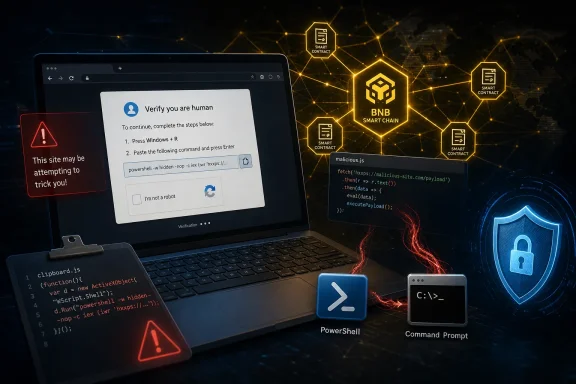
The warning, publicized by Microsoft Threat Intelligence on August 6 and reported by Incrypted on August 8, describes malicious JavaScript injected into compromised sites. That script queries a BNB Smart Chain remote procedure call endpoint, retrieves additional attacker-controlled instructions from a smart contract, and presents the visitor with a fabricated verification screen. The lure then guides the victim through pressing Windows+R, pasting a preloaded command, and executing it.
Microsoft says the activity is associated with ClickFix and TerminalFix techniques and overlaps with EtherHiding, a method previously linked to the ClearFake malware operation. Its assessment that such campaigns can reach thousands of corporate and consumer devices daily is significant, but the public warning does not identify the affected sites, contract addresses, domains, payload hashes, dates of observed activity, or the final malware delivered in this particular cluster. That leaves defenders with a behavior-focused threat notice rather than a complete blocklist-ready advisory.
The blockchain detail is real, but the technique is not new
The headline suggests a new attack scheme, but the underlying technique has been public for nearly three years. Guardio Labs documented ClearFake attackers placing malicious JavaScript and next-stage delivery locations into Binance Smart Chain contracts in October 2023, coining the term EtherHiding for the approach.
What has changed is the frequency and maturity of its use alongside ClickFix lures. Expel reported in January 2026 that ClearFake was using fake CAPTCHAs across hundreds of compromised websites, storing Base64-encoded JavaScript in smart contracts and steering victims toward PowerShell execution through trusted Windows components. Trend Micro then published a May 2026 investigation into ClearFake activity on the BNB Smart Chain test network, where contract-backed routing helped operators change delivery infrastructure without revisiting each hacked website.
Microsoft’s warning therefore should be read as confirmation that the pattern remains active and operationally useful to attackers, not as the discovery of blockchain-hosted malware delivery itself. The most important development for Windows administrators is that the technique has outlived earlier reporting and continues to be combined with a social-engineering mechanism that sidesteps many of the protections users expect from browsers and antivirus products.
The BNB Smart Chain component is not malware by itself. It is a public blockchain network whose smart contracts can store and return data. Attackers abuse that legitimate capability as a dead-drop resolver: instead of embedding a fixed command-and-control domain in a compromised page, they make the page ask a contract where to fetch the next stage.
That complicates takedowns. A registrar can suspend a malicious domain, a hosting company can remove a server, and a security vendor can block a known URL. None of those actions deletes a deployed smart contract from a public blockchain. The attacker can also update data held by a contract when its code permits the deploying wallet to do so, allowing the campaign to replace an exposed downstream domain while retaining the same on-chain lookup point.
There is an important technical correction to the popular description of this risk: blockchain immutability does not mean every stored value can never change. The contract code is generally permanent after deployment, but a contract may include an owner-restricted function that changes its stored data. That is precisely what makes these attacker-created contracts useful. The code remains available while the operator changes the next delivery URL or JavaScript blob with a transaction.
ClickFix turns the victim into the execution mechanism
The more consequential part of the chain is the fake CAPTCHA. A traditional drive-by exploit attempts to exploit a browser or operating-system flaw so code runs without meaningful user participation. ClickFix asks the user to run the code instead, often dressed up as an anti-bot test, a browser error correction, a security verification, or an instruction to restore access to a webpage.
The page can place a command on the clipboard through browser scripting. The victim then pastes it into the Run dialog, Windows Terminal, PowerShell, or Command Prompt. At that point, Windows is behaving as designed: it runs the command the signed-in user explicitly requested. The attacker’s real breakthrough is persuading the person at the keyboard that the request is routine.
This distinction changes how organizations should respond. Blocking one BNB Smart Chain endpoint may disrupt a presently observed campaign, but it does not solve the user-execution problem. Operators can move among public RPC providers, use a different blockchain, return to conventional web hosting, or skip EtherHiding altogether. The durable controls are those that make a pasted command less capable of turning into persistence, credential theft, or a remote-access foothold.
Microsoft’s warning names a familiar collection of Windows-native utilities and mechanisms that can be abused after execution: cmd, PowerShell, conhost, mshta, rundll32, msiexec, WMI, WebDAV, scheduled tasks, and pcalua. These are often described as living off the land techniques because the attacker leans on tools already present in Windows rather than delivering an obvious unsigned executable.
That does not mean those utilities should be broadly removed or indiscriminately blocked. msiexec, PowerShell, WMI, and scheduled tasks can all be legitimate requirements in managed environments. It does mean their parent-child process relationships, command lines, and network connections matter more than a simple file reputation check. A browser spawning a shell process, or a Run-dialog-launched script immediately reaching an unfamiliar external host, deserves far more scrutiny than routine administrative automation.
Blocking BNB endpoints is a narrow control, not a cure
Expel’s January research identified BNB Smart Chain testnet RPC endpoints used in a ClearFake campaign and recommended blocking them where an organization has no legitimate Web3 requirement. That is sensible as a targeted reduction in exposure, especially in an enterprise that does not develop blockchain applications, trade digital assets, or use decentralized services.
But it is not a universal security recommendation. Public RPC infrastructure is legitimate and shared, and blanket network blocks can affect developers, finance teams, research groups, and business applications. More importantly, a block aimed at a single provider can create a false sense of completion when the malicious JavaScript can be redirected to another endpoint, another chain, or an ordinary attacker-controlled website.
Network teams should treat outbound blockchain RPC traffic from normal employee browsing devices as an investigation signal, particularly when it appears alongside visits to newly compromised or low-reputation websites. The stronger detection opportunity sits at the sequence level: browser activity, clipboard-driven user action, shell execution, script interpreter use, and outbound retrieval within a short period.
For Windows environments, the practical priority order is:
- Train users that genuine CAPTCHA services ask them to select images, tick a checkbox, or complete an in-browser challenge; they do not ask for Windows+R or a pasted terminal command.
- Turn on Microsoft Defender’s network protection, web protection, cloud-delivered protection, and tamper protection, then verify through policy reporting that endpoints actually receive those settings.
- Enable PowerShell Script Block Logging and module logging where PowerShell use is permitted, and ensure the resulting events reach a system where attackers cannot quietly erase them.
- Use application control, least privilege, and attack-surface-reduction rules to limit execution paths that ordinary users do not need, rather than relying solely on antivirus verdicts after a command has already run.
- Alert on suspicious browser-to-shell process chains, especially browsers spawning
powershell.exe,cmd.exe,mshta.exe,rundll32.exe, or script hosts with encoded or clipboard-derived arguments. - Review whether WebDAV and legacy script-related components are required in the organization, because they are repeatedly attractive to campaigns seeking trusted Windows execution paths.
The missing indicators limit immediate hunting
Microsoft’s public warning offers useful defensive guidance but does not, at least in the material released with the social-media announcement, provide the indicators needed to determine whether an organization encountered this exact campaign. There are no contract addresses, RPC endpoint names, compromised domains, script samples, hashes, or detection queries tied to the reported cluster.
That omission matters because ClearFake-style infrastructure changes quickly. Guardio’s 2023 research found attackers switching domains through contract updates; Trend Micro and Expel later described the same general advantage in newer activity. A stale domain list would be insufficient on its own, but published contract identifiers and behavioral telemetry would still help defenders hunt historical logs and distinguish this cluster from the many other ClickFix campaigns now circulating.
The broader threat is already visible in the data. Expel’s quarterly threat reporting said ClickFix-based delivery accounted for 43.7% of malware entry points it observed in the first quarter of 2026, overtaking binary-file execution as the most common delivery mechanism in its incident set. That figure should not be treated as a measurement of all global infections, but it captures the direction of travel: attackers increasingly prefer to make users approve the initial execution themselves.
For home users, the defense is primarily behavioral: close the page, do not paste the command, and run a full Microsoft Defender scan if anything was executed. For IT teams, this warning is a reason to validate that scripting controls, Defender protections, logging, and browser-to-shell detections work before the next fake CAPTCHA lands on a legitimate website that an employee already trusts.