
But this is not an August 4 launch. Embedded Computing Design republished the announcement on August 4, while congatec’s own release is dated July 23 and eeNews Europe reported the module the following day. That does not change the hardware, but it does matter for procurement teams tracking availability: this is now an announced product family with a published datasheet and request-for-quote page, not a same-day product introduction with a disclosed shipping schedule.
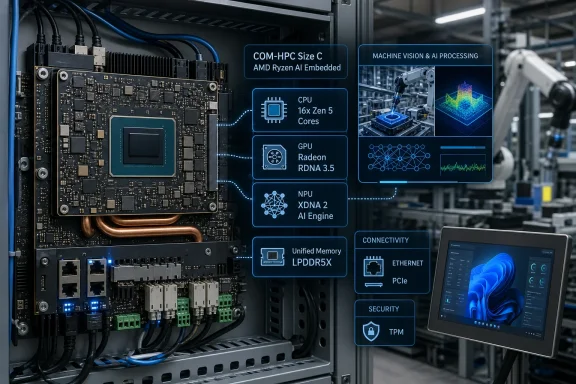 A Ryzen AI Max-class design made into a COM-HPC module
The conga-HPC/cRX1 is based on AMD’s Ryzen AI Embedded X100 series, with three commercial and three industrial-temperature processor choices. At the top sits the Ryzen AI Embedded X199 or X199i: 16 cores, 32 threads, a 5.1 GHz maximum frequency, 64 MB of L3 cache, and 40 Radeon graphics compute units. The X188/X188i reduces the configuration to 12 cores and 32 compute units, while the X168/X168i supplies eight CPU cores with 32 compute units.
AMD’s product record for the X199 confirms the underlying silicon’s 55 W nominal TDP, 45 W to 120 W configurable range, 40 graphics compute units, four-display capability, LPDDR5X-8533 support, and 50-TOPS NPU rating. It also identifies the processor as a BGA SoC with a last-time-buy date of 2037. That long availability window is one of the reasons the part belongs in machines such as robots, medical imaging appliances, industrial controllers, and vehicle systems rather than in ordinary desktop PCs.
congatec is packaging that silicon in the 120 mm × 160 mm COM-HPC Client Size C format. A computer-on-module supplies the CPU, memory, firmware, and core I/O design; the OEM still has to provide a carrier board, enclosure, power design, external connectors, and thermal solution. The module may shrink a system’s integration work compared with designing a full custom motherboard, but it does not turn a 120 W embedded platform into a plug-in PC.
That point is easily lost in claims about replacing accelerator cards. The X199’s combined CPU, GPU, and NPU resources can plausibly consolidate workloads that previously used separate low-end or midrange accelerators, particularly where an application needs inference, graphical display output, and conventional x86 code in the same memory domain. It will not make a separate accelerator unnecessary for every deployment. Model size, inference framework, precision, latency requirements, sustained thermal capacity, and the number of attached cameras or sensors still decide whether an integrated GPU and 50-TOPS NPU are enough.
The 50-TOPS figure is only one part of the compute budget
congatec quotes up to 50 TOPS from the dedicated NPU, up to 59 TOPS of dense INT8 inference performance from the GPU, and up to 29.7 TFLOPS of FP32 GPU compute. Those are distinct measurements for different engines and data types; they should not be casually added together into a single “109 TOPS” product rating.
The NPU is aimed at efficient, continuous inference tasks such as object recognition, speech processing, and image analysis. The integrated RDNA 3.5 GPU is the broader parallel-compute engine for perception processing, graphics, and workloads that do not fit the NPU’s supported operator and model constraints. The Zen 5 cores remain important for deterministic control logic, sensor handling, data preparation, planning, and application code that is neither GPU nor NPU friendly.
AMD’s X100 material emphasizes unified LPDDR5X-8533 memory and shared access across compute engines. In an embedded vision pipeline, avoiding copies between a separate CPU memory pool and a discrete GPU’s VRAM can reduce integration complexity and latency. Yet unified memory is also soldered down on this module, so capacity must be decided at purchase time. The listed configurations run from 32 GB on the X168 variants to 128 GB on X199 models; there are no field-upgradeable DIMM slots to rescue an undersized deployment later.
Windows users should also separate hardware capability from deployment readiness. congatec lists Windows 11 and Windows 11 IoT Enterprise among supported operating systems, along with Linux. The company’s announcement says its preconfigured aReady.COM offerings are ctrlX OS, Ubuntu Pro, or KontronOS—not a pre-imaged Windows option. In other words, Windows support is available for the module, but the Windows image, licensing arrangement, device drivers, lockdown policy, update channel, and recovery process remain OEM work.
PCIe expansion claims require a closer read
The headline I/O number is “up to 24 PCIe Gen4 lanes,” a useful figure for a system that must accommodate industrial Ethernet, fieldbus, storage, wireless radios, frame grabbers, or other low-lane peripherals. However, AMD’s own specification for the Ryzen AI Embedded X199 lists 16 PCIe Gen4 lanes at the processor level.
The records are not necessarily contradictory. congatec’s product page explicitly labels “up to 24x PCIe Gen4” as an assembly option and separately identifies an optional onboard PCIe switch. A switch can fan a smaller number of host-connected PCIe lanes out to more downstream connections, allowing more devices to be attached. It does not manufacture additional upstream bandwidth back to the processor.
For a real design, that distinction is consequential. A carrier-board designer can use the switched configuration to connect many modest-bandwidth devices, which aligns with congatec’s examples of industrial Ethernet, fieldbus, and wireless modules. It is a less attractive solution if several devices must each sustain high simultaneous throughput, such as multiple high-resolution capture cards, NVMe drives, and a discrete accelerator. The PCIe topology, lane allocations, switch model, and contention behavior belong in the design review before an OEM treats “24 lanes” as 24 independent processor lanes.
The rest of the module’s I/O is substantial for a COM: dual 2.5 GbE through Intel i226-series controllers, up to four USB 3.2 Gen 2 ports, up to eight USB 2.0 ports, two SATA 6 Gb/s interfaces as an assembly option, GPIO, I²C, UART, SMBus, SPI, and support for four independent displays. It also includes TPM 2.0 and a congatec board controller for watchdog, health monitoring, board statistics, and power-loss control functions.
Storage specifications have already changed
The published storage capacity deserves caution because congatec’s own materials do not presently match. The July 23 press release and the Embedded Computing Design report describe optional onboard NVMe storage of up to 512 GB. The current congatec product page instead lists an optional 128 GB NVMe SSD with capacity “up to 1 TB.”
The product page also warns that its documents can be updated without notification, which explains how an early specification can move. Still, the current discrepancy means a buyer should treat 1 TB as a configuration claim to confirm in a quote rather than assuming every processor-and-memory variant supports it. It also reinforces a basic COM procurement rule: a press release is a starting point, while an orderable part number, current data sheet, and written configuration quote are the record that matters.
There are small catalog oddities too. congatec’s online part-number list assigns the same visible numbers to both the commercial and industrial X188 and X168 entries, despite those variants carrying different temperature designations. That may be a website listing error rather than a hardware ambiguity, but it is another reason not to use the public catalog alone for a purchase order.
Industrial temperature and 120 W operation are different design problems
The commercial variants are specified for 0°C to +60°C operation. The “i” versions extend the module operating range to -40°C through +85°C, which is the relevant choice for outdoor, vehicle, and harsh-factory installations. AMD’s X199 silicon specification gives a 0°C to 105°C junction-temperature range; the module’s environmental rating is a separate system-level promise shaped by board layout, components, and cooling.
The module’s 45 W to 120 W TDP range similarly gives integrators flexibility rather than a free performance setting. At the upper end, congatec itself offers a 40 mm active cooler with heat pipes and a 12 V fan, as well as a 13 mm heat spreader for designs that will supply their own chassis or conduction cooling. A sealed cabinet, fanless vehicle enclosure, or a hot industrial bay has to be engineered around the selected TDP and ambient rating. Choosing the 120 W ceiling without a matching thermal path is a reliable way to exchange benchmark performance for clock throttling.
congatec says the module was developed in accordance with IEC 62443-4-1 and includes TPM 2.0, positioning it for equipment makers preparing for the European Union’s Cyber Resilience Act. That is useful design-process and hardware-root-of-trust groundwork, but it is not a declaration that an end product is automatically compliant. The OEM remains responsible for secure boot configuration, credential management, vulnerability handling, software bills of materials, patch delivery, and the security of its carrier-board peripherals.
For Windows industrial OEMs, the conga-HPC/cRX1’s value is the chance to keep a high-performance x86 application, a rich local interface, and substantial edge inference on a single modular platform. The immediate constraint is more mundane: congatec has published no price, production availability date, Windows image option, or definitive configuration matrix. Until those appear in a quote and current datasheet, the sensible next step is to validate the selected CPU, memory capacity, PCIe-switch topology, thermal envelope, and storage option against the actual machine—not the launch headline.
