
That distinction matters. A paid Windows license and a subscription for premium Windows experiences can produce very different customer reactions, even if the latter eventually feels like a subscription model in practice. The concern raised by the growing number of AI feature changes is therefore legitimate—but the immediate risk is not necessarily a mandatory “Windows 11 monthly bill.” It is the gradual normalization of a free-or-included base OS paired with an expanding catalog of paid AI functionality.
 The immediate trigger: Deep Research becomes Researcher
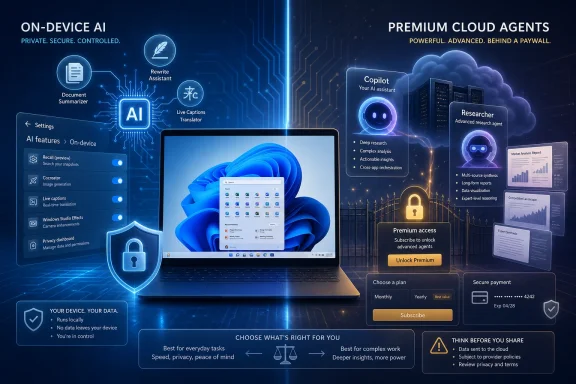
Microsoft has confirmed that Deep Research in the consumer Copilot app will be retired on August 18, 2026. Existing saved reports will remain accessible, but the successor experience—Researcher—is positioned as the route forward for Microsoft 365 Premium subscribers. Microsoft’s support documentation explicitly says that Premium subscribers can continue creating detailed reports and analyses through Researcher after Deep Research is removed.
The distinction is not merely cosmetic. Microsoft describes Researcher as a deeper, multistep agent that can gather and analyze web sources as well as, in workplace contexts, files, email, meetings, and chats to produce structured, source-cited reports. It is currently available to Microsoft 365 Premium customers and to business or enterprise customers with a Microsoft 365 Copilot add-on license.
For users who enjoyed Deep Research as part of the broader Copilot offering, that transition understandably reads as a feature moving from accessible to premium. It is also a clear example of a wider commercial principle: sophisticated AI work costs more to operate than conventional desktop features.
A document editor can run largely on a PC. An AI agent that reasons through a complicated prompt, searches sources, synthesizes documents, cites its findings, and potentially uses high-capacity third-party models is a recurring cloud workload. Microsoft has a strong incentive to meter, tier, or bundle that workload rather than treat it as a permanently unlimited giveaway.
That is not unique to Microsoft. But Windows users have particular reason to notice it because Microsoft is increasingly framing Copilot and agents as part of the Windows experience, not merely as separate web services.
A pattern is emerging—but it is a Copilot pattern first
Deep Research is not the only recent example fueling concerns. Reporting from Windows Central notes a cluster of changes in which AI-related capabilities have been retired, restricted, replaced, or placed behind business and Copilot licensing requirements.
One such change involves Outlook. Microsoft is retiring Meeting Insights by early September 2026 and replacing it with the more capable “Prepare for this meeting” experience, according to reporting on the relevant Microsoft 365 Message Center notice. The replacement summarizes related tasks, documents, and other material, but it requires a paid Microsoft 365 Copilot license. Windows Central’s coverage notes that the older Meeting Insights feature did not require that license.
This is an important nuance for the Windows subscription debate. Outlook, Microsoft 365, and Copilot are all part of Microsoft’s broader personal-computing strategy, but they are not Windows licensing in the traditional sense. Microsoft is monetizing value-added AI assistance around productivity, not charging people to boot their PCs or receive core Windows updates.
Still, customers experience these boundaries less cleanly than product planners do. If Windows 11 advertises Copilot heavily, launches agents from Start or Search, and promotes AI features as part of the “AI PC” value proposition, a consumer who repeatedly finds those tools gated by a subscription may reasonably conclude that Windows itself is becoming more expensive to use fully.
That perception may become as commercially important as the technical separation between Windows and Microsoft 365.
The paid tiers already show the intended model
Microsoft’s own consumer pricing page provides a useful snapshot of that segmentation. Microsoft 365 Premium is listed at $199.99 per year in the United States and advertises AI agents for complex work such as source-cited research reports and data analysis with visualizations. The same page describes different usage levels for Copilot features, with the highest allocation and select exclusive AI access placed at the Premium tier.
That pricing structure does not establish a Windows subscription. What it does establish is that Microsoft has already built a consumer AI subscription ladder:
- A free Copilot baseline with limited access and usage.
- Microsoft 365 Personal and Family subscriptions with broader productivity and AI benefits.
- Microsoft 365 Premium, aimed at customers who want higher AI limits, premium models, advanced agents, and more substantial automation.
In other words, the commercial machinery for a recurring AI upsell is already in place. The unresolved question is how closely those tiers will be tied to the future Windows 11 experience.
Windows is becoming an agent platform
The concern becomes more credible when viewed alongside Microsoft’s technical direction for Windows. Windows 11 is not just receiving isolated Copilot buttons and generative tools. Microsoft is laying groundwork for an operating system in which agents can be discovered, invoked, granted permissions, and assigned tasks across apps.
Microsoft’s Agent Launchers on Windows overview describes a standardized mechanism for apps to register AI agents so that users can find them through supporting Windows experiences, including the Start menu, Search, and applications. These agents are defined as interactive, contextual, task-oriented assistants capable of taking actions on a user’s behalf.
That architecture is significant for two reasons.
First, it makes agents more visible and more central to the desktop experience. Rather than navigating to one specific Copilot page, users may encounter a catalog of specialized helpers surfaced through the operating system. A research agent, a travel agent, a troubleshooting agent, a document agent, or a third-party creative agent can become discoverable through a common Windows mechanism.
Second, Microsoft’s documentation explicitly says agents can be registered dynamically based on authentication, subscriptions, or other conditions. That does not mean Microsoft has announced a plan to sell individual Windows agents. It does mean the platform is technically capable of distinguishing between agents or features a user can access based on entitlement.
That is the foundation for the “modular Windows” concern. If an operating system becomes a storefront and control plane for agents, the practical difference between a paid app, a paid feature pack, a Microsoft 365 subscription benefit, and a Windows add-on can blur quickly.
The Settings agent is a useful counterexample
At the same time, it is important not to overstate the immediate threat. Microsoft’s existing Agent in Settings demonstrates that not every AI-assisted capability is being designed as a cloud subscription service.
According to Microsoft Learn documentation, the Settings agent in Windows 11 version 24H2 uses an on-device model called Settings Mu to help users find and change system settings using natural-language requests. It can make recommendations, offer help with troubleshooting, and—after user permission—assist with changing relevant settings.
Crucially, the model runs locally on the device. If it cannot confidently map a request to a setting, Windows falls back to ordinary search results. Microsoft also says users must explicitly request changes and can undo them.
This is a more reassuring model for Windows users. It suggests that practical, narrowly scoped, local AI can enhance the operating system without an unavoidable per-query cloud cost. A request such as “make my laptop battery last longer” does not inherently need a premium online agent. On-device intelligence is arguably the correct implementation for it.
However, the availability criteria reveal another kind of gating. The Settings agent currently requires a Copilot+ PC, Windows 11 version 24H2 with the appropriate update, and a temporary enterprise feature-control policy setting. Microsoft’s documentation lists those requirements directly.
So the near-term dividing line may not always be a subscription. Sometimes it will be hardware capability, particularly the neural processing unit requirements associated with Copilot+ PCs. For consumers, that can still resemble a premium tier—only one paid through a new device rather than a monthly invoice.
Why agents are unusually easy to monetize
Traditional Windows features are difficult to sell separately because customers see file management, windowing, networking, Settings, accessibility, and basic troubleshooting as inherent parts of an operating system. Charging a monthly fee for them would provoke a powerful backlash.
AI agents change the calculation because they can be portrayed as optional labor-saving services.
A capable agent can:
- Research a topic across websites and internal files.
- Prepare a meeting brief based on email, documents, chats, and calendar data.
- Organize local folders or identify duplicate content.
- Generate, edit, and transform images, audio, documents, and presentations.
- Carry out multistep workflows across apps and web services.
- Act as an intermediary between a user’s intent and a complex interface.
Those capabilities are easier to package as premium convenience than basic system functionality. The customer can still run Windows without them, but may increasingly feel less productive without them.
This is why the subscription concern should be framed as functional dependence, not simply licensing. If the base OS is free to use but the most useful automation, analysis, and assistance features require recurring payments, the resulting experience may still feel like Windows has become subscription-led.
The strategy has an obvious financial logic. Microsoft can distribute a Windows feature once, but cloud agents create continuous costs and can generate continuous revenue. The better the agent is at handling valuable tasks, the more plausible a recurring price becomes.
That does not automatically make the model unreasonable. Services that rely on large-scale models, web retrieval, computation, file processing, and enterprise-grade governance genuinely require ongoing infrastructure. The problem appears when the company begins calling essential capabilities “premium AI” simply because it can charge for them.
Security is the biggest barrier to agent adoption
Price is only part of the issue. For agents to become a successful Windows 11 upsell, they must be trustworthy enough to take meaningful action on a user’s device.
Microsoft’s own Windows agentic security guidance makes clear that this is not a trivial problem. The company warns that agentic systems can produce incorrect or unexpected outputs and identifies cross-prompt injection as a risk: malicious instructions embedded in documents or user-interface elements could manipulate an agent into performing unintended actions, including data exfiltration or malware installation.
That warning should temper the assumption that agentic Windows is ready to become an everyday, broadly monetized utility. A chatbot that drafts text is one thing. An agent that can click, type, navigate files, interact with applications, or carry out online transactions is another.
Microsoft’s proposed safeguards include:
- Separate agent accounts distinct from the human user’s account.
- Limited privileges that only expand when the user grants access.
- Trusted signing and revocation mechanisms for agent software.
- Contained agent workspaces designed to isolate agent activity.
- Explicit user control, including experimental features disabled by default.
Microsoft says Copilot Actions is disabled by default in its current experimental form and requires users to enable experimental agentic features. The company also describes agent workspaces and dedicated agent accounts intended to separate automated tasks from the signed-in user’s normal desktop activity.
Those protections are encouraging, but they are not a finished answer. Isolation, permissions, and confirmation prompts can reduce risk; they cannot guarantee that every agent will correctly interpret a request, handle sensitive context appropriately, or resist cleverly crafted malicious content. A paid agent that damages files, exposes data, or performs an unwanted action would not feel premium—it would feel like a liability.
For Microsoft, then, the challenge is not merely to make paid AI agents attractive. It is to make them predictable, controllable, auditable, and safe enough that mainstream users will permit them to operate.
Cloud PCs point to a different subscription future
The long-term subscription argument also often invokes cloud PCs: a future in which Windows is streamed rather than installed locally. That future is technically plausible, but it remains separate from a compulsory consumer Windows subscription.
Microsoft has substantial experience selling Windows as a cloud-delivered service to organizations. Its Windows 365 for Agents documentation now describes secure, on-demand Cloud PCs for AI agents, including managed identity, device posture, governed agent sessions, provisioning, and billing.
This is evidence that Microsoft sees cloud-hosted Windows environments as a practical substrate for agentic workloads. It does not demonstrate that consumer PCs are about to be replaced by streamed desktops.
The distinction matters because cloud PCs solve different problems:
- Enterprises may need standardized virtual desktops for security, compliance, and centralized management.
- Agents may need isolated, disposable environments to work safely and avoid touching a user’s primary device.
- Consumers often value offline capability, local performance, low latency, privacy, and ownership of their hardware.
A consumer cloud PC tier could eventually emerge as an optional premium offering, particularly for users who want powerful AI workloads without buying high-end hardware. But it would be difficult to position as a universal replacement for local Windows without a major leap in consumer connectivity, reliability, cost, and trust.
The more likely medium-term outcome is coexistence: conventional local Windows, cloud-enhanced Microsoft 365 services, optional AI subscriptions, and specialized cloud environments for demanding or autonomous agent tasks.
What Windows users should watch next
The strongest evidence of a shift toward a consumer Windows subscription would not be another Microsoft 365 feature changing tiers. It would be a move involving core Windows capabilities.
Several developments would deserve especially close attention:
- Core operating-system tools placed behind monthly entitlements
If file management, backup, security, accessibility, basic troubleshooting, or Windows Update quality-of-life features begin requiring a paid Windows AI plan, that would be a major departure. - Windows setup that strongly steers users into recurring AI plans
Bundled trials are normal. A setup experience that makes core functionality appear incomplete without a subscription would be more concerning. - Agent subscriptions sold directly in Windows Settings, Start, or the Microsoft Store
Microsoft’s agent architecture could support discoverable paid agents. The issue will be whether this remains a healthy app ecosystem or becomes a constant upsell mechanism. - Artificial limits on local AI features
If an on-device feature with little ongoing cloud cost is withheld from capable hardware solely to create a recurring tier, consumers would have stronger grounds to object. - Advertising expansion in the free Windows experience
A generous free tier can coexist with paid enhancements. But a base Windows edition loaded with promotions for AI plans would make the subscription strategy feel much more intrusive. - Clear separation between optional and essential
Microsoft needs to state, consistently, that users can operate a secure, supported, capable Windows PC without subscribing to AI services. Ambiguity will fuel distrust.
The verdict: Windows is becoming subscription-adjacent, not subscription-only
The fear that Windows 11 will slowly turn into a subscription-based OS is understandable because the pieces are visible: paid Copilot tiers, premium agents, higher usage caps, retirement of free AI capabilities, Windows-level agent infrastructure, and cloud-hosted Windows services for specialized workloads.
Yet the evidence currently supports a more precise conclusion. Microsoft is moving toward monetizing AI around Windows, rather than announcing a plan to monetize the right to use Windows itself. Deep Research becoming a Premium-only Researcher experience is a notable case of feature tiering, but it is part of the Microsoft 365 Copilot product family—not a new Windows 11 license requirement.
The danger lies in the direction of travel. If the most compelling Windows experiences eventually become a collection of paid agents, cloud intelligence, and premium automation tools, the OS can remain technically free while becoming commercially dependent on subscriptions. That would preserve the letter of the traditional Windows model while changing its everyday reality.
Microsoft can avoid the worst outcome by keeping essential computing capabilities local, reliable, secure, and subscription-free; by pricing AI according to real cloud costs rather than artificial scarcity; and by ensuring that opting out of agents still leaves customers with a fully capable Windows 11 PC. The company’s agent platform may create genuinely useful new ways to work—but whether users see it as progress or as a paywall will depend on where Microsoft draws that line.
