
The Microsoft 365 Roadmap entry, ID 569607, was published August 19 and is marked in development for general availability in Copilot Studio’s web experience for worldwide standard multi-tenant tenants. The important qualifier is that this is a planned rollout, not a feature makers can assume is enabled today—and Microsoft has not published a precise September release date, licensing change, dataset-size limit, or regional deployment sequence.
Microsoft Learn documentation shows that some of the underlying capabilities already exist in parts of Copilot Studio. The roadmap item therefore appears less like the invention of a new evaluation system and more like an effort to make debugging, comparison and test-set creation more complete and accessible in the evaluation workflow that customers use for production agents.
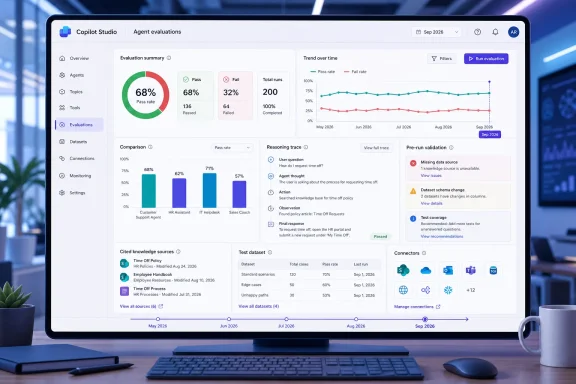 Evaluation results are moving beyond pass-or-fail
Copilot Studio evaluations run test cases against an agent, collect its responses and score them against a selected method or quality criteria. In its current documentation, Microsoft describes results that can include Pass, Fail, Invalid or Error states, along with a pass-rate score for a test set. Makers can inspect a failed case, read the agent response and export results to CSV for external analysis.
That is useful for finding that a regression occurred, but it is not always enough to establish the cause. A poor result can stem from an instruction change, a stale SharePoint source, a tool invocation that used the wrong inputs, an unavailable connector, a change in how the agent routes a query, or a weak test prompt. An aggregate score provides a warning; diagnosing the failure often requires reconstructing what the agent did.
Roadmap ID 569607 promises “richer evaluation explanations,” reasoning traces and cited knowledge sources. If Microsoft delivers those features within the same results view, the practical improvement will be the ability to connect a score to the agent’s retrieval and execution path without switching repeatedly between a test result, Preview, agent configuration and knowledge-source settings.
That distinction matters for IT teams treating agent changes as deployable software rather than one-off chatbot edits. A score falling from 92 percent to 81 percent after a knowledge refresh is an alert. A result that identifies which source was retrieved, which response condition failed and what the evaluator found incomplete is evidence a maker can act on.
Reasoning traces and citations are not wholly new to Copilot Studio
Microsoft’s roadmap language can sound broader than the current product record. The company’s Learn documentation already describes an activity trace for agents powered by the GitHub Copilot harness. That trace shows the processing steps for a message, including knowledge retrieval, tool and connector calls, flows, skills, errors, timings and returned results. It can also show which knowledge source was searched and the content retrieved.
Microsoft also documents cited knowledge sources in the newer agent experience, where agents can search configured sources such as SharePoint, uploaded files, public websites, Azure AI Search, Dataverse and connected business systems. In that experience, the agent can include citations indicating where information came from.
The September roadmap item is still meaningful because it explicitly places richer traces and cited sources in the evaluations experience, where makers review repeatable test runs rather than manually probing a single live preview conversation. But it should not be read as confirmation that all Copilot Studio agents will suddenly gain a new internal-reasoning display in September.
Microsoft’s existing trace documentation is specifically tied to agents powered by the GitHub Copilot harness, and its evaluation documentation distinguishes between the new agent experience, the classic experience and standard agent tooling. The roadmap does not say which existing evaluation surfaces will receive every planned feature, whether classic agents are included, or whether feature behavior will differ by agent type.
For administrators, that omission is consequential. A pilot team can have a documented trace in one authoring experience while another team, using a different agent architecture or legacy experience, has a different diagnostic toolset. Before making the September capability part of a governance requirement, organizations should test it against the actual agent type and environment they run.
Run comparison should improve regression testing, with one operational limit
Microsoft already allows makers to rerun a test set and compare results over time. The planned “evaluation run comparison” reinforces a workflow that should be familiar to software teams: establish a baseline, change one element, rerun the same cases, then inspect what improved and what regressed.
This is especially valuable for agents that use enterprise knowledge and actions. Updating a SharePoint knowledge base, adding a connector, changing instruction priority or moving an agent to a different model configuration can alter responses far beyond the scenario a maker intended to fix. A visible comparison between runs can turn evaluation into a rudimentary regression suite rather than a periodic quality snapshot.
Microsoft’s guidance already recommends recording an agent version and baseline date, then rerunning foundational test sets after material changes such as model updates, major knowledge revisions, new tools or connectors, and production incidents. The roadmap’s comparison feature could make that advice much easier to follow in the product itself.
There are limits that the announcement does not remove. Current Microsoft documentation says Copilot Studio can run only one evaluation test set at a time, and that results are retained in the product for 89 days unless exported to CSV. Teams building a formal release process should therefore preserve run artifacts outside the service when retention, audits or longer-term trend analysis matter.
The new comparison view may reduce the need to download spreadsheets for day-to-day investigation, but it does not substitute for an evidence-retention process. Admins should keep a versioned record of the agent configuration, test-set revision, data-source state, user profile used for the evaluation, evaluation date and exported outcome. Comparing two runs is only credible when the team can identify what changed between them.
Larger datasets address a real weakness in hand-built test sets
The roadmap says Copilot Studio will support larger datasets, customizable test generation and the creation of evaluation datasets from knowledge sources. Microsoft has not said what “larger” means in a published number, so makers should not plan capacity around an assumed ceiling.
Today, Microsoft’s documentation describes conversational test sets as groups of up to 20 test cases. A single test case can represent one question-and-answer exchange or a longer conversation. That limit makes focused scenario testing practical, but it encourages a risk: teams may select tidy examples that reflect how they expect employees to ask questions rather than how employees actually ask them.
Generating test cases from a knowledge source could reduce the manual labor of creating coverage after a new policy library, HR handbook, product catalog or support corpus is connected to an agent. Customizable generation could also help makers target particular document collections, user intents, terminology or edge cases instead of receiving generic questions.
But generated tests introduce a quality-control problem of their own. If the same AI system helps derive the cases, grade the output and recommend fixes, an organization can end up measuring conformance to machine-generated expectations rather than business correctness. Microsoft’s own evaluation guidance recommends defining success criteria and expected responses for high-value scenarios. That remains the right discipline.
The most useful split is straightforward: use generated datasets to broaden coverage and find unknown failure patterns, then maintain human-reviewed “golden” tests for policies, permissions, financial figures, regulated advice, escalation procedures and actions that can affect customers or systems. A large dataset filled with shallow prompts is less valuable than a smaller suite that probes the decisions the agent must get right.
Validation before execution could save failed runs, not fix broken design
The final part of Microsoft’s announcement is additional validation and guidance intended to identify configuration problems before an evaluation begins. This targets a common practical failure: an evaluation is set up correctly on paper, but a required user profile, connector authentication, test-set setting or knowledge configuration prevents it from exercising the agent as intended.
Current documentation already notes that authenticated evaluations depend on access through the Copilot Studio connector. If an administrator disables that connection, the evaluation cannot run. Microsoft also directs makers to repair broken profile connections before testing with a selected user profile.
Pre-run validation can shorten this feedback loop. It may tell a maker that the test will not represent the intended user, that an authenticated connection is missing, or that evaluation settings are incomplete before several minutes are spent processing a run. It cannot, however, prove that the connected identity has the right permissions, that retrieved knowledge is current, or that the test set reflects real user behavior.
Makers should treat the new checks as setup validation, not as a deployment gate by themselves. An agent can complete every configured evaluation while still returning unsafe, misleading or permission-inappropriate answers in production. Microsoft explicitly says its evaluation system measures correctness and performance rather than AI ethics or safety, and that it does not replace responsible AI review or content-safety controls.
September’s release will be worth watching because it could make Copilot Studio evaluations substantially more useful as a troubleshooting and regression-testing tool. Until Microsoft publishes rollout details and the feature reaches a tenant, though, the safe operational assumption is narrower: comparison, explainability and test generation are planned enhancements to an existing evaluation framework, while the responsibility for representative tests, retained evidence and production safeguards remains with the organization running the agent.
