
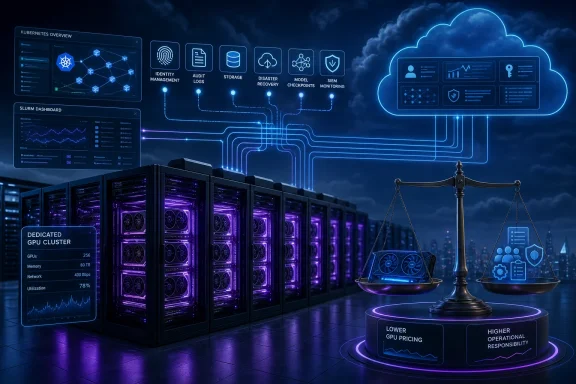
The change is most visible when an AI workload leaves a broad Azure estate for a dedicated GPU cluster. Identity, logging, storage, network segmentation, scheduling, recovery, and even hardware compatibility may no longer be handled through the same familiar control plane. The work is not inherently less secure or less reliable, but the portability assumptions behind standard cloud operations become much weaker.
InfoWorld frames the gap around security, performance management, and disaster recovery. Documentation from CoreWeave, Lambda, and Crusoe supports the larger conclusion while also exposing an important qualification: “neocloud” is an infrastructure category, not a uniform operational standard. Some providers now offer federation, audit logs, managed Kubernetes, Terraform support, and dedicated environments. Others expose a much slimmer infrastructure layer. IT teams need to evaluate the actual service boundary rather than treating the provider’s GPU inventory as the whole product.
 The control plane may be smaller, but the workload is more exposed
A conventional Azure deployment can anchor much of its administration in Microsoft Entra ID, Azure Policy, Azure Monitor, Defender for Cloud, Key Vault, Azure Backup, and the organization’s existing network and compliance patterns. Those services do not eliminate operational mistakes, but they create a shared vocabulary and integration path across security operations, platform engineering, and audit teams.
A specialized AI cloud can offer many comparable primitives, but their scope and implementation differ. CoreWeave’s current documentation describes role-based access controls, SSO and MFA support, workload identity federation, network isolation, encryption, and audit logging. Its AI Object Storage documentation also makes clear that data-plane audit logging must be enabled, and that organization-level enablement applies automatically only to storage buckets created afterward. Existing buckets retain their prior logging state until an administrator changes each bucket individually.
That is a small configuration detail with large consequences. A migration team that validates logging on a newly created pilot bucket could assume it has covered the entire AI data estate, while older buckets containing training data, checkpoints, or model artifacts remain outside the same data-plane logging configuration.
Lambda’s public-cloud documentation illustrates another operational difference. It offers account roles, workspaces, firewall rules, API keys, SSH keys, and audit events, but its listed account-level Admin and Member roles both have broad authority over cloud resources. On Lambda Private Cloud, the company says customers receive root access to compute and head nodes and remain responsible for operating-system security, patch management, and monitoring. Managed Kubernetes can shift some of that work back to Lambda, including cluster maintenance, but that is a different service model from raw or dedicated infrastructure.
The practical point is not that one model is automatically superior. Dedicated hardware and direct root access may be precisely what an AI engineering team needs for performance-sensitive distributed training. But a security team should treat that handoff as a transfer of responsibility that must be documented in the risk register. “The provider runs the data center” says little about who patches Ubuntu, rotates credentials, reviews privileged access, exports logs to the SIEM, or proves tenant and data separation to an auditor.
The security review has to begin with the administrative surface, not the compliance logo. Ask for the provider’s current shared-responsibility matrix, then map each control to an owner: the provider, the enterprise platform team, the model-development team, or a managed-service partner. If no owner exists, the control does not exist in practice.
GPU capacity turns platform operations into performance engineering
The standard public-cloud habit is to select an instance SKU, attach storage, enable autoscaling, and let the platform obscure much of the physical infrastructure. AI clusters do not permit the same degree of abstraction. The GPU model, memory capacity, interconnect, network topology, data location, storage throughput, distributed-training framework, CUDA or driver version, and scheduler all affect the output of a training run and the cost of an inference service.
InfoWorld correctly identifies idle accelerators as the financial threat. The less obvious problem is stranded capacity: a reserved GPU cluster can be technically available while being unusable for the workload currently needing it. A job may require a particular GPU generation, a fixed number of high-bandwidth-connected nodes, a compatible driver stack, or storage close enough to keep accelerators fed. A generic “GPU utilization” percentage does not reveal whether a cluster is doing useful model work, waiting on input pipelines, stalled in collective communication, or repeatedly restarting failed workers.
Research published by Tejas Harith and Antoine Kaufmann through the Max Planck Institute for Software Systems offers a useful explanation. Their work on “post-Moore clouds” argues that accelerated-cloud fleets are increasingly heterogeneous and fragmented. Once a tenant has allocated a workload to a particular accelerator pool, transparent migration to another platform may be impractical or expensive. Migration can require checkpointing, reloading data, rebuilding containers, validating numerical behavior, and absorbing a performance hit at the wrong stage of a training job.
That is why a neocloud capacity reservation should be viewed less like generic elastic compute and more like a production resource commitment. The application team must know what hardware it is buying and how it will use it before finance approves the reservation.
For a Windows and enterprise IT team, the operational adjustment is concrete:
- Record the exact accelerator, driver, CUDA or ROCm stack, container image digest, Kubernetes version, storage class, and networking assumptions used for every production training and inference release.
- Measure accelerator goodput, input-pipeline wait time, inter-node communication, checkpoint duration, and failed-job restart rates alongside ordinary CPU, memory, and network telemetry.
- Treat model checkpoints as planned mobility points, not merely backups, so a lengthy training job has defined moments when it can be paused or moved without losing unacceptable work.
- Require a benchmark using the intended data volume and distributed topology before signing a long-term capacity commitment.
Crusoe’s own documentation reflects this infrastructure-first reality. Its Infrastructure Cloud offering lets customers launch GPU clusters managed with Kubernetes or Slurm and automate deployment with Terraform, while its managed-AI services place more operational responsibility with Crusoe. Those are materially different products even inside one provider. A team that buys a self-managed cluster must be prepared to operate Kubernetes or Slurm; a team that uses a managed inference offering must establish what observability, export paths, and configuration authority it retains.
Disaster recovery means proving that the model can run elsewhere
A backup copy of a model file is not a disaster-recovery plan for an AI service. Recovery requires the organization to reconstruct a chain: source data, preprocessing code, container images, dependency versions, model weights, embeddings, vector indexes, secrets, deployment manifests, policy configuration, inference routing, and monitoring.
The potential failure point expands further in a specialized cloud because identical capacity may not be immediately available in another region or at another provider. A model trained on a particular NVIDIA GPU family may run elsewhere, but its performance, numerical results, driver compatibility, batching behavior, and cost can change. For a production inference service, those changes may affect latency objectives or output-quality controls. For a distributed training run, moving the workload may mean resuming from a checkpoint on a cluster with a different topology.
This is the part missing from broad claims that enterprises should simply adopt “multi-cloud” for resilience. A second cloud account is not a failover environment. It becomes one only after the organization has rehearsed a restore on the target hardware and has decided which differences it will tolerate.
The recovery plan should distinguish between workloads that can wait and workloads that cannot. A research training job may have a recovery point objective of several hours and a recovery-time objective of a day. A customer-facing retrieval-augmented generation service handling transactions may need replicated model artifacts, a warmed alternate inference path, a tested vector-store restoration procedure, and defined degraded-mode behavior when the preferred GPU environment disappears.
The right procurement test is operational portability
The most useful question for a neocloud evaluation is not whether the hourly GPU price beats Azure, AWS, or Google Cloud. It is: How much of the workload can this organization move, observe, secure, and restore without the provider’s direct intervention?
CoreWeave’s published security and Kubernetes documentation, Lambda’s split between public-cloud controls and customer-managed private clusters, and Crusoe’s separate managed and infrastructure-cloud models show why a category-wide conclusion is too blunt. The capabilities exist, but the division of labor varies enough that each one needs its own architecture review.
Before placing proprietary data or a production model in a neocloud, enterprises should demand an evidence-based answer to four operational questions: Can corporate identities be federated with least privilege? Can control-plane and data-plane events reach the enterprise SIEM with a known retention period? Can the exact workload be recreated from versioned infrastructure-as-code and immutable artifacts? Can it resume or serve traffic in another environment after an outage?
If those answers are documented and tested, specialized GPU capacity can be a rational extension of an Azure-centered estate. If they are unanswered, the apparent saving on GPU hours is being offset by an unpriced commitment to build a second cloud operating model under production pressure.
