
As detailed in CrowdStrike’s blog, the new integrations feed findings into Falcon Next-Gen SIEM, linking AI activity to the endpoint, user, identity, and network telemetry security teams already investigate.
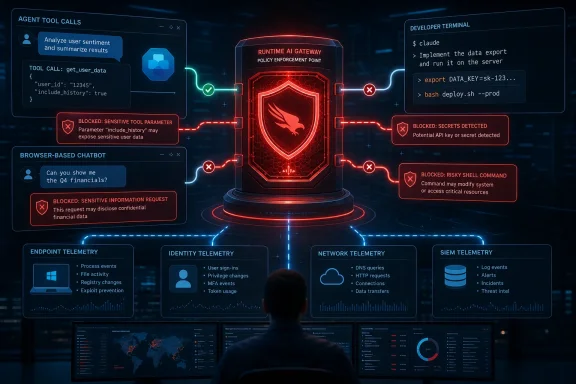 Copilot Studio Gets a Runtime Gate Before Tool Execution
For Copilot Studio, Falcon AIDR operates as an external threat-detection provider. When a generative agent is about to invoke a tool, CrowdStrike evaluates the tool name and proposed input parameters against organizational policy, then returns an allow or block decision before the action runs.
That is a more useful control point than simply reviewing agent conversations after the fact. A prompt-injection attempt that persuades an agent to query a sensitive system or trigger an unapproved workflow can be stopped at the proposed tool invocation, rather than after data has been returned.
Microsoft’s own Copilot Studio documentation describes this external-provider capability as a preview feature and says it applies to generative agents using generative orchestration, not classic agents. It also requires configuration per environment, so administrators should not assume a single tenant-level deployment covers every existing or future Power Platform environment.
There is an operational decision to make, too: Copilot Studio can allow a tool call if the external provider fails to respond in time, unless the administrator chooses a block-on-error policy. For sensitive agents, that fail-open default deserves explicit review.
Claude Code Enforcement Moves Into the Developer Workflow
CrowdStrike is also connecting Falcon AIDR to Claude Code through Anthropic’s hook-event system. The company says the integration can inspect and block prompts and tool activity as they occur, with configuration added through JSON in Claude Code settings rather than a new endpoint agent or build-system component.
The key use cases are straightforward: blocking a developer from sending secrets or personally identifiable information in a prompt, and preventing risky shell, file, or network operations before Claude Code executes them. Events can be associated with a specific Claude Code session and user in Falcon Next-Gen SIEM.
For security teams, this is an attempt to make AI-assisted development observable without requiring developers to abandon the tools they have adopted. For developers, the practical question will be policy quality: overly broad rules can turn a security hook into another source of friction, while narrow rules may miss the sensitive data and high-risk commands the integration is designed to catch.
The Browser Extension Becomes Another AIDR Sensor
CrowdStrike has additionally enabled Falcon AIDR in its browser extension. The company says organizations can assign AIDR policies through existing Falcon host groups and use the extension to monitor and control browser-based AI services.
That provides a common path for covering the employee who pastes material into a public chatbot, the maker building a Copilot Studio agent, and the developer using Claude Code. It also means AI findings can arrive with endpoint context rather than as isolated browser alerts.
The immediate task for Falcon customers is not simply switching on blocking. CrowdStrike recommends starting with monitoring and reporting, then enabling blocking or data transformation once usage patterns and policy exceptions are understood. The success of this release will depend on whether organizations can translate that visibility into rules that stop genuine exposure without breaking the AI workflows employees now treat as routine.
