
That distinction changes how the material should be read. This is not a newly published clinical or Windows AI deployment study; it is a conceptual paper and companion simulation proposing that evolutionary game theory can describe recurring human–AI interactions. Its most useful contribution is a framing tool for thinking about incentives, escalation, cooperation, and resource conflicts. Its headline predictions about ChatGPT, Claude, and Gemini are outputs of researcher-chosen model parameters, not results from controlled interactions with identified, live versions of those products.
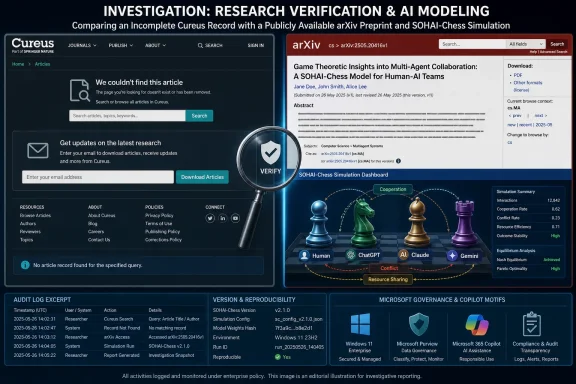 The published-paper trail stops at arXiv
The submitted Cureus link resembles a conventional journal-article address, and the source text supplied with it includes the site’s specialty picker and personal-data consent language. But the page itself, as available now, does not expose the alleged article. Cureus did publish an earlier, separate paper by the same two authors in January 2025: “Generative AI Decision-Making Attributes in Complex Health Services: A Rapid Review.” That paper carries the Cureus identifier e78257 and a conventional publication record.
The serious-games paper cites that earlier Cureus review, but its own front page identifies it as an arXiv manuscript in the computer-science AI and game-theory categories. arXiv’s record lists two authors, Southern Cross University affiliations, 29 pages, four figures, and three tables. The manuscript says it was revised in July 2026; it does not claim journal acceptance, peer review, or publication by Cureus.
This is more than a bibliographic technicality. A journal article, a preprint, and an unrendered or incomplete web entry carry different evidentiary weight. IT leaders should not treat the Cureus URL’s August 7 timestamp as proof that a medical journal has validated the work, because the accessible record does not show that publication.
SOHAI-Chess models assumptions, not product behavior
The paper’s practical centerpiece is SOHAI-Chess, short for Simulation of Human-AI Interaction in Complex Health Services. It is an agent-based web application that places a modeled human participant against modeled versions of ChatGPT, Claude, and Gemini across three classic evolutionary game-theory scenarios: Hawk-Dove, the Iterated Prisoner’s Dilemma, and the War of Attrition.
Those games are familiar abstractions. Hawk-Dove models whether rivals fight for a resource or retreat; the Iterated Prisoner’s Dilemma models whether repeated dealings create cooperation or exploitation; and the War of Attrition models a costly contest in which each party decides how long it can afford to hold out. For systems administrators and AI governance teams, the underlying point is reasonable: user behavior, vendor incentives, institutional policy, and model capabilities can feed back into one another over time.
But SOHAI-Chess does not directly play those games with current hosted models through a documented API experiment. The preprint says its AI agents are represented with six traits: cooperation, memory depth, learning, cost tolerance, autonomy, and capability. Some defaults are tied to prior literature and benchmark results, while the paper explicitly says the values for “learning” and “autonomy” cannot be directly measured from published literature and are therefore assumptions based on public design principles and training goals.
That means the simulation can be reproduced as a calculation if its settings are preserved. It does not mean its results reproduce Claude, Gemini, ChatGPT, Microsoft Copilot, or any other production assistant’s behavior. The difference is fundamental: a deterministic model is faithfully reporting its inputs, not independently measuring a vendor service.
The Claude finding is a scenario result, not a comparative benchmark
The paper’s highlighted result is that its Claude agent trends toward “cooperative co-evolution” across the three games. It assigns Claude a relatively high cooperative disposition and moderate autonomy, then explains that more capability increases the theoretical cost of escalation and therefore pushes the model toward restraint and resource sharing.
The logic follows from the simulator’s definitions. If a model is assigned higher cooperation, controlled autonomy, and a rising cost for conflict, then cooperative outcomes are the expected result. The paper is transparent enough to state that the simulation’s metrics recalculate when users alter those trait values. That transparency is welcome, but it also means the result is sensitivity to a design choice, not a discovery about an AI vendor.
The missing operational details matter even more in August 2026, when the products named in the manuscript have changed repeatedly. The paper does not identify exact model releases, deployment dates, system prompts, temperature settings, tools, memory configuration, licensing tier, API versions, or test conversations. “ChatGPT,” “Claude,” and “Gemini” are product families, not fixed experimental subjects.
A claim that one of those systems is more cooperative than another would need a defined task set, contemporaneous version identifiers, repeated trials, raw outputs, and a method for deciding whether a response counts as cooperation, defection, or withdrawal. SOHAI-Chess supplies none of that. It models hypothetical behavior from parameters rather than conducting an empirical head-to-head evaluation.
Windows and Copilot administrators should not infer deployment guidance
Microsoft Copilot appears in the paper’s broad taxonomy of AI systems, but it is not among the three systems run through the simulation. The manuscript distinguishes GitHub Copilot from Microsoft Copilot in a footnote, yet it does not test either one. There is no analysis of Windows 11, Microsoft 365 Copilot, Copilot Studio, Entra ID, Purview, Intune, tenant controls, data boundaries, or audit logging.
That leaves the paper outside the category of evidence a Windows organization would need before changing its AI policy. It cannot tell an administrator whether a Copilot deployment will improve collaboration, reduce conflict, produce safer decisions, or cause users to defer too readily to an assistant. It also cannot tell a policymaker how a model will act after a vendor changes its underlying service, which hosted AI suppliers can do without the stable versioning expected from conventional on-premises software.
The operational lesson is narrower and more useful. When an organization adopts AI copilots, it is creating a repeated game: users learn which outputs to trust, teams adjust workflows around automation, and the service evolves through vendor releases, administrator controls, and user feedback. Governance should therefore measure the actual interaction rather than assume a product’s cooperative marketing posture translates into dependable institutional behavior.
For Windows shops, that means collecting concrete evidence around high-impact use cases: whether users accept suggestions without verification, whether permissions expose data a user would not otherwise surface, whether incident responders can reconstruct AI-assisted decisions, and whether a changed model version alters outcomes. These are testable questions in a tenant. They cannot be answered by assigning an abstract cooperation score to “AI.”
A useful framework still needs empirical validation
The authors acknowledge several of the paper’s own constraints. They consider only three of 13 listed evolutionary game-theory models, assume current AI capabilities scale without a major paradigm shift, and give cultural and ethical dimensions limited attention. They call for empirical validation and wider interdisciplinary work, which is the appropriate next step.
There is real value in using game theory to force clearer questions about incentives. A health-policy assistant, for example, may be embedded in a conflict over budget, accountability, speed, professional authority, or access to limited services. Framing that situation as one of cooperation, strategic retaliation, or costly persistence can expose where a workflow needs human escalation paths and enforceable limits.
Yet a framework becomes decision-grade only after it is anchored to observable behavior. The paper’s strongest result is that researchers can operationalize a set of assumptions in a simulation and inspect the consequences. Its weakest reading would be that Claude—or any other named model—has been shown to evolve cooperatively with humans.
The immediate correction is straightforward: treat “Serious Games: Human-AI Interaction, Evolution, and Co-evolution” as an arXiv preprint with a simulation, not as a newly verifiable Cureus article or a comparative test of current AI products. For organizations running Copilot or other assistants, the next action is not to adopt its predicted equilibrium; it is to define the real incentives in their own environment and test the live service they actually deploy.
References
- Primary source: Cureus
Published: August 7, 2026 at 6:50 AM UTC
Serious Games: Human-AI Interaction, Evolution, and Co-evolution | Cureus
The serious games between humans and AI have only just begun. Evolutionary Game Theory (EGT) models the competitive and cooperative strategies of biological entities. EGT could help predict the potential evolutionary equilibrium of humans and AI. The objective of this work was to examine EGT...www.cureus.com - Related coverage: emergentmind.com
Human-AI Coevolution Dynamics (HACD-H)
HACD-H models human-AI coevolution through recursive feedback loops integrating emotional adaptation, shared agency, and dynamic governance in sociotechnical systems.www.emergentmind.com - Related coverage: themoonlight.io
[论文评述] GAVEL: Generating Games Via Evolution and Language Models
这篇论文的标题为《GAVEL:通过进化和语言模型生成游戏》,作者主要来自纽约大学、瑞士联邦理工学院、弗林德斯大学、洛万大学、马斯特里赫特大学等机构。本文探讨了如何自动生成新颖且有趣的游戏,这一任务涉及到多个复杂的问题,例如如何以可计算的方式表示游戏规则、在潜在游戏空间中进行有效搜索,以及准确评估新游戏的独创性和质量。 ### 研究背景...www.themoonlight.io - Related coverage: philarchive.org
Search results for `human-AI comparative study` - PhilArchive
 philarchive.org
