

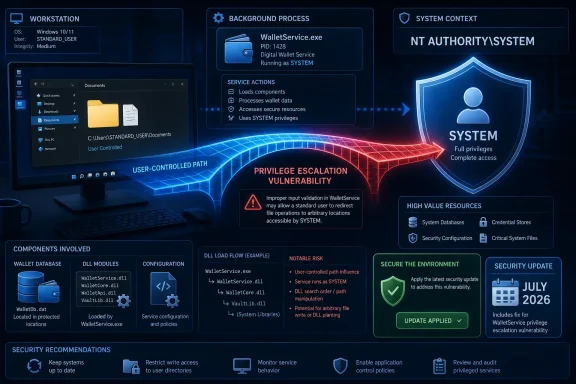
The vulnerability is not a remote break-in. An attacker must already be able to execute code as a valid, low-privileged user on the target machine. That requirement limits exposure compared with a browser or network-facing flaw, but it does not diminish the risk for shared PCs, enterprise workstations, virtual desktop environments, development machines, or endpoints where a phishing payload, malicious installer, or untrusted local user can first obtain a foothold.
What makes this Windows WalletService elevation of privilege vulnerability notable is the boundary it crosses. WalletService resolves a per-user setting while acting on behalf of the user, but later processes the resulting file path as LocalSystem. In the vulnerable design, the service can be induced to open a database prepared in a location selected by the unprivileged caller, allowing database callback behavior to cause attacker-controlled code to load within a SYSTEM service host.
For Windows administrators, the immediate conclusion is straightforward: deploy the July 2026 Windows security updates across all affected systems, verify build remediation rather than relying on partial update status, and treat suspicious WalletService activity as a potential privilege-escalation signal.
Overview: A Local Bug With Full-System Consequences
Microsoft’s vulnerability record describes CVE-2026-49176 as improper privilege management in Windows WalletService that permits an authorized attacker to elevate privileges locally. The published CVSS vector—AV:L/AC:L/PR:L/UI:N/S:U/C:H/I:H/A:H—captures the basic threat model: local access and low privileges are required, but exploitation does not require an additional user interaction and can affect confidentiality, integrity, and availability at the highest level.
The flaw is also associated with two weakness classes:
- CWE-269: Improper Privilege Management
- CWE-59: Improper Link Resolution Before File Access, commonly described as a link-following or path-resolution problem
Those classifications are important because the vulnerability is not merely a bad file permission or a single missing access-control check. It is a trust-boundary failure. A privileged service accepts a path that originates in user-controlled profile state, then treats objects at that path as though they were service-owned and trustworthy.
That is a familiar and dangerous Windows security pattern. Services frequently need to work with user data, but a service running as LocalSystem must distinguish between a path that is safe to read as a user and content that is safe to consume as a privileged process. The moment a SYSTEM service can parse, load, execute, or otherwise act on an attacker-prepared object, an ordinary profile folder can become a route to complete machine compromise.
Why “Local” Should Not Be Read as “Low Priority”
A local privilege-escalation flaw often becomes the second stage of an intrusion rather than the first. An attacker may start with limited code execution through a malicious attachment, a compromised browser profile, an application vulnerability, stolen credentials, or a legitimate but low-privileged remote session. SYSTEM-level elevation turns that initial foothold into an environment where security controls, credentials, persistence mechanisms, and other users’ data are at much greater risk.
For organizations using standard-user accounts as a compensating control, that distinction matters. Least privilege remains valuable—it can prevent the first-stage compromise from immediately becoming catastrophic—but vulnerabilities such as CVE-2026-49176 demonstrate why endpoint patching and behavioral monitoring must reinforce account restrictions.
The local nature of the bug also makes multi-user endpoints particularly relevant. Kiosks, classroom labs, managed Windows 11 devices, shared support workstations, application servers with interactive logons, and virtual desktop infrastructure all create situations where a low-privileged account may have a realistic opportunity to exploit a local service.
The Windows WalletService Attack Surface
WalletService supports the public Windows.ApplicationModel.Wallet WinRT API. According to the technical analysis, a standard user can reach the affected service flow using the supported WalletManager.RequestStoreAsync route and subsequent Wallet item operations; direct access to a private COM class was not necessary.
This is a critical point. The attack does not depend on an administrator accidentally enabling a hidden debugging endpoint or granting a special service permission. The vulnerable operation sits behind an API intended to be usable by normal Windows applications.
The public sequence described by researcher David Carliez is conceptually simple:
- A standard user requests access to the Wallet store through the public API.
- WalletService activates and begins initializing its wallet database.
- The service resolves the caller’s Documents known-folder path.
- It later reverts to its own privileged identity and opens the wallet database below that user-derived location.
The issue is therefore not that Windows allows a user to access their own Documents folder. That is expected behavior. The weakness emerges because WalletService uses a path obtained through the user’s identity but subsequently acts on data there as LocalSystem.
Documents Redirection Is a Legitimate Windows Feature
The affected flow relies on the Windows known folders framework. Microsoft documents SHSetKnownFolderPath as an API that redirects a known folder to a new location. Microsoft’s documentation also explicitly notes that Documents is a per-user known folder and that changing a per-user known-folder location requires only user privileges.
That design is legitimate. Users may redirect Documents to a different disk, network-backed profile location, OneDrive-managed path, or other approved storage destination. Enterprise deployments also regularly redirect folders through policy and profile-management tooling.
CVE-2026-49176 illustrates the hidden security cost of treating redirected user storage as if it were a protected application-data root. A redirected Documents location may be valid for user files, but it remains user-controlled. A SYSTEM process cannot safely make security-sensitive assumptions about arbitrary content beneath it.
The Crucial Privilege Transition
The published root-cause analysis indicates that WalletService impersonates the caller while looking up FOLDERID_Documents, then reverts to itself before appending a Wallet subfolder and opening wallet.db. In other words, the service makes a location decision under the caller’s security context, then consumes the contents under SYSTEM authority.
This is the vulnerability in one sentence:
A caller-controlled Documents mapping influenced where a SYSTEM service loaded a structured database from, without sufficient validation of the database as an untrusted object.
The technical distinction matters. Simply locking down the Wallet directory after it is created is not adequate if the service has already been convinced to process a pre-existing database. Likewise, inspecting only whether the final directory appears to have restrictive permissions misses the earlier and more fundamental failure: the privileged service selected the directory based on mutable, user-controlled state.
How the Database Becomes a SYSTEM Code-Execution Primitive
WalletService uses the Extensible Storage Engine (ESE) for its database handling. ESE is a Microsoft database engine with capabilities designed for trusted application databases. In this case, the security analysis found that WalletService’s vulnerable initialization path opened the database with persisted callback support enabled.
Persisted callbacks can be useful in a controlled application design. However, they become dangerous when a higher-privileged process opens a database created by a lower-privileged user. The analysis describes an attacker-prepared wallet.db containing the expected Wallet data structure and a callback reference that causes ESE to resolve a DLL export while WalletService is running as SYSTEM.
That is the escalation hinge. The attacker does not need to replace a protected system DLL or write into C:\Windows. Instead, the attacker prepares a file in a location they legitimately control and waits for the privileged service to load it.
Why This Is More Serious Than a File-Write Bug
Some local Windows flaws let a standard user influence where a service creates a directory or writes a file. Those flaws can be serious, but exploitation may still require a race condition, a symbolic-link trick, a vulnerable cleanup routine, or an additional application bug.
CVE-2026-49176 is more consequential because the reported path reaches code loading inside a SYSTEM-hosted service process. The analysis demonstrated an attacker DLL loading in svchost.exe under the NT AUTHORITY\SYSTEM identity, not merely a file being placed somewhere unexpected.
The proof-of-concept research then separately handled the challenge of exposing that SYSTEM-level execution to the interactive desktop. That later stage is operationally significant, but defenders should not confuse it with the actual vulnerability. The core issue is already complete once untrusted database content can cause a SYSTEM service host to load attacker code.
A High-Value Lesson for Windows Service Developers
The WalletService flaw offers a clear design lesson for any developer maintaining Windows services, COM servers, background brokers, or application services:
- Do not treat a path derived from a user token as trusted merely because it was resolved through a Windows API.
- Do not parse or load structured content from user-writable directories after reverting to a more privileged identity.
- Do not enable plugin, callback, extension, deserialization, or dynamic-module behavior for data whose provenance is not strongly controlled.
- Validate both the resolved path and the security ownership of the object before a privileged process consumes it.
- Prefer service-owned storage rooted in locations inaccessible to ordinary users when data may influence privileged execution.
The vulnerability is a reminder that impersonation has to cover the entire sensitive operation, not only the path lookup that precedes it. A service that impersonates briefly and then reverts before opening the object may preserve the appearance of user-context handling while still executing the dangerous part as SYSTEM.
Microsoft’s Fix and the Build Numbers That Matter
The reporting identifies Microsoft’s remediation as an internally named servicing feature, Feature_Servicing_WalletServiceRedirectionGuard. Patch comparison indicates that the guard prevents the legacy ESE-opening logic from proceeding, along with related directory-restriction and cleanup routines.
On the examined patched Windows 11 build, 26200.8875, WalletService could still create an empty Wallet directory in the selected location. Crucially, it did not open the attacker-prepared wallet.db, create the usual ESE files, alter the directory access control list in the vulnerable manner, resolve the persisted callback, or load the attacker DLL.
That distinction is operationally useful. Administrators investigating an endpoint should not treat the mere presence of a Wallet folder as evidence that the device remains exploitable. The relevant question is whether the machine has received the security update and whether WalletService has opened suspicious wallet database content from an untrusted location.
Affected Windows Versions Are Broader Than One Windows 11 Build
While the public proof-of-concept comparison focused on Windows 11 25H2 builds 26200.8737 and 26200.8875, the NVD record reflecting Microsoft’s vendor data lists affected Windows 10, Windows 11, and Windows Server releases. The listed remediation thresholds include:
- Windows 10 version 1607:
14393.9339 - Windows 10 version 1809:
17763.9020 - Windows 10 version 21H2:
19044.7548 - Windows 10 version 22H2:
19045.7548 - Windows 11 version 24H2:
26100.8875 - Windows 11 version 25H2:
26200.8875 - Windows 11 version 26H1: corresponding patched builds beginning at the documented threshold
- Windows Server 2016, 2019, 2022, and 2025 update levels identified in the vendor-supplied configuration data
The practical message is clear: do not assume that WalletService risk is limited to a single Windows 11 channel. Patch-management teams should use their normal Microsoft update compliance workflows, inventory operating-system build numbers, and confirm that the July 2026 security update applicable to each servicing branch has been installed.
Why Build Verification Matters
A device can display a recent cumulative-update history and still be behind if it missed a later servicing revision, failed a reboot, rolled back, or is maintained through an image-management process that has not yet incorporated the latest security baseline.
For CVE-2026-49176, administrators should verify:
- The Windows release and architecture on each endpoint.
- The installed operating-system build and revision.
- That the relevant July 2026 security update is successfully installed.
- That update deployment includes systems outside the primary Windows 11 fleet, including supported server and long-term servicing populations where applicable.
- That golden images, virtual desktop templates, and recovery media are updated as well.
A build number alone should be considered in the context of the OS branch. 26200.8875 is relevant to Windows 11 25H2, while different supported releases have different patched revision thresholds.
Detection Opportunities for Security Teams
Patching is the primary mitigation, but detection remains valuable. The public exploit analysis identifies several behaviors that, taken together, are unusually strong indicators of attempted or successful exploitation.
High-Signal Telemetry to Hunt
Security operations teams should consider monitoring for the following sequence:
- A non-administrator process changes the user’s Documents known-folder mapping.
- WalletService activates shortly afterward for the same user.
- A Wallet-related database appears beneath an unusual user-selected root.
- The
svchost.exeinstance hosting WalletService loads a DLL from a user-writable profile, application-data, or temporary path. - A SYSTEM process creates and rapidly deletes a short-lived service pointing to a binary under a user profile.
- A SYSTEM process modifies token session behavior and launches a process on
winsta0\default, especiallycmd.exeor other command interpreters.
The most valuable individual indicator is likely the module load: WalletService-hosted svchost.exe loading a DLL from a random user-writable location is not normal Wallet processing. The researcher specifically identifies that event as the highest-signal observation in the chain.
Practical Hunting Priorities
Detection engineering should avoid alerting on every Documents redirection. Folder redirection can be legitimate, particularly in managed environments. Instead, correlate the event with Wallet activity, unexpected wallet.db creation, and process or image-load telemetry.
Useful analytical questions include:
- Did the Documents mapping change outside an approved profile-management or migration workflow?
- Did the mapping move to a temporary directory, local application-data tree, removable drive, or nonstandard local path?
- Did WalletService access a
Wallet\wallet.dbthat predates the service’s legitimate first use? - Did WalletService-related
svchost.exemap a DLL that is unsigned, newly created, user-owned, or located outside a trusted Windows or application installation path? - Did a SYSTEM process create a service whose executable lives in a user profile?
- Did command shells, scripting engines, or suspicious child processes launch immediately after WalletService activity?
Endpoint Controls That Can Reduce Exposure
Even before patches have reached every endpoint, organizations can reduce risk through layered controls:
- Restrict local code execution from user-writable paths where operationally feasible.
- Use application-control technologies to limit unapproved DLL execution.
- Maintain endpoint detection telemetry for image loads, service creation, registry and known-folder changes, and token-related process activity.
- Reduce unnecessary interactive logons to servers.
- Keep shared-device users in standard-user groups and prevent untrusted software installation.
- Review exceptions that allow scripts, binaries, or DLLs to run from
Downloads,%TEMP%,%LOCALAPPDATA%, and profile-mounted network paths.
These measures are not substitutes for Microsoft’s update. They can, however, make post-compromise escalation more visible and less reliable for an attacker operating before patch compliance is complete.
Risk Assessment for Windows Environments
The CVSS score of 7.8 accurately signals a serious flaw, but environment matters. A fully patched home PC with a single trusted user faces a different practical risk from a large enterprise with hundreds of shared endpoints and multiple ways for low-privileged code to execute.
Highest-Priority Environments
Organizations should treat these systems as priority candidates for accelerated patching:
- Shared Windows 11 endpoints used by multiple staff, students, contractors, or customers.
- Virtual desktop infrastructure where tenants or users operate with local standard-user privileges.
- Developer workstations, which often have software build tools, source code, secrets, and flexible execution policies.
- Help-desk and operations workstations, where compromise could provide access to broader administrative infrastructure.
- Server systems permitting interactive or remote desktop access by non-administrative users.
- Endpoints with limited EDR visibility, particularly legacy or specialty systems that are patched less frequently.
The flaw does not appear to provide a direct remote compromise route by itself. Still, organizations should remember that local privilege escalation is a common way to turn a modest endpoint breach into credential theft, security-tool tampering, persistence, or lateral movement.
Strengths of the Fix
The reported mitigation appears well targeted. Rather than trying to sanitize every possible property inside an attacker-prepared ESE database, Microsoft’s change blocks the risky database-opening path itself. That is the stronger architectural response because it prevents privileged processing of untrusted state at the point where the trust boundary was violated.
The patched behavior also retains a limited directory-creation outcome without opening the database. That suggests the fix is designed to preserve as much surrounding behavior as possible while removing the execution-capable component of the legacy initialization path.
Residual Operational Considerations
Security teams should expect some ambiguity in forensic evidence. Wallet folders and databases may exist for legitimate reasons, while Documents redirection can be part of normal enterprise configuration. Detection must therefore rely on correlations rather than a single artifact.
It is also prudent to distinguish the confirmed weakness from more speculative assumptions. The disclosed research demonstrates the SYSTEM escalation path on the tested vulnerable build and documents a patched comparison. Organizations should not extrapolate a particular proof-of-concept artifact, payload name, or shell-delivery method into a universal indicator of compromise. Focus instead on the underlying behavioral invariants: unusual Documents redirection, WalletService interaction with untrusted profile paths, and privileged code-loading or service-creation activity.
The Bottom Line
CVE-2026-49176 is a consequential Windows local privilege-escalation vulnerability because it converts a normal user-controlled setting into a trusted input for a SYSTEM service. WalletService’s vulnerable flow resolves a caller’s Documents path, later reverts to LocalSystem, and then processes an attacker-controlled wallet database in a way that can lead to privileged DLL loading.
The July 2026 security updates address that trust-boundary error by preventing the vulnerable ESE database-open path from proceeding on patched builds. Administrators should prioritize update deployment across affected Windows client and server branches, verify version-specific build compliance, and hunt for the combination of known-folder changes, WalletService access to unusual profile locations, suspicious SYSTEM service activity, and DLL loads from user-writable paths.
For defenders, the broader lesson extends beyond WalletService: every Windows service that transitions between caller impersonation and a privileged identity must treat caller-derived paths and content as untrusted until they have been validated under the correct security model.
References
- NVD - CVE-2026-49176 nvd.nist.gov
- CVE-2026-49176 Exploit Development: WalletService to SYSTEM • David Carliez davidcarliez.github.io
- SHSetKnownFolderPath function (shlobj_core.h) - Win32 apps | Microsoft Learn learn.microsoft.com