

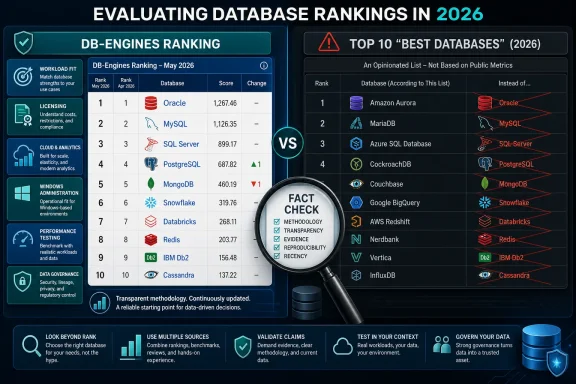
That is more than a minor ordering dispute. The published piece presents a popularity ranking as a broad “best database” assessment, then selectively removes systems that complicate its preferred list. For Windows administrators and application teams, the practical risk is simple: a reader may interpret the article as evidence to shortlist one product over another when the data cited does not support that conclusion.
DB-Engines itself is useful, but it measures popularity signals—including search interest, job postings, and professional-network mentions—not throughput under a given schema, licensing cost in a particular deployment, operational burden, cloud lock-in, or fit for an application. Those are the variables that decide whether a database is actually the right choice.
The cited ranking and the published list diverge
DB-Engines’ July 2026 ranking lists 434 systems. Its first five are Oracle, MySQL, Microsoft SQL Server, PostgreSQL, and MongoDB. The top 10 then continues with Snowflake, Databricks, Redis, IBM Db2, and Apache Cassandra.
NubiaPage gets the first two positions right, then calls PostgreSQL third despite its own stated reliance on DB-Engines. It correctly describes SQL Server as the number-three DB-Engines system in the SQL Server section, but places it fourth in the article’s numbered list. That internal contradiction is the clearest sign that the numerical ranking was not carried through to the final editorial order.
| DB-Engines rank, July 2026 | System | Included in NubiaPage’s top 10? |
|---|---|---|
| 1 | Oracle | Yes |
| 2 | MySQL | Yes |
| 3 | Microsoft SQL Server | Yes, but placed fourth |
| 4 | PostgreSQL | Yes, but placed third |
| 5 | MongoDB | Yes |
| 6 | Snowflake | No |
| 7 | Databricks | No |
| 8 | Redis | Yes, but placed sixth |
| 9 | IBM Db2 | Yes |
| 10 | Apache Cassandra | No |
SQLite was 11th in the July ranking, Elasticsearch 12th, and MariaDB 13th. All three are significant products, and each can be a strong fit in the correct workload. But their inclusion means the article is not a DB-Engines top 10; it is an unlabelled editorial shortlist of mostly familiar general-purpose databases.
The missing systems are revealing. Snowflake and Databricks are central to modern analytics and lakehouse deployments, while Cassandra remains relevant to distributed, high-write workloads. Excluding them can be defensible if the list is explicitly limited to operational application databases. NubiaPage does not make that distinction. Instead, it includes Elasticsearch, which it also concedes is “not a traditional database,” making the selection criteria even less coherent.
The version and licensing details are badly dated
Several product descriptions rely on releases that were already obsolete on August 10, 2026. That is especially problematic in a database buyer’s guide, because release generation and licensing determine support status, migration planning, and whether features are available in a self-managed installation.
Oracle’s current flagship is Oracle AI Database 26ai. Oracle made 26ai generally available for Linux x86-64 on-premises deployments in January 2026 and its current documentation was updated in July. NubiaPage instead treats Oracle Database 23ai as the latest release. Oracle 23ai remains an important release line in the product’s history, especially for AI Vector Search and JSON Relational Duality, but it is not the current product designation.
Microsoft has an equally material update. Microsoft announced the general availability of SQL Server 2025 in November 2025, with built-in vector capabilities, model management, and AI-oriented T-SQL functionality. The NubiaPage entry describes SQL Server as though its primary differentiators remain columnstore indexes, In-Memory OLTP, Always On Availability Groups, Power BI, and Dynamics 365 integration. Those remain relevant, particularly for organizations operating Windows Server and Microsoft-heavy estates, but omitting SQL Server 2025 leaves readers without the most consequential current product context.
MongoDB 6.0.4 is also not a defensible “latest release” reference in August 2026. MongoDB’s current stable release documentation covers version 8.2, including self-managed Community and Enterprise Server availability for features that had previously been concentrated in Atlas. MongoDB 8.2’s July security and reliability update is particularly relevant for Linux administrators because MongoDB documents an incompatibility with a range of Linux kernel releases that can cause the server to stop at startup. A 2026 guide that names 6.0.4 skips both a major version transition and an operational compatibility issue.
Redis is the sharpest error. The article calls Redis 7.0 the latest release and says it runs under the BSD 3-Clause license. Redis 7.0 was already old by 2026. Redis 8 reached general availability in May 2025, incorporated search, JSON, time-series, probabilistic data structures, and vector functionality into the core distribution, and changed the licensing picture. Redis 8 offers a choice of AGPLv3, RSALv2, or SSPLv1; only Redis 7.2 and earlier remain under BSD-3-Clause.
For a company distributing a proprietary Windows or Linux product, that is not an academic footnote. The Redis license choice needs legal review before bundling, modifying, or providing a managed Redis-compatible service. Teams unwilling to accept AGPL, SSPL, or source-available terms may need to assess Valkey or another alternative rather than treating current Redis as a frictionless BSD component.
Stack Overflow data supports PostgreSQL’s momentum, not the article’s percentages
The article is directionally right about PostgreSQL’s developer appeal, but the figures are wrong. Stack Overflow’s 2025 Developer Survey reported PostgreSQL as the most-used database among respondents at 58.2%, ahead of MySQL at 40.5%. NubiaPage instead says roughly 49% of developers use PostgreSQL and approximately 59% use MySQL—numbers that reverse the survey’s actual relationship.
The survey is a measure of its respondents, not a global census of production installations. It overrepresents people who identify as developers and choose to respond to a developer survey; it does not erase the installed-base advantage of Oracle, SQL Server, and MySQL in enterprises. But it does explain why PostgreSQL belongs near the front of any 2026 recommendation list: it has strong developer mindshare, broad cloud support, a permissive license, mature replication and high-availability tooling, and a deep extension model.
The article overreaches when it calls PostgreSQL “the safest long-term bet” without defining the workload. PostgreSQL is an excellent default for new transactional applications, particularly where JSONB, PostGIS, full-text search, or pgvector can reduce the need for another service. It is not automatically the safest option for a Windows organization already standardized on SQL Server Agent jobs, SQL Server Reporting Services, Active Directory-integrated administration, Availability Groups, and Microsoft support contracts.
A database migration is rarely won by feature checklists. It is won or lost on backups, point-in-time recovery, test environments, driver behavior, maintenance windows, monitoring, identity integration, failover design, and the team that will be paged at 2 a.m.
A useful 2026 shortlist starts with workload boundaries
The defensible conclusion from the available data is not that one product is “best in the world.” It is that the market has separated into products with overlapping capabilities and very different operating models.
For a new conventional business application, PostgreSQL deserves the default starting position. Its extension model and permissive licensing make it unusually adaptable, but teams should still validate connection pooling, backup tooling, Windows support requirements, and managed-service portability before committing.
For organizations already deep in Microsoft infrastructure, SQL Server 2025 is a current, first-tier choice rather than an incumbent to be tolerated. Its Windows Server and Azure integration, mature enterprise administration model, and current AI features can reduce integration work that would otherwise be shifted into application code and separate services. SQL Server Express and Developer editions also make local development and smaller deployments accessible, while production licensing must be modelled carefully.
MySQL remains a pragmatic fit for applications built around the LAMP or WordPress tradition, especially where its operational conventions and ecosystem are already familiar. MariaDB should be evaluated as its own product, not as a perpetually interchangeable MySQL replacement; compatibility is substantial, but the two projects have diverged in features, release cadence, and behavior.
MongoDB fits document-centric workloads where flexible records are genuinely a requirement rather than an excuse to avoid data modelling. Redis remains a high-performance tool for caches, queues, sessions, search-adjacent structures, and low-latency state, but its current licensing makes it a procurement decision as well as a technical one. SQLite remains the obvious embedded and local-first database, not a substitute for a multi-writer client-server production system.
Elasticsearch belongs in the discussion when full-text search, observability, security analytics, or log exploration is the job. It should not be casually positioned as the primary system of record simply because it appears in a general database list.
The corrected takeaway is less glamorous but more useful: Oracle and MySQL remain the two most popular systems in DB-Engines’ July 2026 measure; SQL Server, PostgreSQL, MongoDB, Snowflake, Databricks, Redis, Db2, and Cassandra complete that metric’s top 10. None of that establishes a universal buying order. It establishes where attention is concentrated.
Teams selecting a database in 2026 should first classify the workload—transactional, analytical, embedded, document, search, cache, distributed write path, or vector retrieval—then test failure recovery, licensing, observability, and migration costs against their own environment. A list that starts with those constraints will be more valuable than one that calls ten fundamentally different systems “the best” and then fails to reproduce the ranking it cites.