
Cheap, open-weight AI models from DeepSeek, Moonshot and Z.ai are reshaping the cost equation for U.S. software vendors, giving them a viable alternative to sending every customer request through premium APIs from OpenAI, Anthropic or Google. As Business Insider reported this week, that shift could turn a perceived SaaS threat into a margin opportunity—provided enterprises treat model selection as both a cost and security decision.
Vercel’s July AI Gateway production index offers a useful indicator of the change: open-weight models accounted for 29% of total volume in its aggregate data through June, while DeepSeek alone reached 22.6% of token volume. Vercel also reported that Z.ai’s GLM-5.2 entered its leading models by volume within two weeks of release.
For Windows developers and IT teams, the immediate consequence is not that a single Chinese model will replace a frontier U.S. service. It is that model routing is becoming a normal architectural choice: use a high-end closed model for difficult reasoning or sensitive workflows, and send lower-risk summarization, classification, extraction, coding assistance, or support tasks to a lower-cost open-weight option.
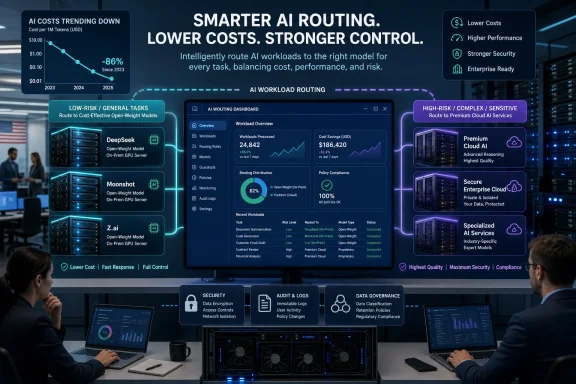
This matters most to software companies whose AI features carry a direct inference bill. A help-desk platform, document-management product, coding assistant, or line-of-business application can see usage scale quickly once generative features are exposed to every user.
Open-weight releases change that calculation in two ways. They expand the number of providers competing on price and performance, and they give organizations the option to run model weights through a chosen cloud provider—or, in some cases, on infrastructure they control.
Vercel lists GLM-5.2 as an MIT-licensed open-weight model designed for long-horizon agentic and coding work. Its listed provider prices are substantially below top-tier proprietary services, though pricing is only one part of the operating cost once GPU capacity, throughput, reliability engineering, and observability are included.
That last distinction is important. Open weight does not mean lightweight. The largest models remain impractical for a typical Windows workstation or a small server, and self-hosting can require substantial GPU memory, storage, inference software, and operational expertise.
That is particularly relevant for enterprise Windows environments. A model embedded in Microsoft 365, a Power Platform workflow, a desktop application, or a ServiceNow-style service process still needs identity controls, data-loss prevention, retention policies, logging and predictable behavior. A low token price does not solve those problems, but it can make broader deployment economically realistic.
The practical opportunity is to avoid treating any model as a permanent platform dependency. Applications that abstract their AI provider, record task-level quality and cost, and maintain fallbacks can use the emerging price competition without rebuilding their product whenever a new model arrives.
Administrators should also separate “private hosting” from “approved hosting.” A model served from an internal GPU cluster may limit data exposure, yet it can still create compliance, licensing, bias, prompt-injection and data-governance issues. The right control is not a blanket ban or blind adoption; it is an approved model catalog with documented use cases and telemetry.
The new competition gives software vendors a meaningful discount on AI inference. The winners will be the ones that turn that discount into better products without importing unmanaged models into production.
Vercel’s July AI Gateway production index offers a useful indicator of the change: open-weight models accounted for 29% of total volume in its aggregate data through June, while DeepSeek alone reached 22.6% of token volume. Vercel also reported that Z.ai’s GLM-5.2 entered its leading models by volume within two weeks of release.
For Windows developers and IT teams, the immediate consequence is not that a single Chinese model will replace a frontier U.S. service. It is that model routing is becoming a normal architectural choice: use a high-end closed model for difficult reasoning or sensitive workflows, and send lower-risk summarization, classification, extraction, coding assistance, or support tasks to a lower-cost open-weight option.
AI Features Become Less Expensive to Operate
This matters most to software companies whose AI features carry a direct inference bill. A help-desk platform, document-management product, coding assistant, or line-of-business application can see usage scale quickly once generative features are exposed to every user.Open-weight releases change that calculation in two ways. They expand the number of providers competing on price and performance, and they give organizations the option to run model weights through a chosen cloud provider—or, in some cases, on infrastructure they control.
Vercel lists GLM-5.2 as an MIT-licensed open-weight model designed for long-horizon agentic and coding work. Its listed provider prices are substantially below top-tier proprietary services, though pricing is only one part of the operating cost once GPU capacity, throughput, reliability engineering, and observability are included.
That last distinction is important. Open weight does not mean lightweight. The largest models remain impractical for a typical Windows workstation or a small server, and self-hosting can require substantial GPU memory, storage, inference software, and operational expertise.
The Value May Move Back to the Application
Business Insider’s larger point is that cheaper intelligence can strengthen companies that already own customer relationships, workflow integrations and proprietary business data. If model capability becomes more interchangeable, the differentiator shifts toward the product around it: permissions, audit trails, connectors, domain-specific prompts, data quality and user experience.That is particularly relevant for enterprise Windows environments. A model embedded in Microsoft 365, a Power Platform workflow, a desktop application, or a ServiceNow-style service process still needs identity controls, data-loss prevention, retention policies, logging and predictable behavior. A low token price does not solve those problems, but it can make broader deployment economically realistic.
The practical opportunity is to avoid treating any model as a permanent platform dependency. Applications that abstract their AI provider, record task-level quality and cost, and maintain fallbacks can use the emerging price competition without rebuilding their product whenever a new model arrives.
Cheap Models Still Require a Supply-Chain Review
The geopolitical framing should not obscure the operational risk. Downloadable weights can keep prompts and enterprise data inside an organization’s own environment, but they also introduce a software supply-chain obligation. Teams need to verify the origin and integrity of model files, review licensing terms, scan the surrounding inference stack, restrict network access, and test for unsafe outputs before production use.Administrators should also separate “private hosting” from “approved hosting.” A model served from an internal GPU cluster may limit data exposure, yet it can still create compliance, licensing, bias, prompt-injection and data-governance issues. The right control is not a blanket ban or blind adoption; it is an approved model catalog with documented use cases and telemetry.
The new competition gives software vendors a meaningful discount on AI inference. The winners will be the ones that turn that discount into better products without importing unmanaged models into production.
References
- Primary source: Business Insider
Published: 2026-07-29T09:00:01.277000+00:00
The Biggest Winner From Cheap Chinese AI? Silicon Valley. - Business Insider
Cheap Chinese AI models are giving America's software companies a boost, lowering costs, lifting margins, and reviving SaaS stocks.www.businessinsider.com - Related coverage: tomshardware.com
Trump administration reportedly reviving push to ban Chinese AI models following Kimi K3 launch, citing cybersecurity concerns — downloadable open weights could make an outright U.S. ban nearly impossible to enforce amid growing adoption | Tom'
Critics say the ban will stifle innovation and encourage monopolieswww.tomshardware.com