
For developers and IT teams, the immediate consequence is straightforward: expensive frontier models are no longer the automatic default for routine code generation, test writing, refactoring, documentation, log analysis, and first-pass agent work. But the more consequential detail is what DeepSeek has actually shipped. V4 Flash is an open-weights, 284-billion-parameter mixture-of-experts model with 13 billion parameters active for each token, a one-million-token context window, and API support designed to fit both OpenAI-style and Anthropic-style integrations.
Axios frames the release as another step in AI’s “race to zero.” The primary records support the pricing part of that argument. They do not yet establish that V4 Flash has erased the performance advantage of the most capable proprietary models across production workloads.
 The price comparison is real — and unusually stark
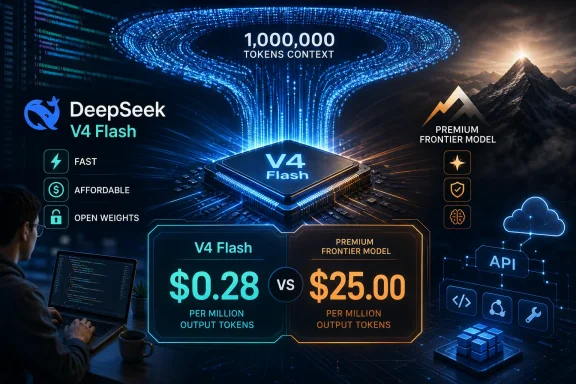
DeepSeek’s own API documentation lists V4 Flash at $0.14 per million uncached input tokens and $0.28 per million output tokens. A cached-input request costs $0.0028 per million tokens, which makes repeated agent prompts, repository context, and long-running coding sessions dramatically cheaper when an application can reuse its prompt prefix.
Anthropic lists Claude Opus 4.8 at $5 per million input tokens and $25 per million output tokens for standard API use. Both vendors advertise one-million-token context limits, so the raw output-token comparison is not a trick of pitting a short-context economy model against a long-context flagship. On the published rate card, DeepSeek charges about 1.1% of Opus 4.8’s output price.
That number is more useful than the usual “99% cheaper” headline because it identifies the billing category. It does not mean every coding task will cost 89 times less. Agent frameworks vary wildly in token consumption, retry behavior, tool-call patterns, context caching, and how much hidden reasoning a provider generates. An inexpensive model that needs three repair loops can lose much of its apparent advantage over a model that completes the job on the first pass.
Even so, the cost floor has moved. At $0.28 per million output tokens, a team can afford to use V4 Flash for high-volume tasks that would be hard to justify on a premium model: generating unit-test variants, triaging tickets, classifying telemetry, migrating boilerplate, reviewing a broad set of pull requests, or running iterative code agents on disposable branches.
This is a July update to an April model, not an entirely new architecture
Axios describes V4 Flash as DeepSeek’s new bargain model, but DeepSeek’s own public documentation shows that the V4 family first arrived as a preview on April 24, 2026. V4 Flash was already the smaller V4 variant: 284 billion total parameters, 13 billion activated parameters, and one million tokens of context.
The July 31 version widely identified as DeepSeek-V4-Flash-0731 appears to be a post-training and agent-focused update rather than a new foundation-model architecture. That distinction is important for anyone comparing benchmark results. A revised checkpoint can produce a major improvement in tool use, coding persistence, and agent behavior without changing the model’s headline parameter count or its basic serving economics.
DeepSeek’s official public-facing material has not yet provided a clean, detailed changelog for the 0731 revision alongside the older V4 preview documentation. That leaves an avoidable gap: developers can see that the API model is called deepseek-v4-flash and can see the current price, but they do not get a clearly versioned API snapshot in the primary documentation that says precisely when a workload moved from the preview checkpoint to the July checkpoint.
For production teams, that is more than documentation trivia. A model update under a continuing API name can alter code style, tool-call frequency, latency, safety behavior, output length, and token spend without a code deployment on the customer’s side. If V4 Flash is part of a CI pipeline, internal coding assistant, or automated remediation service, treat the July model as a new dependency: rerun acceptance tests and compare usage data before assuming last month’s routing rules still make sense.
Benchmarks show a strong coding contender, not a settled Opus replacement
Axios reports that V4 Flash debuted ahead of Claude Opus 4.8 on Arena.ai’s crowdsourced front-end coding leaderboard and delivered the best price-to-performance result among its peers. That is meaningful evidence that V4 Flash is competitive in the sort of web-development tasks developers actually judge by looking at results.
It is not enough evidence to declare the models interchangeable.
Crowdsourced arena rankings capture user preferences on a particular task distribution. They do not establish reliability on a company’s codebase, success across long-running agent tasks, security review quality, Windows automation, correctness under tool failures, or performance with proprietary libraries and internal conventions. The results are also especially sensitive to the model configuration supplied by the provider: reasoning mode, token budget, system prompt, tool harness, and temperature can change outcomes substantially.
Independent comparison data also points to a less absolute story. Artificial Analysis rates Claude Opus 4.8 materially ahead of V4 Flash on its broader intelligence index, while measuring V4 Flash as faster and far cheaper. That is a familiar pattern: DeepSeek has narrowed the gap enough to make price a first-order buying criterion, but the top proprietary model still retains a measurable advantage on aggregate tests.
Anthropic is making exactly that bet. It has kept Opus 4.8 at premium pricing and argues that customers building high-stakes, long-running coding and enterprise workflows will pay for the model’s consistency and autonomy. DeepSeek’s release does not disprove that proposition. It does make the premium much harder to defend for the broad middle of developer work where a capable answer, a fast response, and inexpensive retries matter more than squeezing out the last increment of benchmark performance.
The migration path is easy; the operational work is not
DeepSeek has deliberately lowered integration friction. Its V4 API supports OpenAI-compatible Chat Completions and an Anthropic-compatible interface, which means many existing applications can test the provider with limited adapter work. V4 Flash also supports JSON output, tool calls, fill-in-the-middle completion, and both thinking and non-thinking modes.
The company’s API documentation lists a concurrency limit of 2,500 for V4 Flash, compared with 500 for V4 Pro. That is a signal that the model is intended for volume, not merely as a demonstration of low token prices. For an internal development platform, that can make V4 Flash a credible default candidate for parallel background jobs, especially where queues and rate limits were previously shaped around premium-model cost.
There is a deployment caveat for self-hosters. “Open weights” does not mean a typical Windows workstation can casually run the full model. V4 Flash’s 284-billion total parameters imply roughly 142 GB just to hold a theoretical 4-bit weight representation, before allowing for runtime overhead, context cache, and the memory demands of a one-million-token context. Community quantizations can lower the requirement, but local use remains a serious workstation or server exercise rather than a plug-and-play replacement for a cloud coding assistant.
API users also need to audit model identifiers. DeepSeek says its legacy deepseek-chat and deepseek-reasoner names were retired on July 24, 2026, with V4 Flash taking their place for non-thinking and thinking behavior during the transition. Applications that still send the old identifiers should not assume a graceful fallback will remain available. Explicitly pinning the supported V4 model name, logging the returned model identifier, and setting per-request spend limits are safer than trusting compatibility aliases.
Cheap tokens favor routing, testing, and multi-model workflows
The important market shift is not that every organization should replace Claude, GPT, Gemini, or Grok with DeepSeek overnight. It is that the price-performance gap now supports a more disciplined architecture: use a lower-cost model for the bulk of work and reserve premium inference for escalation.
A practical Windows and enterprise workflow could route routine PowerShell drafting, Intune policy explanations, Event Viewer log clustering, script conversion, first-pass vulnerability summaries, and low-risk code changes to V4 Flash. A higher-priced model can review sensitive changes, resolve stubborn failures, assess authentication or authorization code, and handle tasks where a single incorrect answer costs more than the entire model bill.
That approach also protects teams from a weakness hidden by simple token-rate comparisons: the lowest-priced provider is not necessarily the lowest-cost system once availability, retries, response consistency, data governance, and support requirements enter the equation. Early community reports around the July release have included capacity and provider-stability complaints, though there is not yet enough independent production reporting to characterize them as a broad service issue.
DeepSeek has made the economic case difficult to ignore. Its V4 Flash API now offers one-million-token context, tool use, high concurrency, open weights, and an output rate that undercuts Anthropic’s premium flagship by almost 99%. The next procurement conversation will be less about which model has the most impressive headline benchmark and more about which tasks still justify paying $25 for a million generated tokens.
Update: Beijing bar offers on-site unlimited DeepSeek V4 Flash access (August 3, 2026)
According to AIbase, Beijing’s AGI Bar is now giving customers free, unlimited DeepSeek V4 Flash API access while they are connected to the venue’s Wi‑Fi. Visitors can reportedly enter a supplied base URL and API key into compatible tools such as Cursor, Claude Code, Codex, or Cherry Studio without buying a separate subscription.
The experiment is an unusually concrete example of how low inference costs are moving AI from metered software into a venue amenity, similar to Wi‑Fi. For developers, it also illustrates the appeal of OpenAI-compatible endpoints: a shared API can be tested in existing coding clients with little or no integration work.
The offer appears limited to customers on site, and the report does not establish the provider’s capacity controls, data-handling terms, model routing, or usage safeguards. IT teams should therefore treat it as a public demonstration of falling AI costs—not a substitute for an enterprise API agreement with defined security, availability, and support commitments.
Update: Artificial Analysis reportedly puts V4 Flash at about 3 cents per benchmark test (August 3, 2026)
Technology.org reports that Artificial Analysis now estimates DeepSeek V4 Flash’s average cost at roughly $0.03 per test, rather than simply comparing published per-token prices. That method accounts for tokens consumed during a completed benchmark task, including the effect of longer responses.
The report says V4 Flash scored 50 on Artificial Analysis’ nine-benchmark Intelligence Index, tying Gemini 3.6 Flash but remaining behind higher-priced frontier systems. It also notes that the model generated about twice the median token volume during evaluation, a reminder that low token rates do not automatically produce the lowest bill for every workload.
For IT teams, the finding strengthens the case for measuring model-routing decisions with representative end-to-end tasks—not API price sheets alone. V4 Flash may be exceptionally inexpensive for bulk automation, but verbose outputs, retries, and agent-tool behavior should be included in cost controls before making it a production default.
