

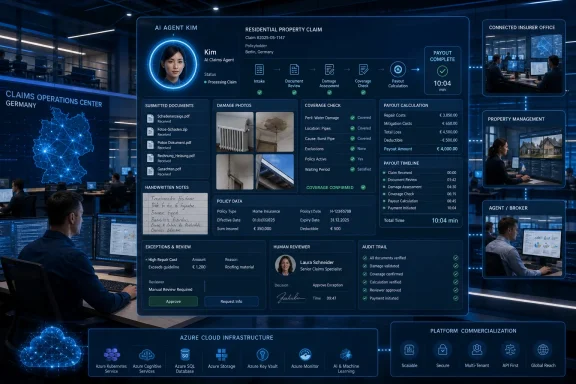
Technology Record reported the latest figures on August 10, citing Domcura’s work with Microsoft and AI consultancy Aithoria on Microsoft Foundry and Azure. The report describes a system that ingests claims paperwork, evaluates documents and photos, requests missing information, performs coverage checks, calculates compensation, and uses large-language-model chat functions to guide customers through reporting a loss.
The available record shows this is an improvement of an existing production service, not the debut of a new AI claims platform. Domcura publicly introduced Kim in October 2024, and insurance-industry reporting at the time said complete, straightforward cases could be handled in roughly 15 minutes, including a final four-eyes approval by employees. Domcura’s current 10-minute figure therefore suggests a five-minute reduction in its advertised best-case process rather than a sudden replacement of claims handling across the board.
Kim has been running since 2024, with humans still in the decision chain
Domcura describes Kim as the first AI employee in the German insurance industry, an expansive marketing claim that is difficult to verify across the full market. What is clear is that Kim was already in operational claims processing by late 2024. In an interview with Pfefferminzia, then-Domcura chief executive Uwe Schumacher said the system read handwritten notes, analyzed damage photos, checked submitted materials for completeness, compared the case with a customer’s policy, calculated compensation, and communicated the result to customers and brokers.
That interview attached an important qualification to the speed claims: Kim could complete the end-to-end process in around 15 minutes when it had every required document and detail, including a human four-eyes release. The current Technology Record account refers to “qualified claims,” but does not define which claim types qualify, the value limits involved, the percentage of claims that meet the criteria, or whether the 10-minute measurement includes the same human release and payment execution.
Those omissions matter more than the difference between 15 and 10 minutes. A simple residential property claim with clear coverage, usable photos, a known policyholder, and complete documentation is a fundamentally different workload from a disputed water-damage case, a suspected fraud claim, or a loss involving coverage interpretation. Automated intake and documentation checks can deliver substantial gains in the first category without proving that the difficult work has been automated.
Later reporting supports the view that Kim is deployed at material scale rather than confined to a demonstration. In 2025, Domcura executive Marcus Wollny said more than 12,000 cases had been processed by Kim, while a Domcura presentation cited by the insurance sector said the system handled about 80 percent of property claims. Neither figure is accompanied by an independently audited methodology, so they should be treated as company-reported operational measures. They do, however, make the 10-minute claim more credible as a production benchmark than as a hackathon prototype.
The 50 percent savings figure lacks the measurement readers need
Domcura’s reported 50 percent reduction in operational costs is the least transparent claim in the announcement. Technology Record does not state the baseline period, whether the calculation includes Azure consumption, model-inference charges, implementation work, partner fees, internal engineering, compliance controls, or the retained employee review process. It also does not say whether “operational costs” means the cost per claim, costs for the claims department, or a narrower slice of document processing.
For IT leaders, that distinction is decisive. An insurer can halve the manual handling time for selected, complete claims while increasing total technology spending during rollout, especially when document intelligence, storage, identity controls, monitoring, model usage, and exception handling are included. The more defensible reading is that Domcura has reported a 50 percent reduction in the operational cost metric it uses internally; it has not published enough detail for customers or competitors to reproduce the result.
Microsoft Foundry itself does not eliminate those costs. Microsoft positions Foundry as a platform for building, governing, evaluating, and monitoring AI applications and agents, while Azure Document Intelligence provides document extraction and analysis. Those services supply the building blocks; Domcura’s actual advantage lies in its claims rules, policy data, workflow integrations, exception handling, and controls over when Kim can act. The difficult part is not extracting text from an invoice. It is deciding whether the invoice, damage evidence, policy conditions, and claim history justify a payment.
That division of labor also explains why the “completely replaces traditional workflow systems” claim attributed to Domcura IT director Lars Malinowsky should be read cautiously. Kim may replace or bypass portions of a legacy claims workflow for eligible cases, but the public descriptions still show it relying on structured business rules, policy data, document collection, human escalation, and final review paths. Those are workflows, even if the user interface has shifted from forms and queues to an AI agent.
The productization effort is the bigger commercial shift
The most substantive new element is Domcura’s attempt to sell its internal operational capability outward. Technology Record says the insurer is working with Microsoft partner Public Cloud Group to become a software solutions provider and is offering Kim to other insurers. Domcura is not merely promising future resale: separate industry sources indicate outside adoption has already begun.
Property-insurance specialist INCON said it had integrated Kim, originally developed by Domcura and Microsoft, into its own claims management process. INCON said Kim automates repeatable work, performs formal coverage checks within seconds, and saves more than an hour of manual work per case through automated checks and follow-up actions. Those are INCON’s claims, rather than independently verified performance data, but they confirm that Kim has been used outside Domcura.
RVM, a broker and insurance services group, also described an event in Munich on January 21, 2026 called “KIM powered by Domcura & Microsoft — Future of Claims Settlement.” In its customer magazine, RVM said it had deployed a related AI-supported vehicle-claims process and presented its experience at the event. The evidence therefore supports the basic commercialization claim, though the market offer is still opaque: no public pricing, licensing terms, supported policy-administration systems, data-residency choices, service-level commitments, or customer list was disclosed in the Technology Record account.
That lack of product detail is significant for insurers evaluating Kim as a purchase rather than an internal transformation project. A white-label claims engine needs more than a chatbot and OCR. Buyers will want to know where policy and claim data reside, how each determination can be explained and audited, how access is segmented across insurers, whether models or prompts are shared, what happens when confidence is low, and who carries responsibility for an erroneous decision.
Azure provides scale, but regulation sets the operating boundary
Domcura says Kim runs continuously and scales automatically in Azure during surge events. That is a practical attraction for home-insurance underwriting, where floods, storms, and freeze events can produce abrupt spikes in claims volume. The immediate operational benefit is not simply faster payment; it is the ability to acknowledge claims, identify missing material, prioritize likely straightforward cases, and keep human handlers available for customers whose situations are complex or urgent.
The insurer has emphasized regulation and compliance, yet the reporting offers few implementation details beyond the use of Azure-hosted services. There is no public description of Kim’s audit trail, model-evaluation regime, human override process, error thresholds, retention policy, or procedure for contesting an AI-assisted claim decision. Microsoft Foundry includes tooling for governance and monitoring, but deploying those controls is an organizational decision, not an automatic feature of using the platform.
Domcura’s earlier public comments point to a more realistic operating model than the “workflow replacement” language suggests: employees are freed from routine, complete claims and redirected toward exceptions, complexity, and customer contact. That is a credible use of generative AI and document automation in insurance. It also means the quality of the exception queue will determine whether the system improves service overall or simply transfers unresolved work to a smaller group of specialists.
The record supports the conclusion that Kim is a genuine, maturing production system with external customers or partners, and that Domcura has improved its advertised turnaround time since 2024. The 10-minute and 50 percent figures remain vendor-reported results with undefined boundaries. For insurers, the next practical test is whether Domcura and its partners publish the integration, governance, pricing, and accountability terms required to make Kim a buyable claims platform rather than an impressive internal case study.