
As detailed in Microsoft’s Dynamics 365 blog, the server builds on its public preview and is now offered independently of Service Agent in Microsoft 365 Copilot. The practical change for IT teams is that an approved AI client can access governed Customer Service capabilities through the Model Context Protocol, or MCP, rather than relying on bespoke connectors and narrowly scoped Copilot extensions.
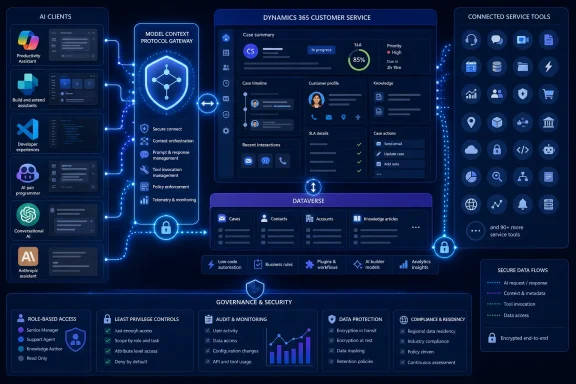 A Dataverse-Governed Route Into AI Clients
Microsoft is positioning the service around the Microsoft-hosted Agent 365 Tooling Gateway, which authenticates users against an organization’s Dataverse environment. That matters because tool access is intended to respect existing Dataverse roles and permissions rather than introduce a parallel permission model for AI agents.
The company says the server can connect with Microsoft 365 Copilot, Copilot Studio agents, Visual Studio Code, GitHub Copilot CLI, and other MCP clients supporting HTTP-based connections. Microsoft explicitly calls out ChatGPT and Claude Code as examples, although deployment teams will need to validate each host’s MCP support, enterprise controls, and audit posture before treating those clients as production endpoints.
For Windows administrators and developers, the immediate appeal is architectural: Customer Service actions can be exposed once through MCP and then reused across AI experiences. That does not eliminate integration work altogether—identity, tool selection, data-loss controls, and user access still need careful configuration—but it can reduce the maintenance burden of building client-specific interfaces.
More Than 90 Tools Put Actions Beside Answers
Microsoft says general availability includes more than 90 service-oriented tools. The catalog spans routine case handling, customer and contact lookups, knowledge operations, email drafting and sending, activity logging, Dataverse queries, and administrative customization.
That breadth moves the product beyond a read-only knowledge connector. A compatible AI experience can reportedly identify the next case in a queue, summarize and update a record, reassign or resolve a case, inspect SLA status, generate or send email, create a case from an email, and search across entities.
This is the more consequential part of the announcement. An AI assistant that can retrieve a customer’s history is useful; one that can act on a case record, send correspondence, or publish approved knowledge content needs substantially tighter operational guardrails. Organizations should begin with narrowly scoped roles and non-destructive tools, then expand only after reviewing logs, approval paths, and real-world failure modes.
Extensibility Is Also the Governance Test
Microsoft’s design also allows administrators to register external MCP servers and Copilot Studio agents alongside the built-in Dynamics 365 tools. That offers a path to assemble a broader service workspace, where Customer Service can sit beside line-of-business systems without forcing agents to switch interfaces.
But the same flexibility creates a new governance boundary. Each added MCP server can expand what an AI host is able to discover and invoke, making inventory, least-privilege configuration, testing, and lifecycle ownership essential. Microsoft’s existing guidance already identifies the older D365 Service MCP Server as deprecated and recommends the newer Dynamics 365 Customer Service MCP Server, so customers with preview-era implementations should plan for that transition rather than extend the legacy toolset.
The GA release gives Dynamics 365 Customer Service shops a standardized route into the fast-growing MCP ecosystem. The next challenge is less about connecting a client than deciding which AI clients—and which customer-service actions—should be trusted to operate on production Dataverse data.
