
The R2750DB MK2’s appeal is straightforward. It combines a three-way driver layout, 144W RMS amplification, HDMI eARC, optical and coaxial digital inputs, analogue line-in, LDAC Bluetooth, a subwoofer output and app-based firmware updates in one powered pair. Digital Foundry found the result well balanced, articulate with dialogue and vocals, and easily loud enough for desktop or media-centre use. Independent retail listings in Japan and the US corroborate the core hardware claims: two 7-inch woofers, 4.5-inch midrange drivers, 1-inch silk-dome tweeters, 45Hz–40kHz claimed response, HDMI eARC and Bluetooth 6.0 with LDAC.
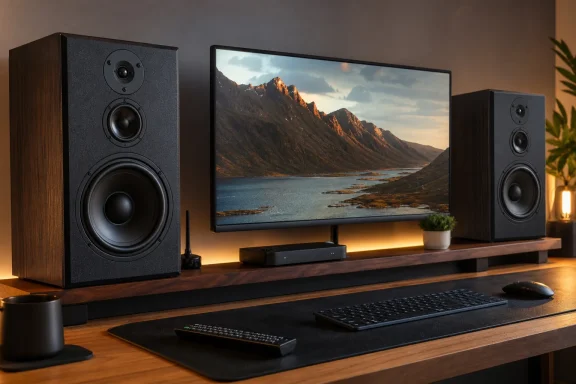
But the “best £300 PC speakers” framing needs an asterisk the size of the cabinets. Each speaker measures roughly 223mm wide, 395mm tall and 280mm deep; the pair weighs 16.57kg. These are not the compact powered monitors most PC buyers picture beside a 24- or 27-inch display. They are closer to small hi-fi loudspeakers that happen to include the electronics, and their placement will determine whether the purchase feels like an upgrade or a desk-management mistake.
 A three-way design changes the desktop proposition
Most powered PC speakers at this price use a two-way arrangement: a woofer handling bass and much of the midrange, plus a tweeter. The R2750DB MK2 adds a dedicated 4.5-inch midrange driver between its 7-inch woofer and 1-inch tweeter. In theory, that gives the system more headroom to keep voices, guitars, game effects and dialogue distinct when bass-heavy material is playing.
Digital Foundry’s listening impressions align with that expectation. The publication reports good instrumental separation and particularly strong treatment of vocals and dialogue, two qualities that matter more to daily PC use than a headline power number. Competitive games, video calls, streamed TV and spoken-word media all expose weak midrange performance quickly; a speaker that can make dialogue intelligible without making the rest of the mix thin has practical value.
The specification is not a substitute for measurement, however. Edifier’s 45Hz low-end claim indicates these can reach substantially lower than tiny desktop speakers, but it does not tell buyers how loud that bass remains, how linear it is, or how a rear-ported cabinet will behave against a wall. Digital Foundry heard a balanced presentation rather than a bass-first tuning, while also suggesting that cinematic games and bass-centric music could still benefit from a separate subwoofer.
That assessment is more useful than treating 144W RMS as a verdict. The R2750DB MK2 is likely capable of moving far more air than a typical soundbar or compact monitor pair, but low-frequency performance is inseparable from room size, desk position and listening distance. A 7-inch woofer can be an advantage; it can also be excessive in a small room with the speakers pushed into corners.
HDMI eARC is the connection that gives these an edge
The feature that most clearly separates the R2750DB MK2 from studio-oriented powered monitors is HDMI eARC. Connected to a compatible television, the speakers can receive stereo PCM audio over HDMI and work with the TV’s volume controls through HDMI-CEC, avoiding the awkward split between a television remote and a separate speaker remote.
That is a meaningful quality-of-life advantage for a desk that doubles as a console or TV setup. Optical input delivers clean digital audio too, but usually leaves volume control to the external speaker system. For a PC, optical, coaxial or line input may be more relevant depending on the hardware; HDMI eARC is designed principally for televisions rather than a standard desktop monitor connection.
There is an important limitation in the supplied specification: eARC support is described as PCM stereo. Buyers should not mistake the HDMI port for an Atmos or multichannel home-theatre decoder. The R2750DB MK2 is a 2.0 system, and its task is to reproduce a stereo mix well. That can sound substantially better than a small soundbar, as Digital Foundry argues, but it is not a replacement for surround speakers where positional rear or height channels matter.
The subwoofer output also deserves a more restrained reading than product listings often give it. It is useful because it offers a later path to more low-end extension, but the review did not test it, and the supplied material does not establish whether the output has a configurable crossover. Anyone purchasing primarily for deep film or gaming effects should budget and plan as if a subwoofer may be necessary rather than assuming the 7-inch woofers settle the matter.
Bluetooth is convenient, but Apple users do not get LDAC
Edifier’s Bluetooth 6.0 implementation supports multipoint pairing and LDAC as well as SBC. The practical divide is not Bluetooth version branding; it is codec support. Modern Android devices that support LDAC can send higher-bitrate audio than SBC, while iPhones and iPads do not support LDAC and will use AAC or SBC depending on the speaker’s capabilities. The submitted review specifically identifies SBC as the fallback in this case.
For a desktop speaker that may also handle a phone or tablet, multipoint is welcome. It permits two devices to remain paired, even though only one can send audio at a time. The annoyance Digital Foundry identified is that the speakers must be switched to Bluetooth input before the Edifier ConneX app can connect. That makes the app less suitable as an always-available control panel for a PC or TV source.
The app’s firmware-update function is a more consequential feature. Active speakers increasingly contain Bluetooth radios, DSP, input switching and HDMI control logic; those are all areas where bugs can be corrected after sale. Edifier’s ability to deliver firmware updates is preferable to a sealed-off product, though it also means buyers should check for updates during setup rather than assuming the shipped software is final.
The missing controls matter at a PC
Digital Foundry identifies the R2750DB MK2’s biggest ergonomic omission: there is no convenient front-facing volume control or headphone jack. The main adjustments are at the back of the active right speaker, with the supplied remote and mobile app filling the gap.
That is less troublesome in a living-room installation, especially through HDMI eARC, than at a Windows desk. PC users commonly change volume several times an hour, switch to headphones for a call, or need a fast mute control. Windows can handle system volume from the keyboard, of course, but analogue sources and separate devices make physical controls more valuable. A front knob is mundane hardware, yet it is often the difference between a speaker that feels integrated into a workstation and one that feels like a hi-fi component parked beside it.
The cabinet scale compounds the issue. To position the tweeters near ear height, many desk setups will need stands or risers. At nearly 40cm tall, a pair can block sightlines, crowd a monitor arm’s range of motion or push displays too close together. Digital Foundry managed them beside a 32-inch monitor on a 180cm-wide desk, which is useful evidence of feasibility, but it should not be read as a universal desktop-sizing recommendation.
The price claim is stronger than the superlative
Digital Foundry’s review supports the idea that Edifier has put an uncommon combination of acoustic hardware and connections into this class of active speakers. It does not establish that the R2750DB MK2 is categorically the best £300 PC-speaker choice, because no comparative lab measurements or direct shootout with competing products accompany the verdict.
The stronger buying case is specific. Choose the R2750DB MK2 if you have the physical room for big cabinets, want a single powered pair for a Windows PC and television, value HDMI eARC, and prefer clear dialogue and broad connectivity over a compact footprint or front-panel convenience. Avoid treating them as nearfield studio monitors by default, or as a simple soundbar substitute that can be tucked under a display.
For the right desk or media setup, the R2750DB MK2’s size is the feature that enables its stronger sound. For the wrong one, it is the reason a nominally excellent £300 speaker pair becomes an expensive obstruction.