
That is the useful core of a new Winston & Taylor analysis, originally published in Law360, which maps the overlapping rules that can attach to conversational AI. Its timing is unusually important: the European Union’s AI Act transparency obligations took effect on August 2, 2026, while the Federal Trade Commission is still considering its separate proposed policy on AI-output accuracy after its July comment period closed.
The article is right to warn operators against treating this as a single “AI disclosure” problem. But the regulations do not all demand the same thing, apply to the same party, or create the same risk. A banner reading “This chat may use AI” can help, but it does not independently settle whether an operator has obtained consent to record a conversation, complied with SMS rules, accurately described its bot’s capabilities, or given an EU user the notice required for a direct AI interaction.
For Windows administrators and development teams deploying a bot through a website, a customer relationship platform, Microsoft Copilot Studio, Azure-hosted services, or a third-party customer-support platform, the decisive question is no longer whether the foundation model was built in-house. It is what the organization itself presents to users, captures from them, and sends to vendors.
 The FTC proposal is not a new chatbot-labeling rule
The Winston & Taylor piece connects the FTC’s July 1 proposed policy statement on “suppression of accuracy” with consumer-facing chatbot disclosure. The connection is directionally sensible, but it needs a sharper boundary.
The FTC’s proposal is aimed at companies that market AI systems while allegedly steering their outputs toward undisclosed ideological objectives contrary to reasonable expectations of objectivity and accuracy. It frames that conduct as potentially deceptive under Section 5 of the FTC Act when it conflicts with explicit or implied representations about the system’s effectiveness or suitability.
As of August 16, the FTC’s own public record still calls this a proposed policy statement, not a final rule or a new enforceable chatbot-specific disclosure mandate. The public-comment deadline was July 31. Operators should not portray the proposal as though it has created a nationwide requirement to label every support chatbot.
Yet the underlying Section 5 risk remains real and older than the proposal. If a company tells customers that its assistant is an impartial product finder, an accurate account-information tool, or a reliable technical-support channel while deploying undisclosed behavior that materially changes the result, the legal exposure rests on the company’s representations and the net impression of the interaction. “The model made the decision” is not a useful defense when the company selected the prompts, guardrails, knowledge sources, interface, and claims around the bot.
The more immediate FTC signal for chatbot operators remains the agency’s September 2025 Section 6(b) inquiry into seven companies offering AI companion products. That inquiry was not an enforcement action. Still, the FTC specifically sought information on disclosures, advertising, data handling, safety testing, children and teens, monetization, and how companies process user inputs and generate responses. Those are exactly the records a mature chatbot deployment should be able to produce without reconstructing them after a regulator calls.
U.S. disclosure duties remain trigger-specific
There is no single general federal law that says every U.S. website chatbot must announce itself. The U.S. position is a patchwork of state statutes and broad consumer-protection rules, with each law tied to its own trigger.
Maine’s 2025 law is a clear example. It prohibits use of an AI chatbot or other computer technology in trade or commerce where it may mislead a reasonable consumer into believing they are dealing with a human, unless the consumer receives clear and conspicuous notice that they are not. A violation is treated as a violation of the Maine Unfair Trade Practices Act.
New Jersey’s bot law is narrower in its commercial trigger but concrete about timing. For communications connected to the sale or advertisement of merchandise or real estate, a bot operator must disclose at the outset, clearly and conspicuously, that the interaction is conducted by or through a bot. The statute also covers certain election-related communications.
Those statutes are not interchangeable. Maine turns on a reasonable-consumer deception standard in trade or commerce. New Jersey focuses on particular commercial and political contexts and expressly requires an up-front notice. Teams should therefore avoid a compliance matrix that merely says “AI disclosure: yes.” The matrix needs columns for jurisdiction, audience, use case, trigger, notice placement, exact notice text, and the evidence retained for each live version.
A generic footer will rarely be the safest implementation. A better pattern is an opening message that identifies the system plainly—“You’re chatting with Acme’s AI support assistant”—followed by a persistent visual indicator in the chat window and a nearby route to a human agent. The wording should match reality. Calling a tool “automated support” while its responses are generated by a large language model can create a fresh ambiguity rather than resolve one.
Europe’s Article 50 deadline has already arrived
The most consequential omission in the Winston & Taylor framing is temporal. It describes the EU AI Act as instructive while the Article 50 transparency duties are already applicable as of August 2, 2026.
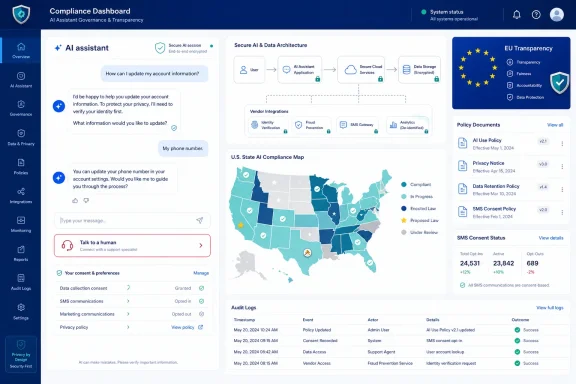
The European Commission’s guidance says providers of AI systems that directly interact with people, including chatbots, agents, and avatars, must ensure people are informed that they are interacting with AI unless that fact is obvious. The notice must appear from the start of the first interaction, in a clear and distinguishable form, and the “obvious” exception is to be interpreted narrowly.
This is not confined to European companies. The Commission says providers outside the EU are within scope if their AI system’s output is used in the EU. A U.S. company that makes its customer-support bot available to EU visitors cannot assume that incorporation in Delaware or hosting in a U.S. cloud region ends the analysis.
There is an important provider/deployer distinction. Article 50’s direct-interaction design obligation sits principally with the provider of the AI system. But an enterprise that configures a vendor platform under its own branding, exposes it on its own website, and determines the conversation flow should not assume the vendor’s boilerplate has solved the operational problem. Contractual allocation and regulatory responsibility can diverge, especially when the enterprise controls user-facing implementation.
The Article 50 grace period is also easily misunderstood. It applies narrowly to machine-readable marking and detection duties for certain AI-generated content under Article 50(2), for systems placed on the market before August 2. It is not a broad grace period allowing a public chatbot to remain silent about its AI identity until December.
A chatbot disclosure is not wiretap consent
The article’s most practical warning concerns litigation over third-party session-replay, analytics, and chatbot providers. In these claims, plaintiffs argue that a company invited a consumer to communicate with it but failed to disclose that another entity captured, processed, or analyzed the exchange.
The legal theory has appeared in litigation around web analytics and is extending to chatbot deployments. It should not be treated as settled law in every state or for every vendor architecture. Outcomes depend on the text of the applicable statute, whether a vendor was a party to the communication or a third-party interceptor, the nature of the data collection, the notice and consent language, and binding precedent in the relevant jurisdiction.
But the technical consequence is clear: an AI label is not enough. “You are interacting with an AI assistant” says nothing about whether messages are logged by an external provider, reviewed for quality assurance, used to improve a model, combined with session data, or transferred across regional boundaries.
Before launch, operators should be able to answer four basic questions:
- The team should identify every service that receives chat content, metadata, attachments, device data, session identifiers, transcripts, or derived analytics.
- The team should document whether each processor uses the data for service delivery only, retains it, trains models on it, or may disclose it to subprocessors.
- The team should separate a notice that the user is talking to AI from any recording, analytics, or third-party-processing notice and from any consent mechanism required by local law.
- The team should test whether an ordinary visitor can reach the relevant notice before entering sensitive account, health, financial, employment, or payment information.
This work cannot be delegated entirely to legal or privacy teams. The answer may be hidden in a JavaScript tag manager, a CRM integration, a support-platform configuration, an Azure logging setting, a vendor’s model-improvement toggle, or a transcript export job owned by operations.
SMS handoffs need their own consent design
A bot that offers to text a customer with an order update, a quote, or a follow-up conversation crosses into a separate compliance track. The Telephone Consumer Protection Act and state counterparts can impose requirements that differ sharply depending on whether a message is transactional, informational, or marketing.
The FCC’s revised opt-out protections took effect in April 2025. Businesses must honor marketing opt-outs and allow revocation of consent through any reasonable means. A chat interface should therefore not bury “Reply STOP to cancel” in a lengthy terms screen and then ignore a user who writes “don’t text me again” in the chat itself.
A double opt-in is not always legally required, but it can provide cleaner evidence for automated marketing texts. More importantly, the consent screen should not force users to accept promotional texts as the price of getting ordinary customer service. A bot that collects a phone number to solve a technical problem should make clear what messages will follow, from whom, and how the user can stop them.
Build an evidence trail, not a disclaimer archive
The compliance control that will matter most after an incident, complaint, or demand letter is the ability to reconstruct the experience a particular user actually received. Static policy pages are weak evidence if the bot’s prompt, vendor configuration, routing logic, disclosure text, and data settings change every few weeks.
Operators should version the user-facing introduction, system prompts, knowledge sources, model versions, escalation rules, retention settings, vendor terms, and consent flows. They should preserve release dates and test results, including screenshots or recordings of the notice as rendered on mobile and desktop. A meaningful review also needs adversarial testing: Can the bot impersonate a human? Does it imply professional or binding advice? Does it make unsupported commitments? Does it solicit sensitive data before the user sees the notice?
The point is not to make every customer-service interaction feel like a legal intake form. It is to keep the AI identity and material data practices visible while routing consequential decisions to accountable people.
For organizations with EU-facing traffic, the first action is overdue: verify that every direct chatbot interaction offers a clear AI notice at the beginning of the conversation. For U.S.-only operators, the immediate task is narrower but no less concrete—replace the single “AI disclaimer” with an inventory of state disclosure triggers, third-party data flows, consent mechanisms, and messages the bot actually sends.
