

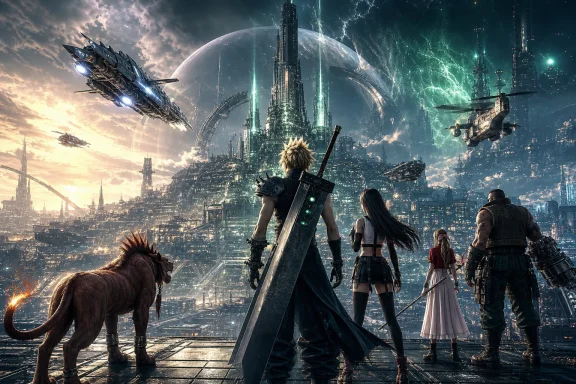
The name and date deserve care because early reporting contained two easily repeated errors: the official title is singular—Revelation, not Revelations—and the launch year is 2027, not 2026. Square Enix’s announcement identifies Revelation as the third and final entry in the Final Fantasy VII Remake Series.
For Windows users, this is a clear availability announcement, but it is not yet a complete PC-buying guide. Square Enix has named the stores, editions, and release date, while PC system requirements remain unannounced. That leaves meaningful questions about hardware readiness, feature support, and how the different PC storefront options will compare closer to launch.
Release date and PC storefronts
FINAL FANTASY VII REVELATION is scheduled for Thursday, April 8, 2027. PC players will be able to find it through Steam, the Epic Games Store, and Xbox on PC. Xbox Series X|S is also a confirmed console platform.
That three-store PC plan matters in practical terms. It gives Windows players a choice of ecosystem rather than limiting the game to a single launcher or storefront. Players who maintain libraries on Steam or Epic will have a route to buy there, while people primarily using the Xbox PC environment will also have an official option.
What has not been announced is just as important for someone deciding whether to upgrade a desktop or handheld PC. Minimum and recommended specifications have not been published; the current PC store information leaves the operating-system requirement as to be determined. There is therefore no verified basis yet for claims about performance targets, storage space, ray tracing, ultrawide displays, upscaling technologies, controller support, or compatibility with particular Windows handhelds.
The sensible conclusion is straightforward: the release date is reliable enough to plan around, but not enough to judge whether an existing PC will run the game well. Players considering a hardware purchase chiefly for Revelation should wait for Square Enix’s formal PC requirements and technical details.
The Xbox position: confirmed platform, incomplete entitlement picture
Xbox Series X|S is among the launch platforms, and Xbox on PC is explicitly named as a PC destination. Microsoft’s store information also describes an Xbox Trilogy Edition containing Revelation for PC and Xbox Series X|S, with Xbox Play Anywhere capability attached to that listed bundle.
That wording is useful, but it calls for a precise distinction. It supports an expectation of cross-device purchase treatment for the listed Trilogy Edition; it does not establish that every edition or standalone purchase of Revelation will necessarily have identical Xbox Play Anywhere terms. Until individual store listings and edition descriptions are fully detailed, buyers who care about owning the game across console and PC should check the entitlement label on the exact product they intend to buy.
This is more than fine print. A player with both an Xbox console and a Windows gaming PC may value a single purchase far more highly than separate versions. Conversely, someone committed to Steam may prefer that ecosystem’s library and launcher even if the Xbox edition offers a different cross-device proposition. The announcement confirms the broad choices, but prospective buyers should avoid assuming all storefronts provide the same ownership, save, or account behavior before those terms are specified.
A finale built around broader exploration and party control
Square Enix’s gameplay materials point to an ambitious closing chapter, while providing enough concrete detail to separate confirmed systems from trailer speculation.
The Highwind airship will be used for exploration. That signals a new travel layer for the party and is one of the most recognizable elements of the original Final Fantasy VII being brought into this trilogy’s final installment. The announcement also confirms Piko, a chocobo that functions as both a mount and a combat ally. Piko has new traversal and combat abilities, although the full range of those actions has not been detailed in the published text.
Players will be able to switch both the actively controlled character and the party composition while exploring. That could have a substantial effect on the moment-to-moment experience: rather than treating party setup solely as a pre-battle decision, the game is presenting it as part of navigating the world. Square Enix also says players can use a grappling gun to scale rooftops and navigate a city.
There is an important boundary around that last point. The official description confirms the rooftop traversal mechanic and city navigation, but it does not name the city in that description. Specific claims tying the grappling sequence to Wutai go beyond what has been confirmed in the available primary announcement material.
Quest design appears intended to make party selection matter beyond combat as well. Square Enix says certain quests let players assign party members in ways that affect some events and scenarios. That is a potentially meaningful narrative-system promise, but its scope remains unknown. It should not yet be read as proof of radically branching story routes or entirely separate campaign outcomes. The confirmed claim is narrower: party assignments can influence some quest events and scenarios.
FITS adds four combat-oriented play styles
Revelation introduces FITS, short for the Function-Integrated Tactical Suitwear system. Square Enix describes these as uniforms with unique move sets intended to customize play styles. The four specialized FITS types are:
- Warrior
- Knight
- Black Mage
- Summoner
The materials identify Cid in Knight FITS and Vincent in Summoner FITS. In a series already centered on a multi-character party, a uniform-based system may give Square Enix another way to differentiate roles and personalize combat approaches.
Still, the announcement does not spell out the precise mechanical relationship between FITS and older Final Fantasy job systems. The labels will naturally invite comparisons to familiar job archetypes, but a resemblance in naming is not confirmation that the system reproduces earlier games’ abilities, progression, or restrictions. Similarly, the footage may prompt detailed interpretations of individual attacks, but only the broad FITS setup, the four types, and the identified Cid and Vincent examples are established here.
This distinction matters because feature trailers often invite a degree of extrapolation that later proves inaccurate. The confirmed takeaway is compelling on its own: Revelation has a new loadout-like system designed to alter move sets. The deeper rules—whether outfits can be freely swapped, how they are unlocked, and how they interact with each party member—remain to be explained.
Queen’s Blood returns, with Red XIII in focus
The card game Queen’s Blood will return in Revelation, and it will include a new storyline centered on Red XIII. That is a notable confirmation for players who engaged with the game’s side activities in the prior entry.
Its inclusion suggests that Revelation will not treat the finale solely as a rush toward its main plot and large-scale combat systems. It preserves at least one established optional-style activity while giving it a character-focused narrative thread. However, Square Enix has not yet laid out the size of that storyline, whether its rewards affect the wider game, or how the card game’s rules may change. Those are reasonable questions for later previews, not facts established by the launch announcement.
Editions, prices, and the Nintendo Switch 2 exception
Square Enix has outlined an extensive U.S. edition lineup. The physical Standard Edition is priced at $69.99, the physical Deluxe Edition at $99.99, and the physical Collector’s Edition at $349.99. The Collector’s Edition is exclusive to the Square Enix Store.
Digital editions are listed as follows:
- Standard Edition: $69.99
- Premium Edition: $99.99
- Premium Plus Edition: $109.99
- Trilogy Edition: $84.99
The price structure makes the Trilogy Edition particularly relevant to newcomers or people who have not acquired the earlier installments, while premium tiers are aimed at players seeking added content or collectibles. The announcement does not, by itself, make one edition universally better. Buyers should compare the items included with their preferred platform edition rather than treating a higher price as a guarantee of more useful game content.
Pre-orders are available in physical and digital form, but there is one explicit exception: digital Nintendo Switch 2 pre-orders will open later. It is therefore inaccurate to say that every digital platform is already available for pre-order. The practical advice is to verify availability on the chosen store rather than relying on a blanket claim about all platforms.
Story DLC is planned, not dated
Square Enix has also announced a Story Expansion Pass with two planned additions: Story DLC 1: Sephiroth and Story DLC 2: Vincent & the Turks. Both are planned for release between Winter 2027 and Spring 2028, and each may be sold separately after release.
The window is broad, and the company says planned dates and content can change. As a result, April 8, 2028 should not be treated as a confirmed point by which the full post-launch story package will be available. No individual DLC dates, detailed scope, or final content breakdown has been announced.
For players who prefer to experience a game only after all major story additions are available, patience may be warranted. For those focused on the core finale, the base game is still set for April 2027. Neither choice is inherently better: it depends on whether playing at launch or waiting for a more complete announced content slate is the priority.
What Windows and Xbox players can plan for now
The key facts are unusually clear for a game this far from release. FINAL FANTASY VII REVELATION is the trilogy’s final chapter, it launches April 8, 2027, and PC is included day one through Steam, Epic Games Store, and Xbox on PC. Xbox Series X|S is also confirmed, while the listed Trilogy Edition carries an Xbox Play Anywhere designation.
The gameplay announcement provides concrete reasons for interest: Highwind exploration, Piko’s combined traversal-and-combat role, explorable-city movement through a grappling gun, changing active characters and parties in the field, quest events shaped in part by party assignments, FITS uniforms, and Queen’s Blood’s Red XIII-focused return.
The remaining unknowns are equally practical. PC specifications have not arrived. Storefront and edition entitlements need close reading. And the two announced story DLCs have a release window rather than firm dates. Revelation now has a date and a broad platform plan; the technical and purchasing details Windows players need for a confident buying decision will have to come later.