

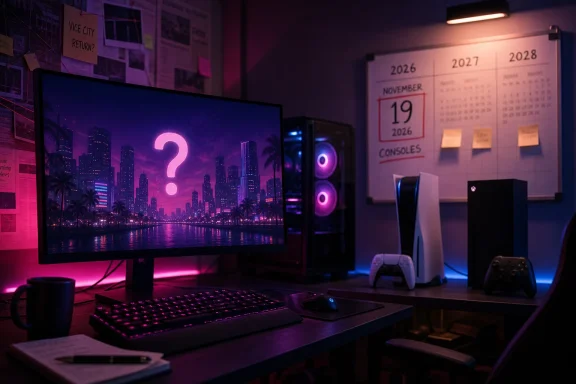
The honest answer is therefore frustratingly simple: nobody outside Rockstar and Take-Two knows when GTA VI will come to PC, or whether Rockstar will announce it before the console release. The company’s official game, support, preorder, and investor materials continue to name only the two current console platforms. That absence is more useful than the rumor mill: PC preorders, Steam listings, system requirements, Rockstar Games Launcher pages, and a release date do not exist.
For a Windows player deciding whether to wait, late 2027 is a reasonable earliest expectation, not a forecast to put on a calendar. A release in 2028 would also fit Rockstar’s record at least as well.
The console date does not create a PC countdown
Rockstar’s November 19, 2026 date is firm enough to anchor the discussion, but it does not establish a standard PC delay. The publisher has followed different paths with each major release, and the gaps often reflected product strategy, development schedules, and changing console generations rather than a repeatable porting formula.
Grand Theft Auto IV reached PC on December 2, 2008, roughly seven months after its April 2008 PlayStation 3 and Xbox 360 debut. Grand Theft Auto V is the more painful comparison: it launched on Xbox 360 and PlayStation 3 in September 2013, arrived on PlayStation 4 and Xbox One in November 2014, then came to PC in April 2015—19 months after the original console launch.
Red Dead Redemption 2 took a middle course. It launched on PS4 and Xbox One on October 26, 2018; Rockstar announced its PC version almost a year later, in October 2019, and released it on November 5, 2019. That was just over 12 months from console release to PC availability.
Apply those historical gaps mechanically to GTA VI’s November 19, 2026 console date and the result is a wide window:
- A seven-month gap comparable to GTA IV would point to June 2027.
- A 12-month gap comparable to Red Dead Redemption 2 would point to November 2027.
- A 19-month gap comparable to GTA V would point to June 2028.
Those dates describe old release patterns, not evidence about GTA VI’s production. The major correction to the “not before November 2027” claim is that Rockstar’s own history includes a shorter seven-month turnaround. June 2027 cannot be ruled out by precedent. It also cannot be treated as likely simply because it is mathematically possible.
Rockstar has not even made the first PC commitment
There is an important distinction between a delayed PC version and an unannounced one. In previous cycles, players eventually got a formal Rockstar statement identifying PC as a platform, followed by system requirements, release timing, storefront details, and PC-specific features. GTA VI has none of that public paperwork today.
That means the most credible expectation is not “the PC port is definitely coming on a certain month.” It is that Rockstar will eventually need to make a distinct PC announcement before a launch can happen. The absence of that step leaves several core technical and commercial questions unanswered:
- Rockstar has not said whether GTA VI on PC would launch through Steam, Epic Games Store, the Rockstar Games Launcher, or some combination of those storefronts.
- Rockstar has not published minimum or recommended hardware requirements, performance targets, graphics features, ultrawide support, or input options.
- Rockstar has not said whether a future PC edition would arrive alongside a new version of GTA Online, include cross-platform play, or share progression with console accounts.
- Rockstar has not defined how it would handle the modding and roleplay community that became a major part of GTA V’s PC afterlife.
The last point is especially significant. Take-Two acquired Cfx.re, the team behind FiveM and RedM, in 2023. That made the relationship between Rockstar’s official online business and the enormous PC roleplay scene more direct, but it did not produce a public GTA VI PC plan. Anyone claiming that FiveM guarantees a simultaneous—or early—PC online launch is filling a genuine information vacuum with a convenient narrative.
The “core consumer” explanation is not a release plan
PC Gamer based part of its analysis on comments from Take-Two chief executive Strauss Zelnick, who told Bloomberg in May that Rockstar begins on consoles because it is judged on serving its “core” consumer. In the same discussion, Zelnick said PC could represent 45% to 50% of sales for a major Take-Two launch.
Those statements make the company’s position clearer, even if they do not make it more satisfying for PC customers. Take-Two does not appear to be arguing that PC lacks commercial value. Its chief executive described PC as potentially accounting for nearly half of sales in the right circumstances. The choice is instead one of sequencing: Rockstar is putting the console version first and is not publicly explaining the length of the gap.
That leaves two explanations that should not be confused. A staggered launch can give a studio more time to optimize a technically ambitious game across a much broader range of CPUs, GPUs, memory configurations, display modes, drivers, and operating-system environments. It can also create a second marketing and sales moment later. Both can be true, but neither proves that Rockstar is deliberately trying to make customers buy GTA VI twice.
The “double-dip” theory is common because GTA V was sold across two console generations before the PC release. It is a reasonable commercial suspicion, not a confirmed Rockstar strategy for GTA VI. There is no official statement saying that a PC edition will be timed for a next-generation PlayStation or Xbox refresh, and no announced next-generation version of GTA VI to pair with it.
Why 2028 is still a live possibility
The optimistic case for PC is that Rockstar has more experience shipping large-scale PC versions today than it did during the GTA V era. The current console hardware is also based on PC-like AMD technology, which may reduce some of the architectural distance involved in a port. But reduced distance is not the same as a simultaneous release commitment.
Rockstar’s PC releases have historically been treated as full products with distinct technical work, rather than a checkbox at the end of a console build. GTA V’s PC edition brought extensive graphics settings, higher visual limits, first-person mode support, and the Rockstar Editor. Red Dead Redemption 2 added a range of graphical and technical enhancements, but its launch also encountered widely reported problems for some PC players, including launcher and startup failures that required post-release fixes.
That history gives Rockstar an incentive to avoid promising a date before it can validate the PC version across the hardware it intends to support. It also makes a short advance notice entirely possible. The company announced Red Dead Redemption 2 for PC on October 4, 2019 and released it on November 5. A prolonged silent period would therefore not establish that a PC version is distant; it would simply be consistent with Rockstar’s past communication style.
What Windows players should actually watch for
The next meaningful GTA VI PC news will not be a social-media “insider” claiming a quarter or a retailer placeholder with an impossible price. It will be a Rockstar Games announcement that names PC alongside a release date, or a support page that begins listing PC editions and technical requirements.
Until then, do not buy a console under the assumption that PC availability is imminent, and do not plan a GPU upgrade around invented specifications. GTA VI’s confirmed console release is still more than three months away, and Rockstar has not provided enough public information to determine what a Windows version would require or when it would ship.
The earliest historical comparison puts PC in June 2027. The more defensible planning window begins in late 2027 and extends through 2028. But the only date that matters today is November 19, 2026—and it is a date for PS5 and Xbox Series X|S, not for PC.