

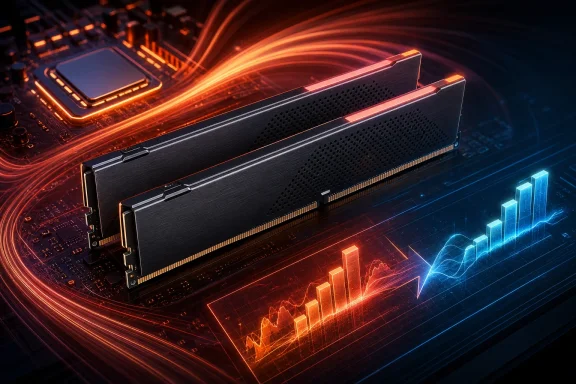
That makes the Flare X5X potentially interesting for a Ryzen desktop build, but it also makes it a product that needs unusually careful comparison shopping. Its confirmed specification is narrower than some initial coverage suggested, its price and retail timing remain unknown, and there are no independent benchmarks for this specific kit yet. EXPO ULL may be a worthwhile refinement, but it should not be treated as proof of a guaranteed gaming uplift on every AM5 system.
The confirmed Flare X5X launch specification
G.SKILL announced the Flare X5X series on August 31, 2026. At launch, the confirmed configuration is a 32 GB dual-channel kit made up of two 16 GB DIMMs, rated for DDR5-6000 at CL36-36-36-76 with an AMD EXPO ULL profile.
That final timing number matters because it is easy to compare the new memory with the existing Flare X5 line incorrectly. A standard Flare X5 DDR5-6000 32 GB kit has been specified at CL36-36-36-96. Early reporting that assigned the 96 value to the new Flare X5X appears to have conflated the established Flare X5 specification with the newly announced X5X kit. For buyers comparing product listings and reviews, the correct announced Flare X5X timing string is CL36-36-36-76, not CL36-36-36-96.
The modules use a minimalist, non-RGB design. That has a practical appeal beyond aesthetics: users assembling restrained workstation, living-room, or compact desktop systems do not need to pay for lighting hardware or manage another RGB software component. But it is a design choice, not evidence of a performance difference.
Several details that normally shape a memory purchase are not yet confirmed. G.SKILL had not disclosed a Flare X5X part number, module voltage, warranty terms, DRAM IC selection, module organization, or the complete set of timing values. There is also no confirmation of higher-capacity kits, different data rates, or tighter timing versions. Prospective buyers should therefore avoid assuming that a broader product stack will follow, even if it would be commercially plausible.
What EXPO ULL changes—and what it does not
AMD EXPO is the profile system that lets compatible AMD platforms apply validated memory-overclocking settings through firmware. EXPO ULL is an enhanced form of that idea. In addition to the familiar headline data rate and primary timings, its profile supplies additional tuned memory sub-timings. G.SKILL’s stated objective is lower latency at the same memory speed.
This distinction is meaningful. Two kits can both advertise DDR5-6000 and CL36 yet behave differently after their complete timing configurations are applied. The primary figures printed on packaging communicate only part of the memory configuration. Secondary and tertiary timing choices can influence the delay involved in particular memory operations, which is why a pre-tuned profile could deliver a benefit without an increase in the nominal transfer rate.
However, “could” is essential here. The launch material does not disclose the complete ULL sub-timing table, quantify the latency reduction, or show Flare X5X-specific benchmark results. As a result, it is not possible to establish how large the practical difference is between this kit and an equivalently specified standard EXPO kit, nor whether the effect persists across motherboard models and firmware versions.
AMD has made a broader platform-level assertion: certified EXPO ULL memory can provide an additional 4% average increase in frames per second compared with non-ULL EXPO memory. That figure is useful context for the technology, but it is not an independently verified result for the Flare X5X. It also is an average rather than a minimum performance guarantee. A buyer should not read it as a promise that this exact 32 GB kit will add 4% FPS in a particular game, at a particular resolution, with a particular graphics card.
In many real PC workloads, memory sensitivity varies substantially. A game constrained by GPU performance may show little visible benefit from a memory-latency adjustment. Some software and game engines can respond more strongly, while productivity workloads may prioritize capacity or other system factors. That variability is not an argument that ULL is useless; it is an argument for waiting for controlled, like-for-like testing before assigning a cash value to it.
Setup is not automatic: BIOS support is central
The DDR5-6000 EXPO ULL setting is an overclocking profile rather than the memory’s out-of-box default behavior. On compatible hardware, the DIMMs initially boot at SPD/default settings. To apply their rated ULL configuration, users need a compatible AMD processor and motherboard, a BIOS that supports the profile, and manual activation of the appropriate profile in firmware.
That has a few concrete implications for Windows users building or upgrading a Ryzen PC:
- Update expectations before purchasing. A motherboard may need a newer BIOS before it recognizes or correctly applies an EXPO ULL profile. The launch information does not name supported CPU models, board models, BIOS revisions, or QVL entries for the Flare X5X.
- Do not assume an EXPO label alone is enough. Standard EXPO support and EXPO ULL support are related but not necessarily interchangeable at the firmware level. Buyers should check the motherboard vendor’s support information once specific Flare X5X SKUs and compatibility lists are available.
- Treat stability testing as part of installation. Applying the profile changes memory settings from their default SPD state. A successful boot is encouraging, but it is not by itself a thorough stability verdict. Users relying on a PC for work, school, or sensitive data should validate the system after enabling the profile and monitor it for crashes, application errors, or unexpected restarts.
- Keep a recovery path in mind. If a memory profile does not train or prove stable, reverting to defaults through normal firmware recovery procedures may be necessary. This is ordinary memory-tuning reality, not a unique defect of Flare X5X.
The absence of a named BIOS baseline is particularly important. Information about a BIOS requirement for a related G.SKILL product family should not be carried over to Flare X5X. Until G.SKILL and board vendors identify the actual supported configurations, users need to verify support for the exact memory SKU and motherboard combination they plan to use.
Price and availability are still the largest buying unknowns
G.SKILL said Flare X5X availability would roll out in phases across worldwide markets. It did not announce a price, retailer list, country-specific timetable, or firm retail date.
This makes any current price forecast unsuitable as a buying recommendation. A reported estimate of roughly $509.99 is speculation, not an MSRP or an expected street price confirmed by G.SKILL. Nor is there enough public information to calculate a sensible premium over conventional DDR5-6000 EXPO kits.
That missing price is central to the product’s value proposition. If EXPO ULL commands only a modest premium and independent tests show repeatable gains in memory-sensitive games, the Flare X5X could become a straightforward option for users who want a low-profile Ryzen-oriented kit without manual timing work. If the premium is large, then conventional DDR5-6000 EXPO memory—or a higher-capacity kit better matched to the user’s application needs—could be the more rational purchase.
The phased rollout adds another practical complication. A specification advertised globally may not arrive at local retailers at the same time, and early availability can make comparisons difficult. Waiting for a product page, a final part number, local listings, and motherboard compatibility information is more useful than relying on generic launch descriptions.
Who should wait, and who should pay attention
For an existing AM5 system that already has stable DDR5-6000 EXPO memory, there is currently no evidence-based reason to regard Flare X5X as a must-have upgrade. The platform claim of improved FPS is not a product-specific benchmark, and swapping an otherwise suitable 32 GB kit for another 32 GB kit is hard to justify without a known price and independent performance data.
For someone planning a new Ryzen desktop, Flare X5X is more relevant—but still a watchlist product rather than an automatic purchase. Its confirmed 2×16 GB DDR5-6000 configuration, non-RGB presentation, and ULL-tuned profile form a coherent package for a mainstream gaming or general-purpose build. The questions to resolve before checkout are simple but consequential: Is the exact kit listed for the intended motherboard? Does the board’s current BIOS support EXPO ULL? Is its local price proportionate to measured gains? And is 32 GB the right capacity for the planned workload?
Users whose work needs more memory should not let a new latency feature overshadow capacity planning. There is no confirmed Flare X5X capacity beyond the initial 32 GB kit. Until larger variants are actually announced, buyers needing more memory should choose based on confirmed capacity, compatibility, and stability rather than waiting on unannounced versions.
A promising profile, not yet a proven product advantage
The Flare X5X announcement establishes a real technical distinction: its EXPO ULL profile adds tuned sub-timings, and the announced kit carries tighter final primary timing than the similarly named standard Flare X5 DDR5-6000 kit that helped cause early specification confusion. It also reinforces that memory profiles are increasingly a firmware-and-platform feature, not just a number printed on a DIMM heatspreader.
But the unanswered questions remain decisive. No independent Flare X5X latency or gaming testing has been published, the detailed timing configuration is undisclosed, compatibility specifics are not named, and no price has been announced. Until those gaps close, the sensible reading is that EXPO ULL is a potentially valuable refinement for compatible Ryzen systems—not a measured, universal performance upgrade that buyers should rush to purchase.