
Google announced the model on August 13, three weeks after Gemini 3.6 Flash. The Indian Express reported the launch and its emphasis on debugging, software planning, web development, and enterprise workflows; Google describes 3.7 Flash as its most capable “workhorse” model for coding and agents. The compressed release cycle is notable, but it does not by itself establish that the model represents a new foundation model or a wholesale architectural break from 3.6 Flash.
The practical catch is that Google’s strongest performance claims remain Google’s own measurements. Teams should treat Gemini 3.7 Flash as a candidate for controlled evaluation, not as evidence that it will replace an established coding model in production.
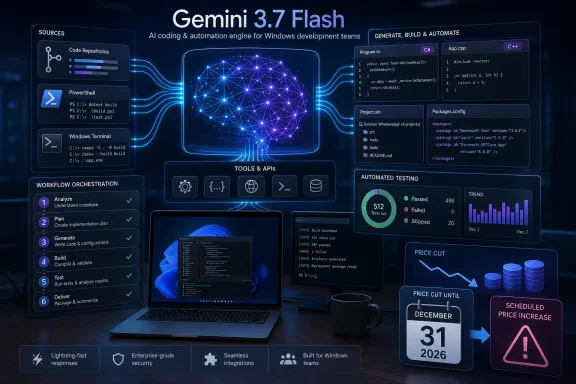 Google’s price cut has a fixed expiration date
Gemini 3.7 Flash is priced at $0.75 per million input tokens and $3.75 per million output tokens through December 31, 2026. On January 1, 2027, Google says those prices will rise to $1.50 for input and $7.50 for output per million tokens.
That makes the timing material for anyone building an agent workflow with a recurring token bill. A simple workload consuming one million input tokens and one million output tokens costs $4.50 under the introductory rate, then $9.00 at the scheduled standard rate. Actual agent costs can be much higher because an agent may repeatedly read source files, summarize intermediate results, query tools, and generate long patches before it completes one task.
Google says the introductory rate is half the original Gemini 3.6 Flash price. That is a clear commercial incentive to move new workloads onto the newer API now, particularly for businesses testing high-volume code review, ticket triage, document extraction, or internal support automation.
It is also a reason not to use launch-period token pricing as the basis for a multiyear business case. An engineering organization that approves a project because it looks economical at $4.50 per million mixed tokens needs to model the published January increase before it commits to an architecture, prompts, evaluation suite, and operational tooling tied to a single provider.
The submitted reporting from xpert.digital frames the offer as a deliberate lock-in move. The available record supports a narrower conclusion: Google has publicly announced a time-limited discount followed by a defined price increase. Whether customers remain after that increase will depend on measurable quality, latency, availability, data-handling terms, and the switching cost of their own integrations—not price alone.
Coding benchmarks show a large claimed jump, not an independent verdict
Google’s headline figures compare Gemini 3.7 Flash with Gemini 3.6 Flash on several coding and workflow benchmarks. The company reports 43.6 percent on FrontierCode 1.1 Main, up from 34.4 percent, and 65.3 percent on DeepSWE v1.1, up from 49.0 percent. It also reports a WebDev Arena score of 1,588 Elo, compared with 1,538 for the previous Flash model.
Those are meaningful deltas if they hold up in ordinary development work. A model that needs fewer correction prompts, produces smaller and more accurate code changes, or handles repository conventions better can save more than a model that merely has a higher benchmark score. This is especially true for teams using agents to investigate build failures, update dependencies, generate tests, or resolve narrowly scoped issues across large codebases.
But Google selected the test setup, model configuration, and comparison conditions behind its announcement. The figures are useful for deciding what to test; they are not yet an independent ranking of every coding model on the market. The xpert.digital report correctly notes that broadly recognized third-party test organizations had not yet published a corresponding independent result set for Gemini 3.7 Flash at the time of publication.
The company’s own material also does not show an across-the-board win. Google’s comparisons indicate that other models retain leads in at least some agent and software-engineering tests. That is unsurprising: coding agents are highly sensitive to the task definition. A model that performs well in a clean benchmark environment can still stumble on a Windows-specific build chain, undocumented internal APIs, a legacy .NET Framework application, PowerShell scripts with environmental assumptions, or a repository with conflicting instructions.
For Windows developers, the useful evaluation is not “Can Gemini 3.7 Flash generate a polished landing page?” It is whether it can complete the jobs that consume engineer time without creating a silent maintenance burden:
- It should fix a known issue in a representative .NET, C++, Python, or TypeScript repository while producing a reviewable diff.
- It should run and interpret existing test suites rather than declaring success after editing files.
- It should respect Windows paths, PowerShell behavior, package-manager conventions, line endings, and CI rules where those details matter.
- It should be measured for false fixes, regressions, unwanted dependency changes, and the rate at which an engineer must intervene.
A benchmark score does not answer those questions. A short, repeatable internal harness does.
Agent use changes the risk profile
Gemini 3.7 Flash is being positioned for agentic workflows: systems that plan multiple actions, invoke tools, inspect results, adapt to errors, and continue until they reach an objective. Google says the model improves instruction following, tool use, multi-step planning, and its ability to recover when it hits obstacles.
That positioning matters more than the usual “better at code” launch language. A conventional chat assistant can suggest a bad command and leave the user to decide whether to run it. An agent that has permission to execute commands, modify files, access a browser, query internal systems, or draft communications has a wider operational blast radius.
Google says Gemini 3.7 Flash is available through the Gemini API, Google AI Studio, Android Studio, and Google Antigravity, with enterprise availability through Gemini Enterprise offerings. Those channels make the model accessible to developers on Windows, but the announcement is not a Windows tooling release. Google has not presented it as a replacement for Microsoft’s developer stack, nor has it announced a special integration with Visual Studio, Windows Terminal, PowerShell, Azure DevOps, or GitHub.
That distinction is easy to miss amid the agent hype. A Windows shop can use Gemini 3.7 Flash through an API or a supported development environment, but it still needs to decide which tools receive credentials, what repositories an agent can edit, where generated code is reviewed, and whether proprietary data may be transmitted to the chosen service.
The security controls should be proportionate to the agent’s permissions. A read-only code-analysis assistant and an agent permitted to open pull requests, change cloud configuration, or operate against production-connected tooling are different systems. The latter needs tightly scoped service identities, audit logs, human approval gates, network restrictions, and a credible rollback path.
Google says it has updated safeguards covering chemical, biological, radiological, nuclear, and cyber-related misuse. That is relevant to the vendor’s policy layer, but it does not remove the ordinary enterprise controls required when an AI agent can touch source code or business systems.
The one-million-token context window remains an operational trade-off
Google retains a one-million-token context window for Gemini 3.7 Flash. For large codebases, contracts, incident histories, architecture documents, and product specifications, that capacity can reduce the need to manually split material into smaller prompts.
The important limitation is that a large context window is not the same as reliable long-context reasoning. A model may technically accept a vast repository snapshot while overlooking the one configuration file, dependency constraint, or security requirement that determines whether its proposed change is safe. Bigger input capacity can also encourage wasteful agent designs that repeatedly resend large amounts of static context.
Google also offers configurable “thinking” levels, allowing developers to trade off response speed, cost, and additional reasoning effort. That is useful, but it means a result labelled “Gemini 3.7 Flash” may not be directly comparable across teams unless they record the configuration used. An evaluation that omits thinking level, token counts, tool permissions, prompt structure, and retry logic is difficult to reproduce and nearly impossible to cost accurately.
For administrators, the deployment question should therefore be framed around workload tiers. Use a lower-cost configuration for extraction, classification, and routine transformations; reserve higher-effort settings for tasks where the model must reason across several files, tools, or policy constraints. Measure output quality and total task cost together. The cheapest token price is not a saving if it leads to a larger number of retries or more human cleanup.
What teams should do before treating 3.7 Flash as a default
Google’s announcement gives developers a credible reason to trial Gemini 3.7 Flash, especially where agent workloads are constrained by inference cost. The model’s availability in API and developer channels means a Windows-based team can test it without reorganizing its entire development environment.
The sensible first deployment is a narrow, reversible one: a non-production repository, redacted test data, limited tool access, a fixed set of representative issues, and mandatory human review. Record task completion, elapsed time, input and output tokens, failed tool calls, regression rate, and the amount of engineer rework. Then rerun the same cases against the model currently in use.
Google’s price cut is real through the end of 2026, and its claimed coding improvements are large enough to warrant that test. But the January 1, 2027 price increase is already part of the offer. Teams that establish their own quality and cost baseline now will be in a position to decide later whether Gemini 3.7 Flash is genuinely a cheaper workhorse—or simply a discounted migration path.
