

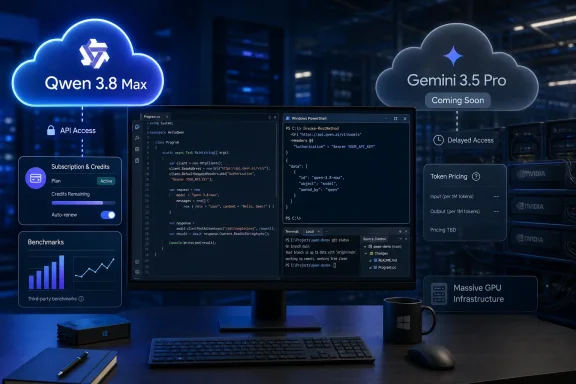
qwen3.8-max as a supported production model and says calls to the earlier qwen3.8-max-preview identifier are automatically routed to it. Google, by contrast, still labels Gemini 3.5 Pro as “coming soon.” The practical choice available to Windows developers and IT teams today is Qwen 3.8 Max versus Google’s currently shipping Gemini models, not Qwen versus a Gemini flagship that has no public API model ID, price, model card, or published benchmarks.That distinction cuts through several claims in the Geeky Gadgets explainer, which credits Universe of AI. Qwen 3.8 Max’s stated 2.4-trillion-parameter scale and Alibaba’s plan to release weights are meaningful announcements. But the claims that it is already an open-source, locally deployable bargain at $2 per million input tokens and $6 per million output tokens are not supported by Alibaba’s current public product documentation.
For organizations deciding whether to attach the model to Qwen Code, Cursor, Claude Code-compatible tooling, or an internal agent running on Windows workstations and servers, the missing details are more important than the headline parameter count.
Qwen 3.8 Max Is Accessible, but Its Economics Are Not Published as Token Rates
Alibaba has moved beyond the initial preview label. QwenCloud’s current model list identifies qwen3.8-max for reasoning, visual understanding, and text generation, and states that the qwen3.8-max-preview endpoint remains callable while routing requests to the production model. That is a useful compatibility decision: developers who integrated the preview endpoint do not have to rewrite their client configuration simply because the product name changed.
However, Alibaba is selling access through a Credits-based Token Plan, rather than publishing conventional pay-as-you-go input and output token prices for Qwen 3.8 Max. The individual plan currently starts at $6 per month for Lite, $18 for Standard, and $68 for Pro. Those subscriptions include rolling seven-day Credit limits, with the service pausing when a plan’s quota is exhausted unless the customer buys additional Credit Packs.
The vendor documentation does not publish a fixed dollar-per-million-token conversion for Qwen 3.8 Max. Credits cover multiple text, visual, audio, video, search, and code-interpreter services, and usage varies by model and task. A $6 subscription is therefore not evidence that each million tokens costs $2 in and $6 out. It is a capped subscription offer with shared consumption across a broad catalog.
The cost claim in the submitted comparison should be treated as unverified. That matters for any team forecasting agentic coding expenses, because reasoning-heavy models can produce substantial hidden-token workloads. A flat token-rate comparison is already imperfect; a Credits subscription with rolling limits cannot be converted into a reliable per-token cost without Alibaba publishing the deduction coefficients and actual usage data for the specific task.
There is another operational constraint buried in the plan structure. Lite customers receive 2,500 Credits per seven-day period, Standard gets 10,000, and Pro gets 40,000. The temporary lifting of a five-hour limit does not eliminate that weekly ceiling. A developer can have apparently unrestricted access early in a test cycle and still be stopped by quota during a long code migration, document-analysis run, or multi-agent workflow later in the week.
“Open Weights” Has Not Yet Made Qwen 3.8 Max a Local Model
Alibaba’s promise to release Qwen 3.8 weights has helped fuel the argument that the model provides an escape route from proprietary cloud AI. The available record supports a narrower conclusion: the hosted Qwen 3.8 Max service is available, while the open-weight release remains a separate event.
Early reporting from TechNode noted that Alibaba had not published the architecture, training-data information, benchmark results, or an open-weight release schedule when Qwen 3.8 was previewed in July. More recently, QwenCloud’s own documentation has documented a production hosted model and routing from the preview identifier. It does not provide a downloadable weight package, a model card, a license, hardware requirements, or an installation path for Windows, Linux, or any other platform.
That is not a semantic quibble. Open weights would let organizations decide where inference runs, what guardrails they apply, and whether sensitive source code or documents ever leave a controlled environment. A hosted API, even one designed for broad compatibility with Qwen Code, Cursor, Claude Code, and OpenClaw, does not provide that control.
Local deployment also deserves a reality check. A 2.4-trillion-parameter model is not a workstation model merely because its weights may eventually become downloadable. At 16-bit precision, the raw parameter data alone would occupy roughly 4.8 TB; even a 4-bit representation would begin around 1.2 TB before runtime overhead, context cache, operating-system requirements, and any multi-GPU sharding arrangement. Those figures are simple storage arithmetic, not a published Qwen deployment specification, but they show why “run it locally” and “run it on a Windows PC” are very different propositions.
A smaller Qwen 3.8 variant could make local evaluation realistic for teams with high-end Nvidia GPUs or Windows Server hosts configured for GPU inference. The 2.4T Max model, assuming Alibaba releases its weights as promised, is more likely to be an on-premises cluster, cloud-GPU, or specialist inference-server project. It will not turn a typical desktop with a GeForce RTX card into a frontier-model appliance.
Qwen Has Not Published the Evidence Needed for Benchmark Claims
Alibaba’s 2.4T parameter claim is notable, but parameter totals do not establish coding quality, tool-use reliability, latency, context retention, or cost per completed task. The company has not released enough technical detail to resolve basic questions that affect evaluation: whether the total is dense or mixture-of-experts capacity, how many parameters are active per token, what its context limits are under production conditions, and which evaluation harnesses produced its advertised results.
That makes broad claims that Qwen 3.8 Max beats GPT 5.6, matches or surpasses Opus 4.8, or wins professional-task benchmarks impossible to audit from the public record. The submitted explainer also invokes DeepSeek v4 Flash and several other named models without providing a common benchmark, prompt set, tool harness, test date, or price basis. Those are not meaningful performance comparisons.
This is especially relevant to Windows-focused developer work. A model that scores well on a software-engineering benchmark can still fail a normal enterprise task: following a repository’s relative paths, applying a PowerShell-oriented setup instruction, preserving line endings, recognizing a Visual Studio solution structure, or making safe changes across a large Git worktree.
Qwen’s own public issue tracker illustrates why early testing should be treated as integration work rather than a leaderboard exercise. One reported Qwen Code issue described qwen3.8-max-preview as a thinking-only model that rejected an internal request to disable thinking, producing an invalid-parameter error during long-context operations such as context compaction. Another issue described incorrect handling of relative file paths in a Claude Code-compatible tool workflow. Neither report proves a general flaw in the production Qwen 3.8 Max endpoint, and software changes quickly. They do show that the surrounding harness, endpoint mode, and agent tools can decide whether a model succeeds or fails on a real coding job.
Gemini 3.5 Pro Is Delayed, but Google Has Not Published Its Replacement Terms
Google’s original Gemini 3.5 announcement on May 19 said Gemini 3.5 Pro was in internal use and would roll out the following month. That date passed. Google’s current Gemini model page still lists Gemini 3.5 Pro as “coming soon,” while presenting Gemini 3.1 Pro, Gemini 3.5 Flash, Gemini 3.5 Flash-Lite, and Gemini 3.6 Flash as actual choices.
Bloomberg reported on July 16 that Gemini 3.5 Pro was months behind schedule while Google worked to improve its capabilities, particularly coding. Reuters independently reported that the model’s June launch had been delayed, placing the setback in the context of competition for coding and agentic-AI workloads. Axios later reported employee accounts of low morale, although Google disputed that morale problems were causing model delays or major departures.
Those reports make the delay material, but they do not validate every more dramatic claim being attached to it. There is no official statement that Google is abandoning frontier-model development to become an infrastructure supplier. Google is shipping new Gemini models, and its published materials continue to position Gemini as the foundation for API, enterprise, Android Studio, and agent-platform products.
The more immediate result is simpler: buyers cannot evaluate Gemini 3.5 Pro because Google has not made it available. No public pricing, rate limits, model card, API identifier, benchmark table, or deployment documentation exists for the Pro release. A comparison that portrays Qwen 3.8 Max as cheaper than Gemini 3.5 Pro is comparing a billable hosted service against a product whose commercial terms do not exist.
For a current Google baseline, Gemini 3.6 Flash is the relevant model. Google lists it at $1.50 per million input tokens and $7.50 per million output tokens without caching, alongside published scores for SWE-Bench Pro, Terminal-Bench, MLE-Bench, OSWorld-Verified, and other evaluations. Those figures are vendor-published rather than independent, but they are at least concrete enough to test against an actual workload.
The Useful Comparison Is a Controlled Trial, Not a Vendor Narrative
Qwen 3.8 Max has changed the market in one specific way: Alibaba is making a very large, current-generation model available through a low-entry subscription and routing it into mainstream coding-agent tools. Google’s missing Gemini 3.5 Pro gives Qwen an opportunity to win developer attention before Google’s intended flagship arrives.
But Qwen’s advantage is access, not yet verified local control or transparent economics. Its public documentation does not substantiate the $2/$6 token pricing cited in the submitted story, and it does not document an open-weight download for the 2.4T model. Gemini 3.5 Pro, meanwhile, remains a delayed product rather than a model an IT department can procure, benchmark, or deploy.
Teams considering Qwen should run it against a pinned internal test suite: Windows codebases, PowerShell automation, Visual Studio projects, issue-tracker tasks, and long-context repository changes. Record the model identifier, date, harness version, Credit consumption, wall-clock time, failed tool calls, and human rework. Until Alibaba publishes token pricing, a model card, and the promised weight release, that evidence will be more valuable than any claimed model-versus-model victory.