
Forbes reported Monday that Alibaba calls Qwen3.8-Max its most capable model yet and says it matches or exceeds leading U.S. systems across visual reasoning, office work, coding, and agentic tasks. The announcement is real, and QwenCloud’s own documentation confirms that qwen3.8-max-preview is available now. But the practical status is narrower than “an open model has launched”: Alibaba has made a cloud-served preview available through its Token Plan subscriptions, Qoder, and QoderWork, while the actual weights remain promised for the following week.
That difference changes the immediate takeaway for Windows developers and IT teams. Qwen3.8-Max can be trialed today as an alternative model endpoint in compatible tooling, but it cannot yet be treated as a self-hosted, air-gapped, or independently auditable replacement for ChatGPT, Claude, or a locally deployed open-weight model.
 The August 3 announcement follows a July preview
Alibaba had already previewed Qwen3.8-Max on July 19 at the World Artificial Intelligence Conference in Shanghai. Reporting from SiliconANGLE, TechNode, and others at the time described the same core pitch: a 2.4-trillion-parameter multimodal Qwen model that Alibaba said ranked second only to Anthropic’s Fable 5.
The company’s own QwenCloud documentation corroborates the existence of the preview model, its exact identifier, and where it is accessible. It is listed as qwen3.8-max-preview, with reasoning, visual understanding, and text-generation capabilities. QwenCloud also documents integrations with OpenAI- and Anthropic-compatible tools including Claude Code, Cursor, Cline, OpenCode, Codex, and Qwen Code.
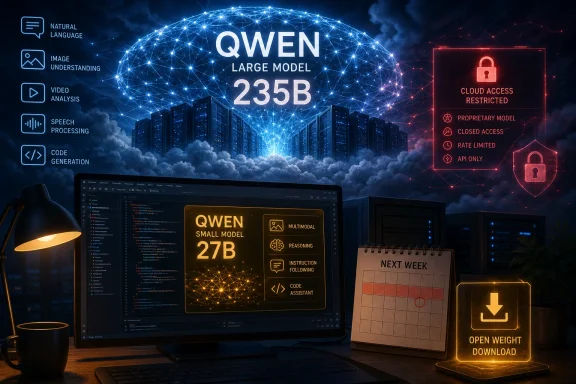
What changed on August 3 is not that Qwen3.8-Max suddenly became available. The major new commitment is that Alibaba says both Qwen3.8-Max and Qwen3.8-27B will receive open weights next week. The company has not yet published the download, model card, license, hardware requirements, inference reference stack, or a final release date beyond that relative timeframe.
For IT buyers, this is an announcement to monitor rather than an asset ready to approve for production deployment. Until checkpoints and licensing are public, a Qwen3.8-Max rollout is still an Alibaba-hosted service decision with the ordinary operational questions that accompany any hosted model: data residency, account controls, service continuity, pricing changes, rate limits, retention rules, and support boundaries.
“2.4 trillion parameters” does not mean a 2.4-trillion-parameter runtime
Alibaba describes Qwen3.8-Max as a 2.4-trillion-parameter mixture-of-experts model. The parameter count makes it one of the largest model designs publicly discussed by a major AI vendor, but it should not be read as a straightforward measure of either quality or hardware requirements.
A mixture-of-experts, or MoE, model routes each token through only a portion of its available expert networks. That design can reduce the compute used for an individual request compared with activating every parameter in a dense model. It does not make the full checkpoint small. The complete weights, memory layout, quantization options, context cache, multimodal components, and distributed-serving configuration will determine whether Qwen3.8-Max can run outside hyperscale environments.
That is why the smaller Qwen3.8-27B release may prove more operationally important for Windows enthusiasts, developer workstations, and enterprise labs. A 27-billion-parameter model can plausibly be quantized and used on high-memory consumer GPUs, multi-GPU workstations, or specialized on-premises inference servers. A 2.4-trillion-parameter checkpoint will almost certainly require a server cluster even if sparse activation makes individual inference cheaper than its headline count suggests.
Alibaba has not yet supplied the details needed to make that capacity plan. There is no public release artifact to measure, no official quantized build, no stated VRAM target, and no published throughput data across common NVIDIA, AMD, or Intel accelerator configurations. The announcement therefore establishes scale, but not deployability.
Alibaba’s performance comparisons are vendor claims, not an independent ranking
The central marketing claim is aggressive. Alibaba says Qwen3.8-Max performs comparably to or better than Anthropic’s Fable 5 and OpenAI’s GPT-5.6-Sol in several categories, including multimodal reasoning, visual agents, office intelligence, real-world understanding, visual perception, and coding.
Those comparisons should be read as Alibaba’s internal evaluation results. They are useful as a statement of where Alibaba believes the model is strong, but they are not the same thing as a neutral leaderboard or a reproducible benchmark report.
The earlier July preview attracted the same scrutiny. SiliconANGLE reported that Alibaba presented its “second only to Fable 5” positioning without public benchmark scores at the time, while eWeek noted the absence of a model card, activated-parameter count, and detailed technical documentation. The August announcement includes more ambitious comparison claims and demonstrations, but independent validation still lags the vendor narrative.
One detail is especially worth separating from the headline: Alibaba says Qwen3.8-Max can code for hours without user input and that, in an internal exercise, it spent 16 days building and refining an AI coding tool. That is a claim about a managed agent environment, not proof that the model can safely operate unsupervised in a normal software-development workflow.
A 16-day coding run may involve task orchestration, repositories, test harnesses, tool permissions, retry policies, compute budgets, checkpoints, and human-designed success criteria. A model can produce a large number of commits and still make poor architectural choices, introduce security defects, or optimize narrowly for a test suite. Until Alibaba releases the task setup, the repository history, evaluation conditions, and failure data, the demonstration should not be translated into a policy of allowing a coding agent broad unattended access to a Windows build server or production repository.
The preview’s access model is more restrictive than “open” suggests
QwenCloud’s documentation makes clear that Qwen3.8-Max-preview is currently tied to the Token Plan. The company says the model may be changed, removed, or replaced when the preview period ends. That is ordinary preview-language, but it matters for anyone attempting a proof of concept.
A team can point a compatible client toward QwenCloud and use Qwen3.8-Max-preview for complex reasoning, coding, image understanding, web search, code interpretation, web scraping, and other built-in tools. QwenCloud even publishes configuration guidance for using it with OpenAI’s Codex command-line client. In that configuration, the model metadata declares a 983,616-token context window, high or extra-high reasoning settings, and image input support.
The same documentation also reveals a less polished side of the release. A July issue in Qwen’s public qwen-code repository showed that the preview model behaved as a thinking-only model: sending enable_thinking=false returned an invalid-parameter error. The reported issue concerned internal operations in the coding tool, including context compaction and permission classification, and was marked as a high-priority bug.
That does not disqualify Qwen3.8-Max-preview. It does establish that teams should test it in their exact agent stack before assuming a nominally OpenAI- or Anthropic-compatible endpoint will be behaviorally interchangeable. Compatibility at the HTTP API layer is not the same as compatibility with a client’s assumptions about reasoning toggles, context management, tool calls, output formats, retries, and permission flows.
The open-weight release will decide whether this is a model story or a cloud-service story
Alibaba’s strongest strategic claim is not that it has built a large model. OpenAI, Anthropic, Google, Moonshot AI, DeepSeek, and other labs can all point to models with frontier-scale capabilities and huge infrastructure behind them. The distinction Alibaba is seeking is to combine a top-tier model claim with weights that can leave Alibaba’s cloud.
If the Qwen3.8-Max weights arrive next week under a commercially usable license, with documentation and reproducible inference guidance, the release could give cloud providers, research groups, and large enterprises a credible option to run a high-end Chinese model without relying on a proprietary U.S. API. That would also put pressure on closed-model vendors by making customization, regional hosting, and model inspection part of the competitive conversation rather than exclusive features of lower-capability open models.
There is a substantial practical limit: most organizations will not be running a model of this scale on a local Windows PC. Even a well-optimized sparse model will be a data-center deployment for nearly everyone. The 27B sibling model is the one likely to reach local experimentation, developer workstations, and private departmental deployments first.
For now, Qwen3.8-Max is a capable-looking preview with an unverified vendor benchmark narrative and a meaningful promise attached to it. The concrete milestone is the weights release Alibaba has scheduled for next week. Until the model files, license, model card, and inference requirements land, the claim that it is an open challenger to ChatGPT and Fable remains an announcement, not a deployment fact.
Update: Alibaba publishes specific Qwen3.8-Max benchmark and pricing claims (August 9, 2026)
StartupFortune reports that Alibaba has now attached specific figures to its Qwen3.8-Max performance claims, including 93.0 on PaperBench, 82.8 on IFBench, 86.6 on Terminal-Bench 2.1, and 86.1 on OSWorld-Verified. The reported comparison table puts the model ahead of some Claude and GPT variants in selected tests, while still below GPT-5.6 Sol on Terminal-Bench.
Alibaba has also reportedly priced hosted Qwen3.8-Max access at $2 per million input tokens and $6 per million output tokens, with lower pricing for cached context. Those rates, if confirmed in Alibaba’s current service documentation, would materially affect cost comparisons for teams running high-volume coding or agent workloads.
The reported open-weight timetable remains unchanged in substance: Alibaba says downloads are expected on Hugging Face and ModelScope around August 10. Until the repositories, license, model card, and serving guidance are actually public, however, Qwen3.8-Max remains primarily a cloud-preview and vendor-benchmark story rather than a deployable self-hosted option.
