
That leaves Gemini 3.7 Flash in the unconfirmed rumor category, not the “spotted in testing” category. There is a meaningful difference: Google has routinely exposed preview models and documented production models well before or alongside broader launches. As of August 8, Google’s public Gemini model catalog and API changelog list Gemini 3.6 Flash, Gemini 3.5 Flash-Lite, and older model families, but no Gemini 3.7 Flash.
Tbreak is right about the larger, confirmed story: Google’s fast-moving Flash line continues to ship while Gemini 3.5 Pro remains unavailable to the public. But its headline turns a thin, single-sourced claim into a stronger conclusion than the public record currently supports.
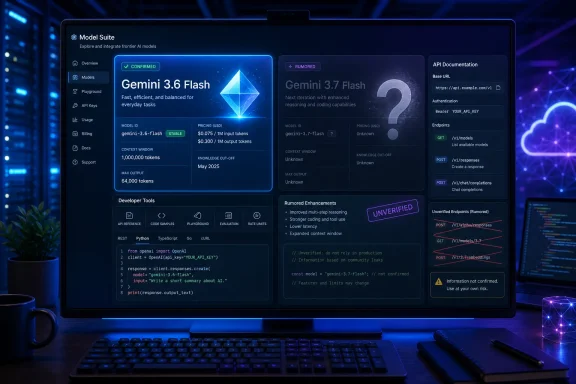 The alleged 3.7 Flash evidence cannot be checked
Tbreak says NokiaPowerUser found “code references,” “API endpoint pre-allocations,” and “backend testing signals.” Those are potentially useful clues only when the publication shows what it found and where it found it. A named model string in a public client, an API discovery response, a Cloud console reference, a release candidate package, or a documented endpoint would be independently testable. None is included in Tbreak’s report.
The article also does not link to the NokiaPowerUser story it relies on. Searches for the exact Gemini 3.7 Flash name turn up social-media speculation and forum threads, rather than a documented leak or a reproducible technical finding. That is especially important because model names are cheap to invent and easy to circulate once they reach enthusiast communities.
“Endpoint pre-allocation” is also not a Google product term with a defined public meaning. Google may reserve internal resources, test routes, experiment with aliases, or stage configuration changes without committing to a public model, a name, a pricing tier, or a release timetable. An internal reference can establish that someone tested a string; it does not establish that a broadly released product is imminent.
For developers and IT teams, the operational conclusion is straightforward: do not plan migrations, procurement, capacity estimates, or application logic around gemini-3.7-flash. There is no supported model ID to call, no published context-window specification, no pricing, no rate-limit table, no regional availability information, and no stated deprecation path from Gemini 3.6 Flash.
Gemini 3.6 Flash is the latest public Flash model
Google’s own July 21 announcement is considerably more concrete. Gemini 3.6 Flash and Gemini 3.5 Flash-Lite were released as generally available models, with stable API identifiers:
gemini-3.6-flashand
gemini-3.5-flash-lite. The company described 3.6 Flash as its workhorse model for coding, knowledge work, multimodal tasks, and agentic execution.
Google’s published documentation puts Gemini 3.6 Flash at $1.50 per million input tokens and $7.50 per million output tokens. It supports text, image, video, audio, and PDF input; offers a 1,048,576-token input limit and 65,536-token output limit; and supports tools including code execution, function calling, Google Search grounding, Maps grounding, structured outputs, URL context, and the preview Computer Use capability.
Those public details are why Gemini 3.6 Flash is a product teams can evaluate today, whereas Gemini 3.7 Flash is not. Google has also made 3.6 Flash available through the Gemini API, AI Studio, Android Studio, Gemini Enterprise, Google Antigravity, and the Gemini app. That distribution matters more to working deployments than a possible future version number.
Google has been shipping Flash variants quickly, but the cadence does not prove the next rumored name or timing. Gemini 3.5 Flash became generally available on May 19, 2026. Two months later, on July 21, Google released 3.6 Flash and 3.5 Flash-Lite, while announcing a tightly controlled Gemini 3.5 Flash Cyber deployment through CodeMender. The pattern establishes that Flash receives frequent investment; it does not confirm a 3.7 release.
Gemini 3.5 Pro missed Google’s own June target
The delay of Gemini 3.5 Pro is real and far better documented than the 3.7 Flash rumor. At Google I/O on May 19, Google said Gemini 3.5 Pro was already being used internally and that it looked forward to rolling it out “next month” — meaning June 2026. June passed without a public release.
Bloomberg reported on July 16 that Gemini 3.5 Pro was months behind schedule as Google worked to improve the flagship’s capabilities, particularly coding. Reuters separately carried the same core Bloomberg report, while 9to5Google and Search Engine Journal documented the missed June commitment and absence of a public API release. Google has not confirmed Bloomberg’s reporting about the internal technical cause, performance targets, or the reported training-data changes, so those details remain attributed to Bloomberg’s sources rather than established fact.
Google did confirm the status on July 21. In its Gemini 3.6 Flash announcement, the company said Gemini 3.5 Pro was testing with partners and would be broadly available as soon as it was ready. Google also said it had begun its most ambitious pre-training run yet for Gemini 4.
The company still has not published a new Gemini 3.5 Pro launch date, public benchmark results, API prices, model documentation, supported regions, quota terms, or a preview endpoint. “Testing with partners” is evidence that a model exists and is being evaluated; it is not a release program that customers can depend on.
The reported Pro-versus-Flash reversal is plausible, but not proven
Tbreak’s central theory is that Gemini 3.7 Flash could reach users before Gemini 3.5 Pro. That outcome is plausible because Google has already released more Flash products while Pro waits. Yet the evidence proves only half the proposition: Pro is delayed. It does not prove that a 3.7 Flash model exists, much less that it will arrive first.
There is another correction worth making. Tbreak says Google “skipped a public 3.5-class Pro entirely when it moved from Gemini 2.5 to the 3 family.” The public record shows a more complicated lineup. Google released Gemini 3 Pro Preview in November 2025, then Gemini 3.1 Pro Preview in February 2026. Gemini 3.5 Pro is a separate, later promised model, and the issue is that it missed its expected June rollout — not that Google had no public Pro-class model at all during the transition.
For Windows developers using Gemini through web applications, IDE extensions, Android Studio, Cloud services, or internally built automation, this distinction has practical consequences. Flash-class models are appropriate where latency, token cost, and high-volume orchestration matter. A Pro-class model is normally the prospective choice for more demanding reasoning and coding workloads, but an unreleased model cannot be evaluated against existing services, assessed for data-handling needs, or added to a production fallback strategy.
A sensible rollout plan should therefore pin explicit supported model IDs rather than depend on “latest” aliases, maintain regression tests for tool calling and structured-output workflows, and keep an alternate provider or model path for workloads that require stronger coding performance. Google’s July release notes also flagged changes affecting 3.6 Flash and future model releases, including deprecated sampling parameters, which is a more immediate compatibility issue than an unverified 3.7 endpoint.
The next record worth watching is Google’s, not rumor threads
Google may yet announce Gemini 3.7 Flash, and the rapid evolution of the Flash family makes that unsurprising. But the public record on August 8 supports only this: Gemini 3.6 Flash is the current stable Flash model, Gemini 3.5 Pro remains partner-tested with no announced availability date, and Google has begun pre-training Gemini 4.
Until Google publishes a model ID, release note, model card, pricing, or product announcement, Gemini 3.7 Flash should remain off deployment roadmaps. The concrete decision for administrators is to test and budget around Gemini 3.6 Flash now, while treating Gemini 3.5 Pro and any supposed 3.7 Flash release as unavailable.
References
- Primary source: tbreak.com
Published: August 8, 2026 at 1:33 PM UTC
Gemini 3.7 Flash groundwork spotted as 3.5 Pro waits
Google is already prepping Gemini 3.7 Flash, with groundwork in place — while Gemini 3.5 Pro remains months behind schedule and unreleased.tbreak.com - Related coverage: nokiapoweruser.com
Google Confirms Gemini 3.5 Pro Is Still in Partner Testing - NPowerUser
Gemini 3.5 Pro is still testing with partners and will launch once Google says it's ready. - Read in Google AI News on NPowerUser nokiapoweruser.com
- Related coverage: searchenginejournal.com
Google Delays Gemini 3.5 Pro Over Coding Issues: Report
Google said it expected Gemini 3.5 Pro to roll out by now. It hasn't shipped, and Bloomberg reports coding is part of what's holding it up.www.searchenginejournal.com - Related coverage: tradingview.com
Google Says Gemini 3.5 Pro Currently Testing With Partners — TradingView News
Google:www.tradingview.com
- Related coverage: magica.com
Gemini 3.5 Pro misses June rollout amid coding report | Magica
Gemini 3.5 Pro missed its expected June rollout. Google confirms partner testing but not the reported coding shortfall or a new release date.magica.com - Related coverage: helloai.com
Gemini 3.6 Flash Ships — 3.5 Pro Still Waiting | Hello, AI
Google GA'd Gemini 3.6 Flash on July 21 while 3.5 Pro stays partner-only. helloai still tracks Gemini 3.1 Pro — and arena already scores the new Flash near frontier.helloai.com - Related coverage: testingcatalog.com
Google launches Gemini 3.6 Flash and Gemini 3.5 Flash Lite
Google introduces new Gemini Flash models: 3.6 Flash, 3.5 Flash-Lite, and 3.5 Flash Cyber, targeted at the needs of developers and enterprises. www.testingcatalog.com
- Related coverage: felloai.com
Gemini 3.5 Pro Release Date: What We Know + Flash Review
Gemini 3.5 Pro is still unreleased. Google says it is testing with partners, Bloomberg says months late. Every confirmed spec, price and debunked rumor.felloai.com - Related coverage: pureai.com
Google Ships Three New Gemini Models, Leaves Flagship Pro Version Waiting -- Pure AI
Google on Tuesday released three new additions to its Gemini model lineup, a token-efficient workhorse model, a low-cost speed-focused variant, and a specialized cybersecurity model, while confirming that its long-teased flagship Gemini 3.5 Pro remains in partner testing with no firm release date.pureai.com - Related coverage: tech.yahoo.com
Google releases three new Gemini models — but no 3.5 Pro
Google released Gemini 3.6 Flash, 3.5 Flash-Lite, and Flash Cyber, but the continued absence of Gemini 3.5 Pro raises fresh questions about its AI strategy.tech.yahoo.com - Related coverage: digitalapplied.com
Gemini 3.5 Pro Slips Again and Alphabet Sheds $200B
Google delayed Gemini 3.5 Pro on coding shortfalls and Alphabet lost roughly $200 billion in a day. Why model-roadmap risk is now a market event.www.digitalapplied.com - Related coverage: siliconangle.com
Google expands Gemini with cheaper models and a bug-hunter it keeps on a leash - SiliconANGLE
Google expands Gemini with cheaper models and a bug-hunter it keeps on a leash - SiliconANGLE siliconangle.com
- Related coverage: aiwiki.ai
- Related coverage: blog.google
3.6 Flash, 3.5 Flash-Lite, and 3.5 Flash Cyber
We’re introducing new Gemini models, including Gemini 3.6 Flash, 3.5 Flash-Lite and 3.5 Flash Cyber.blog.google - Related coverage: ai.google.dev
- Related coverage: ai.google.dev
- Related coverage: blog.google
3.6 Flash, 3.5 Flash-Lite y 3.5 Flash Cyber
Presentamos nuevos modelos Gemini , entre ellos el Gemini 3.6 Flash, el 3.5 Flash-Lite y el 3.5 Flash Cyber.blog.google - Related coverage: aiproductivity.ai
StepFun 3.7 Flash Beats Gemini and DeepSeek on Coding
StepFun releases Step 3.7 Flash, a 196B MoE model that runs locally on 128GB RAM and edges out Gemini Flash 3.5 and DeepSeek V4 Flash on coding benchmarks.aiproductivity.ai
- Related coverage: models.sulat.com
Gemini 3 Flash Preview by ZenMux | AI model information
Gemini 3 Flash Preview by ZenMux, released on Dec 17, 2025. Compare capabilities, pricing, limits, providers, and latest news on Sulat.models.sulat.com - Related coverage: aibenchy.com
Google: Gemini 3 Flash Preview vs StepFun: Step 3.7 Flash · Score 6.8 vs 6.9 | AI BENCHY
Side-by-side AI benchmark comparison of Google: Gemini 3 Flash Preview and StepFun: Step 3.7 Flash so you can quickly see which model is stronger on score, reasoning quality, reliability, and value. Score 6.8 vs 6.9 · Total Cost $0.085 vs $1.207 · Response Time (avg) 2.95s vs 64.68s. aibenchy.com
- Related coverage: openrouter.ai
Step 3.7 Flash vs Gemini 3.5 Flash - AI Model Comparison | OpenRouter
Compare Step 3.7 Flash from stepfun and Gemini 3.5 Flash from Google on key metrics including benchmarks, price, context length, and other model features.openrouter.ai - Related coverage: benchlm.ai
Gemini 3.5 Flash vs Step 3.7 Flash: Benchmarks & Cost | BenchLM.ai
Gemini 3.5 Flash vs Step 3.7 Flash across 5 shared public benchmark results, with stated evidence bases, workload costs, context, and specifications.benchlm.ai - Related coverage: llmdb.app

Gemini 3.1 Pro vs Step 3.7 Flash: Pricing, Benchmarks & Specs (2026) | llmdb.app
Compare Gemini 3.1 Pro vs Step 3.7 Flash side-by-side. Live 2026 analysis of context windows (2,000,000 vs 262,144 tokens), token cost ratio, MMLU & HumanEval benchmarks, and latency.
llmdb.app
- Related coverage: github.com
GitHub - stepfun-ai/Step-3.7-Flash: A high-efficiency Flash model for real-world agents. · GitHub
A high-efficiency Flash model for real-world agents. - stepfun-ai/Step-3.7-Flash github.com
- Related coverage: ominigate.ai
StepFun: Step 3.7 Flash Benchmarks & Rankings — OminiGate
Independent benchmark scores and leaderboard rankings for StepFun: Step 3.7 Flash: Intelligence, Coding, and Math indices, plus MMLU-Pro, GPQA, AIME and more.ominigate.ai - Related coverage: develeap.com
News - Develeap
 www.develeap.com
- Related coverage: opencode.ai
- Related coverage: news.bloomberglaw.com
Google Gemini Launch Delayed as Tech Falls Short of Goals (2)
Alphabet Inc.’s Google is months behind schedule on delivering Gemini 3.5 Pro, its most powerful flagship AI model, because the company has been taking time to try to improve its capabilities, particularly in coding, according to people familiar with the matter.news.bloomberglaw.com
- Related coverage: investing.com
Google Gemini launch delayed as tech falls short of internal goals, Bloomberg News reports By Reuters
Google Gemini launch delayed as tech falls short of internal goals, Bloomberg News reportswww.investing.com - Related coverage: 9to5google.com
Gemini 3.5 Pro delays due to coding performance
In mid-May, Google announced Gemini 3.5 Flash at I/O 2026 and said the Pro version would arrive in June. That deadline has passed.9to5google.com - Related coverage: marketscreener.com
Google Gemini launch delayed as tech falls short of internal goals, Bloomberg News reports | MarketScreener
Alphabet's Google is months behind schedule on the release of Gemini 3.5 Pro, its most powerful flagship AI model, as the tech giant works to improve its capabilities, particularly in coding,...www.marketscreener.com
- Related coverage: tech.yahoo.com
Google is delaying the launch of Gemini 3.5 Pro
The company announced its latest AI model in May, but has yet to release it.tech.yahoo.com - Related coverage: finance.yahoo.com
Google Gemini Launch Delayed as Tech Falls Short of Internal Goals
(Bloomberg) -- Alphabet Inc.’s Google is months behind schedule on delivering Gemini 3.5 Pro, its most powerful flagship AI model, because the company has been taking time to try to improve its capabilities, particularly in coding, according to people familiar with the matter.Most Read from...finance.yahoo.com - Related coverage: latimes.com
Inside Google's Gemini delay: Coding stumbles, clashing teams and frustrated engineers
Inside Google’s Gemini delay: coding stumbles, clashing teams and frustrated engineerswww.latimes.com - Related coverage: investing.com
Alphabet stock falls 4% on report of Gemini AI model delays By Investing.com
Alphabet stock falls 4% on report of Gemini AI model delayswww.investing.com - Related coverage: benzinga.com
Alphabet Stock Sinks on Reports of Google Gemini Delays - Alphabet (NASDAQ:GOOGL) - Benzinga
Alphabet shares fall on reported delay in Gemini 3.5 Pro's launch and concerns about Google's AI capabilities.www.benzinga.com - Related coverage: androidauthority.com
Google’s next flagship Gemini model reportedly stuck months behind schedule
Google is reportedly months late with Gemini 3.5 Pro, as coding performance and internal complexity slow its release.www.androidauthority.com - Related coverage: techxplore.com
