
Reporting from TechnoSports Media Group and South Korea’s The Elec says Google has begun rolling Spark out in India to Google AI Pro and Ultra subscribers. Tom’s Guide, meanwhile, has published a hands-on collection of seven daily-use prompts aimed at showing how Spark differs from a conventional chatbot: the value is in recurring jobs, monitored information and multi-step work rather than a single response in a chat window.
Google originally introduced Gemini Spark at I/O 2026 in May, describing it as a personal agent running on dedicated Google Cloud virtual machines. The company said users choose which services to connect and that Spark should seek confirmation before consequential actions.
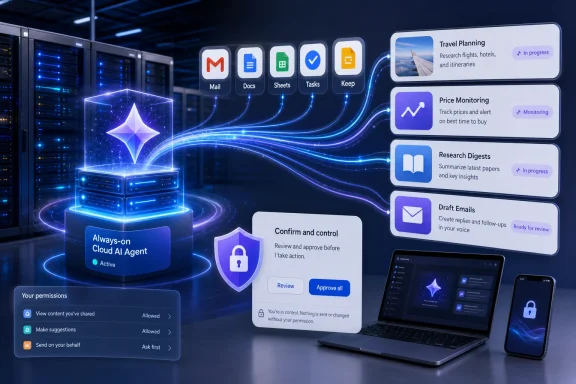 The useful prompt is a workflow, not a question
The most revealing part of the Tom’s Guide report is not a magic prompt formula. It is the class of requests that Spark can sustain: compiling travel confirmations into an itinerary, watching for price changes, turning scattered notes into a task list, preparing recurring research, or drafting replies based on context the user has explicitly provided.
That is a meaningful distinction for Windows users accustomed to Copilot, browser assistants and chatbots that require an active session. Spark is intended to run a job on Google’s infrastructure, with Workspace as its initial center of gravity, then report back when the task reaches a decision point or completes.
Google’s June Spark update also expanded the product beyond Workspace with Google Tasks, Google Keep, Canva, Dropbox, Instacart, OpenTable and Zillow Rentals, alongside custom Model Context Protocol connections. A macOS beta for Google AI Ultra subscribers in the U.S. brought the agent closer to local desktop files, though Google says Spark only receives access to files users authorize.
Google’s model details have already changed
There is a notable discrepancy in the rollout reporting. TechnoSports says the India release uses Gemini 3.6 Flash, while Google’s I/O materials described Spark as powered by Gemini 3.5 and the Antigravity agent framework. That may reflect a post-launch model upgrade, but Google’s earlier public material should not be read as confirmation that every regional Spark deployment uses 3.6 Flash.
The difference matters less than the operating model. A faster model can improve responsiveness, but a background agent’s real risk lies in its permissions, data access, triggers and ability to perform actions across connected accounts.
The confirmation screen is not the whole security model
Google’s promise that Spark checks in before sending email or spending money is sensible, but IT administrators and privacy-conscious users should look beyond the final confirmation dialog. An agent with Gmail, Drive, Docs and Sheets permissions can collect, summarize and transform a considerable amount of personal or corporate information before it reaches a high-stakes action.
For now, Spark is best suited to bounded, reviewable work:
- It can monitor a defined set of emails or documents and produce a digest rather than act on every finding.
- It can build a draft itinerary, spreadsheet or email response that a user reviews before sharing.
- It can track a specific recurring condition, such as subscription-price changes, instead of being granted broad and permanent instructions.
Gemini Spark’s appeal is that it shifts AI from answering to doing. Its challenge is proving that users can delegate routine work without accidentally delegating judgment—a test that will matter even more as Google adds Chrome, third-party tools and deeper desktop access.
