
That gap matters for builders ready to buy. Gigabyte’s June 26 announcement declared the RTX 5080 INFINITY and RTX 5080 INFINITY WOOD “officially available,” yet named only those two 5080 models and said the RTX 5070 Ti and RTX 5070 versions were planned for July. The lower-tier cards have since appeared on Gigabyte product pages and in its AORUS store, confirming the lineup moved beyond a paper launch. But availability is still uneven by region and seller, and the $1,899.99-to-$929.99 figures should be treated as retailer prices, not MSRPs.
The material change is therefore less about a new GeForce GPU tier and more about how Gigabyte is selling a custom RTX 50-series card: a premium, display-first model with a concealed 16-pin power connection, a compact-looking but unusually thick cooler, and an explicit price premium for cable presentation.
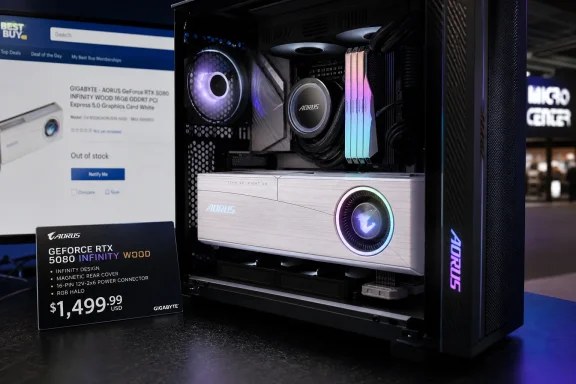 The four-card lineup is confirmed, but U.S. stock remains the unresolved part
Gigabyte introduced the INFINITY family around its 40th-anniversary “ENTER INFINITY” campaign at Computex 2026. VideoCardz independently reported the RTX 5080, RTX 5070 Ti, and RTX 5070 models when Gigabyte first showed the series in June, including the separate white-and-wood-grain RTX 5080 INFINITY WOOD edition.
Gigabyte’s official product catalog now lists four relevant SKUs:
- AORUS GeForce RTX 5080 INFINITY 16G.
- AORUS GeForce RTX 5080 INFINITY WOOD 16G.
- AORUS GeForce RTX 5070 Ti INFINITY 16G, model GV-N507TAORUS IF-16GD.
- AORUS GeForce RTX 5070 INFINITY 12G, model GV-N5070AORUS IF-12GD.
ThePCEnthusiast’s story groups the two RTX 5080 finishes as one $1,899.99 tier, then assigns $1,299.99 to the RTX 5070 Ti and $929.99 to the RTX 5070. Those numbers may accurately reflect the listings the publication saw, but they are not corroborated by Gigabyte’s U.S. site, which provides a “Where to Buy” area without a public price.
A U.S. reseller record provides a useful warning against assuming the cards are broadly in stock. Connection lists the RTX 5080 INFINITY WOOD as temporarily out of stock at $1,947.96, with prospective buyers told to call for delivery timing. Meanwhile, Gigabyte’s own AORUS storefront lists all four cards in euros, including add-to-cart controls, demonstrating that at least some regional channels are live. It does not establish that Amazon and Newegg have maintained purchasable U.S. inventory.
The conclusion is straightforward: the INFINITY cards have reached retail channels, but a stable, widely available U.S. launch has not been independently established. That is a different proposition from a normal nationwide graphics-card release.
The hidden connector is the product’s real feature
Every INFINITY card uses a single 16-pin 12V-2x6 power input, but Gigabyte has positioned the connector behind a removable magnetic backplate cover rather than leaving it exposed across the card’s top edge. The company describes the design as compatible with its Stealth series and, at Computex, said the approach relocates the power connection to the rear for cleaner builds and better airflow.
That language should not be mistaken for a fully cable-free graphics-card installation. The INFINITY board still needs a conventional 16-pin cable or the included adapter; it does not magically receive power through a Stealth motherboard. What changes is the visible cable path. With the right case, PSU lead, and room behind the GPU, the cable can be kept away from the usual glass-panel view.
For showcase systems, that is a legitimate improvement. A standard RTX 50-series card forces the stiff 16-pin cable to bend above its shroud, often in the most visible part of a vertical or horizontal GPU installation. The INFINITY layout moves that problem out of immediate view and lets the magnetic cover finish the exterior more cleanly.
There is a practical trade-off. Concealing the connector does not eliminate cable-clearance requirements, and builders should not force a tight bend merely because the cover hides it. VideoCardz noted in its early examination of the RTX 5070 INFINITY that there is limited space for a cable bend beneath the cover; visually hidden and mechanically unconstrained are not the same thing. Use a PSU’s native 12V-2x6 cable where possible, check the card’s rear clearance before ordering, and do not assume a narrow dual-chamber case will automatically accommodate the routing.
Gigabyte includes adapters in the box: a three-8-pin-to-12V-2x6 adapter with the RTX 5080 models and a two-8-pin version with the RTX 5070. That makes the cards usable with older power supplies, but it also makes a native modern PSU cable the cleaner option—the exact outcome buyers are paying the INFINITY premium to achieve.
The performance uplift is a factory overclock, not a different class of GPU
The INFINITY branding does not unlock additional CUDA cores, memory capacity, or memory-bus width. The cards retain the standard NVIDIA configurations: 10,752 CUDA cores and 16GB of GDDR7 on the RTX 5080; 8,960 cores and 16GB on the RTX 5070 Ti; and 6,144 cores with 12GB on the RTX 5070.
Gigabyte’s rated boost clocks are higher than NVIDIA’s reference specifications:
| Model | Gigabyte boost clock | NVIDIA reference clock | Increase |
|---|---|---|---|
| RTX 5080 INFINITY | 2,805 MHz | 2,617 MHz | About 7% |
| RTX 5070 Ti INFINITY | 2,670 MHz | 2,452 MHz | About 9% |
| RTX 5070 INFINITY | 2,715 MHz | 2,512 MHz | About 8% |
Those clock deltas look substantial on a spec sheet, but GPU boost behavior, power limits, game engines, and thermal conditions decide actual frame rates. Buyers should expect results in the same general range as other premium factory-overclocked RTX 5080, RTX 5070 Ti, and RTX 5070 cards—not a performance tier above them.
Gigabyte’s own 5080 specifications reveal the physical cost of that premium cooler. The RTX 5080 INFINITY and INFINITY WOOD are each 330 mm long, 145 mm tall, and 65 mm thick, with an 850W recommended PSU. They are not small cards merely because the exterior is clean. The RTX 5070 Ti uses the same 330 × 145 × 65 mm dimensions and calls for a 750W PSU, while the RTX 5070 shrinks to 309 × 132 × 55 mm but still occupies serious space in a mid-tower.
The cooling hardware is also more elaborate than the two visible fans imply. Gigabyte’s WINDFORCE Hyperburst design uses two visible Hawk fans, a flow-through heatsink with cutouts in the backplate, and a concealed centrally located Overdrive Fan intended to add airflow under load. Gigabyte claims its dual-cutout approach improves airflow penetration over traditional and single-cutout backplates, but independent thermal and acoustics testing for these particular retail cards remains limited.
Gigabyte is charging for presentation, and its own store shows how much
The pricing question is where the INFINITY line becomes harder to recommend purely on performance. Gigabyte’s AORUS storefront lists the RTX 5080 INFINITY above the company’s RTX 5080 Gaming OC, and repeats the same pattern between the RTX 5070 Ti INFINITY and Gaming OC as well as the RTX 5070 INFINITY and Gaming OC. The regional prices differ by roughly 10% to 18% depending on model.
That is the economic reality of the product. Buyers are paying for the hidden connector system, the Hyperburst cooler, RGB Halo lighting, the unusual turbine-style shroud, a card-support kit, and—in the WOOD version—the decorative wood-grain treatment. The package also includes Gigabyte’s four-year warranty when registered within 30 days, extending the standard three-year coverage.
For a conventional side-panel-closed gaming PC, that premium is difficult to translate into more useful performance. A well-priced RTX 5070 Gaming OC or RTX 5070 Ti Gaming OC will deliver a broadly comparable experience once the same GPU, memory configuration, driver, and game settings are involved.
For a custom display build, the calculation changes. The INFINITY design addresses a highly visible flaw of modern high-end GPUs: the prominent, tightly bent power lead at the top or side of a card. If the objective is a clean build around a tempered-glass chassis, vertical mount, or Gigabyte Stealth-compatible component set, the card solves a problem that a typical factory-overclocked model leaves untouched.
The buying decision comes down to cable routing and actual checkout availability
The RTX 5080 INFINITY WOOD is the clearest example of Gigabyte’s intent. It does not try to justify itself with a higher GPU specification; its pitch is that a graphics card can function as a designed object inside a living-room or showcase PC. That will appeal to a narrow but real set of builders, particularly those matching white components, pale wood accents, and hidden cabling.
The RTX 5070 Ti INFINITY is likely the more rational option for enthusiasts who want the same presentation without paying RTX 5080 money, provided its retail premium remains controlled. The RTX 5070 INFINITY brings the design to the lower end of the range, but its 12GB memory configuration remains the standard RTX 5070 constraint; the INFINITY cooler does not alter it.
Do not buy based on the premise that the cards are a new performance generation within RTX 50. They are premium board-partner variants whose value depends on build aesthetics, cable management, and whether a particular retailer can actually fulfill the order at the quoted price. For U.S. buyers, the next concrete milestone is not another Gigabyte announcement—it is consistent stock, seller-backed pricing, and a checkout page that confirms delivery rather than an out-of-stock notification.
References
- Primary source: ThePCEnthusiast
Published: August 7, 2026 at 11:45 PM UTC
Gigabyte RTX 50 INFINITY GPUs Now Available | ThePCEnthusiast
Gigabyte's RTX 5080 INFINITY WOOD, RTX 5070 Ti INFINITY, and RTX 5070 INFINITY graphics cards are now available on Newegg. Here's what makes the new lineup different and how they compare.thepcenthusiast.com - Related coverage: gigabyte.com
- Related coverage: gigabyte.com
- Related coverage: thepcenthusiast.com
GIGABYTE AORUS RTX 5090 INFINITY Launches With Hyperburst Cooling | ThePCEnthusiast
GIGABYTE has launched the AORUS GeForce RTX 5090 INFINITY 32G with WINDFORCE Hyperburst cooling, hidden Overdrive fan, and all-metal design.thepcenthusiast.com - Related coverage: noticias3d.com
- Related coverage: en.overclocking.com
Gigabyte has released the specs for its RTX 5080 Infinity Wood! - Overclocking.com EN
Gigabyte unveils its RTX 5080 Infinity Wood, a white graphics card with stunning wood-inspired accents! en.overclocking.com
- Related coverage: connection.com
- Related coverage: videocardz.com
- Related coverage: prnewswire.com
GIGABYTE EVENT Unveils the Full-Stack of New Products with "ENTER INFINITY" at COMPUTEX 2026
/PRNewswire/ -- GIGABYTE, the world's leading computer brand, today unveiled its most comprehensive product lineup to date under the theme "ENTER INFINITY."... www.prnewswire.com
- Related coverage: videocardz.com
- Related coverage: shopping.yahoo.co.jp
gigabyte+5070ti(GIGA-BYTE)のおすすめ人気商品一覧 通販 - Yahoo!ショッピング
gigabyte+5070ti(GIGA-BYTE)の2026年8月最新の人気商品一覧。ランキング・クチコミ・レビュー・最安値比較からお買得なおすすめ商品を探せます。LINEアカウント連携でPayPayポイント毎日5%(上限あり)|Yahoo!ショッピングshopping.yahoo.co.jp
