

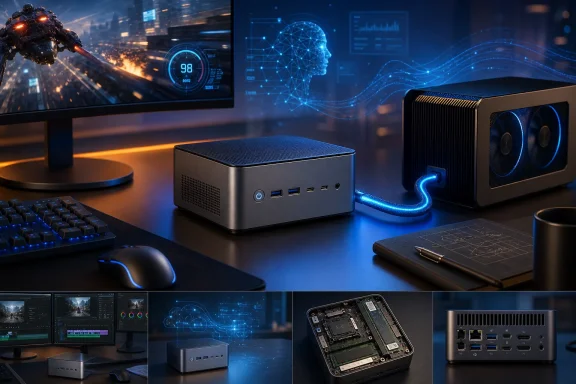
Wccftech tested a 64 GB/1 TB EVO-T2S at a 60 W CPU limit and found the Arc B390 substantially ahead of the older Arc 140T in gaming-oriented benchmarks. Its Cyberpunk 2077 result of 87.9 fps at 1080p Medium with balanced upscaling and its 116 fps result in Forza Horizon 5 at 1080p Medium are strong figures for an iGPU, although both results depend on upscaling rather than native-resolution rendering. At $2,099 for the reviewed configuration, though, the EVO-T2S is no longer competing against ordinary $500-to-$900 mini PCs; it is competing against systems with discrete graphics, and its value rests heavily on I/O, local AI experimentation and the option to add an external GPU.
The Arc B390 Is the Real Panther Lake Upgrade
Intel’s own processor record confirms the Core Ultra X7 358H is a 16-core mobile SoC with four Performance-cores, eight Efficient-cores and four low-power Efficient-cores. It has a 25 W base power rating, an 80 W maximum turbo rating, 18 MB of cache, support for up to 96 GB of LPDDR5X-9600, and—most relevant here—the full Arc B390 configuration with 12 Xe3 cores at up to 2.5 GHz.
That GPU configuration is significant because Intel does not attach the B390 to every Core Ultra Series 3 chip. The EVO-T2S uses a SKU with the 122 TOPS Arc GPU rather than the smaller four-Xe-core graphics designs in much of the lineup. Phoronix’s independent Linux testing likewise identifies the X7 358H as a B390-equipped part and confirms the 12-Xe-core, 2.5 GHz specification. In other words, GMKtec has not merely installed a newer Intel processor; it selected the version of Panther Lake that carries the graphics block enthusiasts are actually looking for.
Wccftech’s results show the practical consequence. In 3DMark Speed Way, the EVO-T2S scored 956, nearly double the 489 it recorded for GMKtec’s prior EVO-T1 with Core Ultra 9 285H and Arc 140T graphics. The uplift was similarly large in Steel Nomad and Port Royal. Gaming did not scale quite as cleanly—game engines, drivers and the chosen upscaler all matter—but the new machine was consistently well ahead of the Arc 140-series systems in the review’s more demanding tests.
The limitation is also clear. GMKtec’s Ryzen AI MAX+ 395-based EVO X2, using Radeon 8060S graphics, remained comfortably ahead in most of Wccftech’s graphics numbers. In Cyberpunk 2077, the AMD system delivered 111.9 fps before frame generation compared with 87.9 fps for the Intel machine; in Forza Horizon 5, it reached 156 fps against 116 fps. The Arc B390 makes Intel competitive in a compact integrated-graphics PC. It does not displace AMD’s larger Radeon 8060S as the outright iGPU performance leader.
OCuLink and 10 GbE Change What This Box Can Be
The EVO-T2S’s strongest case is its expansion rather than its benchmark charts. Independent reviews from Frandroid and Japan’s PC Watch corroborate the unusual port selection: 10 GbE and 2.5 GbE Ethernet, dual USB4, Wi-Fi 7, HDMI, DisplayPort and an OCuLink connector. PC Watch also lists a 148.2 W external adapter, while Frandroid reports the three BIOS profiles—35 W Quiet, 45 W Balanced and 54 W Performance—with boosting to 60 W.
OCuLink is the port to pay attention to. It exposes a PCIe Gen4 x4 link for an external GPU rather than using USB4’s 40 Gbps link. The distinction is material for anyone considering an RTX-class eGPU: OCuLink retains a more direct PCIe connection and avoids the bottlenecks and protocol overhead associated with many Thunderbolt or USB4 eGPU enclosures. Frandroid explicitly identifies the connector as Gen4 x4 and notes that it is intended for an external graphics card.
That makes the EVO-T2S more defensible as a desk-bound Windows workstation than as a sealed “AI supercomputer.” It can serve as a quiet office PC, compact home lab node, high-speed NAS client or 10 GbE workstation today, then gain discrete graphics later without replacing the entire system. The dual Ethernet ports also make it more versatile than a typical consumer mini PC for routing, virtualization and storage-adjacent workloads, though buyers should not confuse a pair of high-speed NICs with enterprise support, validated drivers or remote-management features. GMKtec has not positioned this as an Intel vPro-class fleet device.
There is a tradeoff beneath that flexibility: the 64 GB of memory is soldered. Frandroid confirmed the LPDDR5X-8533 memory cannot be upgraded, while the M.2 storage and Wi-Fi module can be accessed. For a machine pitched at creators and local-LLM users, that makes the original configuration decision permanent. Sixty-four gigabytes is generous for a Windows 11 mini PC in 2026, but it is also the ceiling—not a starting point.
“180 TOPS” Does Not Describe a Single AI Workload
GMKtec markets the EVO-T2S as a 180 TOPS local AI system. The arithmetic is real: Intel specifies up to 122 INT8 TOPS from the Arc B390 GPU and 50 INT8 TOPS from the NPU, with additional CPU compute contributing to the rounded platform figure. Intel also confirms NPU support for Windows Studio Effects and frameworks including OpenVINO, Windows ML, WebNN and ONNX Runtime.
But 180 TOPS is an aggregate peak capability, not a promise that one LLM, image model or Windows app will receive all 180 TOPS. PC Watch raised the crucial caveat in its hands-on review: present software generally runs an AI workload on either the NPU or GPU, rather than efficiently pooling both accelerators for the same job. When both are active, they also contend for the same unified memory bandwidth.
That is the gap between the marketing number and what buyers will experience. The NPU is useful for supported Windows effects and applications built to target it. The Arc B390 is likely to be the more consequential accelerator for many current local AI tools, image-generation pipelines and GPU-backed LLM workflows. The CPU continues to matter for preprocessing, orchestration and software that cannot use either accelerator. Those are three different execution paths, not one 180-TOPS engine.
The reporting on local models illustrates how loose this category remains. Wccftech says it tested models ranging from Llama 3.2 1B through 14B-class workloads in LM Studio and argues that 30B-to-45B models can run “decently” on the machine. Frandroid, testing a Llama 3.2 3B model through Ollama using the iGPU and Vulkan, reported 47.1 tokens per second for generation and said 13B models in 4-bit quantization were a more straightforward fit. GMKtec itself has gone much further, claiming support for inference of 120B-parameter models when paired with its Phison aiDAPTIV+ storage technology.
Those statements are not directly comparable. Parameter count alone says little without the quantization level, context length, GPU offload settings, model architecture, prompt-processing performance and tolerance for slow generation. Storage offloading can make an otherwise too-large model loadable, but it does not make an SSD behave like system RAM or graphics memory. Buyers should treat the EVO-T2S as a capable platform for small and medium local models and experimentation, not as a substitute for a workstation GPU with large dedicated VRAM.
The Storage and Pricing Story Is Still Messy
The EVO-T2S appears under multiple names—EVO-T2S and NucBox EVO-T2—and its storage configuration is unusually opaque. Wccftech describes its review unit as having a 1 TB PCIe Gen4 x4 SSD, while Frandroid’s 64 GB/1 TB test system is described as using a PCIe 5.0 x4 primary SSD plus an open PCIe 4.0 M.2 slot. PC Watch reports a conventional 1 TB SSD, a faster PCIe 5.0 option, and an 853 GB Phison AI SSD option that partitions capacity for aiDAPTIV+ use.
The hardware itself is less contradictory than the sales material makes it appear: these are likely different regional and storage SKUs. What is missing is a simple, consistent GMKtec matrix telling buyers exactly which SSD generation, capacity and aiDAPTIV+ behavior they get in each country. That matters because the Wccftech review’s $2,099 price is attached to the 64 GB/1 TB configuration in its product box, while launch reporting listed the conventional 64 GB/1 TB model at $1,899 before an introductory $60 discount and the 853 GB AI SSD configuration at $2,099. Frandroid, meanwhile, listed its 64 GB/1 TB unit at €1,699.99.
The conclusion is straightforward: do not buy the EVO-T2S by its model name alone. Confirm the processor, actual installed SSD, whether the second M.2 slot is free, the operating system license, regional warranty terms and the precise price at checkout. GMKtec’s hardware recipe is compelling, but the configuration naming has not kept pace with a product that now spans multiple regions and storage tiers.
At the right price, the EVO-T2S is a rare compact Windows machine with credible integrated gaming, unusually strong networking and a genuine eGPU escape hatch. At $2,099, it needs to be bought for that complete platform—not for a synthetic 180 TOPS figure, and not with the expectation that soldered 64 GB memory will turn it into a no-compromise local AI workstation.