

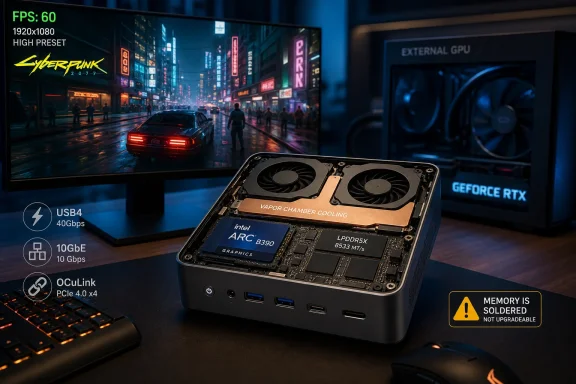
That distinction changes how the result should be read. The EVO-T2S is not evidence that ordinary office-grade integrated graphics have suddenly become gaming hardware. It is a nearly $2,000 compact desktop pairing one of Intel’s highest-end Panther Lake processors with 64GB of unusually fast LPDDR5X-8533 unified memory, aggressive cooling, and a power budget that reaches 54W sustained in Performance mode. PCWorld’s result is meaningful precisely because this is an unusually complete implementation of that platform rather than a bargain mini PC with an Intel logo on the front.
ComputerBase’s separate testing supports the basic conclusion. Its EVO-T2S sample placed well ahead of systems based on the prior Arc 140T and AMD’s Radeon 890M in its Full HD gaming aggregate, while remaining far behind AMD’s Ryzen AI Max+ 395 and Radeon 8060S combination. In other words, Arc B390 materially raises the ceiling for an Intel iGPU, but it does not erase the difference between a high-end integrated design and the fastest unified-memory machines—or a conventional PC with a discrete GPU.
Arc B390 makes 1080p a practical target
The Core Ultra X7 358H is Intel’s 16-core, 16-thread Panther Lake mobile chip: four performance cores, eight efficiency cores, and four low-power efficiency cores. Intel’s own specifications identify the attached Arc B390 as a 12-Xe-core GPU. GMKtec’s EVO-T2S turns that laptop-class silicon into a small desktop measuring roughly 154 × 151 × 74 mm, then gives it substantially more cooling and I/O than most notebooks built around the same processor.
PCWorld ran its unit in the middle, 45W Balanced profile, not GMKtec’s 54W Performance setting. That makes its Cyberpunk 2077 numbers more useful than an eye-catching best-case benchmark: 48 fps at 1080p Medium is playable but does not leave much room for heavier scenes, while 64 fps with XeSS Balanced is the setting buyers should expect to use. The review also found ray-tracing-oriented tests falling to single-digit or low-double-digit frame rates. That is the boundary: the B390 can run demanding games with sensible image settings and upscaling; it is not a ray-tracing machine.
ComputerBase tested the same X7 358H/Arc B390 platform under several power profiles and found the performance-mode gaming gain over its default profile stayed below 10 percent in the tested graphics benchmarks. Quiet mode cost a little more than 10 percent relative to the standard setting. That is good news for people who do not want to run a tiny desktop at maximum fan and power settings every day: the out-of-box mode appears to retain most of the machine’s graphics performance.
Frandroid reached a similar conclusion from game testing, reporting 76 fps in Red Dead Redemption 2 at 1440p Medium and more than 103 fps in Forza Horizon 5 at 1440p High, alongside roughly 58 fps in Cyberpunk 2077 at 1440p High with XeSS Quality. Those results should not be treated as a universal 1440p promise—games, drivers, XeSS settings, and power modes vary too much—but they demonstrate the headroom available in lighter or better-scaling titles.
The broader consequence for Windows users is that 1080p gaming has become realistic in a desk-friendly Intel mini PC without adding an eGPU enclosure, external power supply, desktop graphics card, and the cable clutter that setup requires. For esports titles, older AAA releases, emulation, indie games, and games with mature XeSS support, the integrated GPU is sufficient. Buyers planning to run new titles at maximum settings or expecting stable high-refresh-rate 1440p should still budget for a discrete GPU elsewhere.
The memory is the reason the iGPU works—and the reason the PC cannot grow with you
The EVO-T2S ships with 64GB of soldered LPDDR5X-8533. PCWorld correctly identifies that bandwidth as fundamental to the B390’s results: integrated graphics draw from the same system memory pool as the CPU, instead of accessing dedicated GDDR memory on a graphics card. A fast, wide memory configuration gives the GPU more of the bandwidth it needs while also leaving enough total capacity for Windows, game assets, creative applications, virtual machines, or local AI workloads.
GMKtec and Intel benefit from describing this as a 64GB machine rather than detailing the trade-off. The RAM is not upgradeable. Frandroid confirmed the memory is soldered at the processor package, while ComputerBase lists 64GB as the maximum capacity. For a normal Windows workstation, 64GB is generous. For a buyer spending nearly $2,000 specifically because the device is being pitched for local language models, the inability to move to 96GB or 128GB later is a material constraint.
That limitation is especially relevant to GMKtec’s AI pitch. PCWorld reports that the system includes a local software environment with a Claw Assistant and a model hub for downloading open-source models, while GMKtec cites up to 180 TOPS when CPU, GPU, and NPU compute are combined. The NPU alone is rated at up to 50 TOPS. But aggregate TOPS are not a guarantee that a given model or application will use every engine at once; software support and available memory are more consequential in many local inference workloads.
TechRadar found the same tension. It notes that the hardware is capable, but its review unit’s memory configuration was fixed, and it cautioned that the 180-TOPS figure is a heterogeneous total rather than a direct measure of local-model throughput. The EVO-T2S is a well-equipped machine for experimenting with local AI, but its memory capacity is a purchase-day decision, not an upgrade path.
GMKtec’s storage configuration is less settled than the product name suggests
There is a more immediate buying concern in the reviews: the EVO-T2S has appeared with substantially different bundled storage despite broadly similar CPU and memory specifications.
PCWorld’s review unit contains a Phison PASCARI drive reported as 768GB of regular system storage plus an additional 85GB AI-storage partition or device, for a manufacturer-stated total of 853GB. PCWorld measured very high sequential results: up to 9,167 MB/s reads and 8,399 MB/s writes. It also says that the extra AI storage is intended for Phison’s AI functions and is not regular user-accessible capacity.
ComputerBase, by contrast, tested an X7 358H, 64GB EVO-T2S with a 1TB Crucial PCIe 4.0 SSD installed. Frandroid tested a 1TB configuration it identifies as PCIe 5.0 and measured roughly 7.8 GB/s sequential read and write performance. TechRadar also reports a 512GB Kingston PCIe 4.0 SSD in its tested system and separately demonstrated that the primary M.2 slot can achieve more than 10 GB/s when it installed a compatible Crucial PCIe 5.0 drive.
These reports do not prove that any one reviewer received the wrong system. They do establish that “EVO-T2S with 64GB RAM” is not a sufficiently precise configuration description for a buyer comparing listings. GMKtec’s official product material promises two M.2 2280 slots, with a PCIe 5.0 x4 primary slot and a second slot for storage expansion, but the supplied SSD, its capacity, and its actual interface evidently vary by market or batch.
Anyone considering the EVO-T2S should verify the exact SKU, physical SSD capacity, and whether the installed drive is PCIe 4.0 or PCIe 5.0 before ordering. This matters less for casual desktop work than it does for local AI, large game libraries, high-resolution video workflows, or anyone paying a premium in expectation of next-generation storage performance.
The ports make it a credible compact workstation, not merely a gaming box
GMKtec’s I/O design is unusually ambitious for a mini PC. The front offers a USB4 port, two USB 3.2 Type-A ports, a USB 2.0 port, and audio. The back includes another USB4 port, HDMI, DisplayPort, two additional USB 2.0 ports, 2.5GbE, 10GbE, and OCuLink. Both USB4 ports are rated at 40Gbps and support DisplayPort plus Power Delivery.
The standout is OCuLink, a PCIe 4.0 x4 external link that provides substantially more direct GPU connectivity than conventional USB4 eGPU setups. PCWorld puts its theoretical bandwidth at just under 8GB/s; GMKtec warns in its official product information that the port does not support hot-plugging. That means an attached eGPU enclosure should be connected and disconnected only with the EVO-T2S powered off.
OCuLink is not a free route to a desktop gaming PC. An enclosure and GPU add cost, physical bulk, and operating complexity. But it does preserve an upgrade route that compact all-in-one systems normally lack. A buyer could use the Arc B390 now for 1080p gaming and Windows productivity, then add a more capable GPU later for CUDA-dependent work, demanding 3D rendering, or higher-fidelity gaming.
The dual 2.5GbE and 10GbE networking adds another practical angle. The EVO-T2S can serve as a compact Windows workstation connected to fast shared storage, a virtualization host, a small development system, or a media-production desktop without immediately requiring a separate network adapter. This is where GMKtec’s port selection has more lasting value than an RGB-lit top fan.
Cooling holds the performance together, but support remains the weak spot
PCWorld’s review describes a vapor chamber and two-fan cooling system, including a large top-mounted fan under the metal cover. One potentially confusing detail: the case button marked “Fan Mode” controls RGB lighting rather than fan speed. Frandroid measured 37 dB(A) from one meter under full load, and ComputerBase found the system inaudible at idle and quiet under load. The cooling is not decorative; it is what permits a laptop processor and its integrated GPU to sustain the power levels that make the B390 compelling.
The price remains hard to ignore. PCWorld listed the EVO-T2S at $1,959 at the time of its August 7 review. ComputerBase listed a €1,649.99 manufacturer price for its German configuration, while Frandroid’s 64GB/1TB configuration was listed at €1,699.99. Pricing and included storage therefore need the same SKU-level scrutiny as the hardware itself.
ComputerBase also flags GMKtec’s support position as a concern compared with larger mini-PC vendors. Its reporting lists a one-year mail-in warranty and notes restrictive direct-store return terms, including a seven-day return window and a 15 percent restocking charge for opened items. Those terms may differ by country and seller, but prospective buyers should check the policy attached to the exact store listing rather than assume the premium price buys enterprise-style support.
The EVO-T2S succeeds at the hardware job PCWorld tested: it makes Intel’s Arc B390 feel like a usable gaming GPU in a very small Windows PC. The buying decision is less straightforward. At this price, the machine earns consideration as a compact workstation with 10GbE, USB4, OCuLink, 64GB of fast memory, and a real 1080p gaming baseline—not as an inexpensive replacement for a desktop with a graphics card.