
There is one date correction worth making at the outset. God of War: Laufey launches on February 16, 2027, while Fable Premium Edition early access begins on February 18, ahead of its standard February 23 release. That makes Sony’s release two days ahead of Fable early access, not one. The symbolism, however, remains exactly as sharp: a PlayStation platform holder is putting one of its most important franchises into the market just as Xbox asks PS5 users to buy one of Microsoft’s biggest upcoming games. Xbox Wire’s release schedule and reporting on the newly announced God of War: Laufey date establish the unusually tight release window.
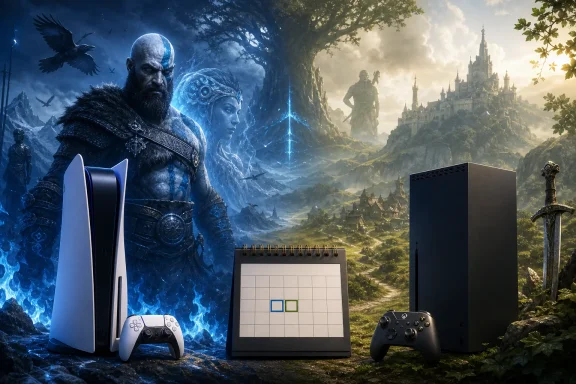 A launch calendar that exposes the platform gap
For years, the console market has been driven by a simple consumer calculation: which box gives me access to games I cannot otherwise play? Subscription perks, backward compatibility, cloud streaming, controllers, ecosystem services, and hardware specifications all matter. But for a large segment of buyers, especially those entering a new console generation, exclusive games remain the most concrete reason to choose one platform rather than another.
That is why the February 2027 collision matters beyond social-media point scoring. God of War: Laufey is not merely another PS5 release. It is the next major entry in one of Sony’s defining first-party franchises, developed by Santa Monica Studio and centered on Laufey—Faye—as she navigates an afterlife realm called the Everywhen. PlayStation has positioned it as a mainline continuation with a new protagonist, new combat ideas, and a story that extends the Norse-era God of War mythology rather than simply revisiting it. Sony’s own announcement describes Laufey’s journey through the afterlife of the gods and confirms the studio’s emphasis on her soul-based abilities.
Fable, meanwhile, is Microsoft’s opportunity to revive one of Xbox’s most distinctive role-playing properties. Developed by Playground Games, the studio best known for the Forza Horizon series, the reboot aims to return players to Albion with a new cast, moral choices, fantasy satire, and recognisable legacy characters including Jack of Blades. Microsoft has set the full launch for February 23, 2027, with Premium Edition access beginning February 18. Xbox’s showcase recap identifies Hayley Atwell’s Isabel as a major figure in the new story and confirms the staggered release dates.
The concern for Xbox is not that Fable and God of War: Laufey share precisely the same genre. They do not. One is a British fantasy action RPG built around player expression and the long legacy of Albion; the other is a cinematic action-adventure from a franchise associated with intense combat, lavish production values, and PlayStation’s modern blockbuster identity.
The problem is attention.
February is already becoming a congested release month, with Tomb Raider: Legacy of Atlantis, Persona 4 Revival, God of War: Laufey, and Fable all competing for retail spending, review coverage, livestream time, and players’ limited hours. GamesRadar’s release roundup places Fable alongside those major February launches. A high-profile Sony exclusive arriving first will inevitably dominate PlayStation’s marketing conversation at the moment Microsoft needs Fable to feel like an essential event.
That does not mean Fable is doomed on PS5. A great game can overcome a crowded calendar, and the PlayStation audience is enormous. It does mean, however, that Microsoft is asking consumers to make room for an Xbox-published game while Sony supplies the more obvious platform-exclusive reason to stay engaged with PS5.
Xbox’s strategic reversal arrives with an important exception
Microsoft has recently acknowledged the centrality of exclusives more directly than it had in years. At the Xbox Games Showcase, the company announced that Gears of War: E-Day and Clockwork Revolution would be Xbox console exclusives, with Microsoft explicitly stating that neither game is merely a timed exclusive. Xbox Wire described the move as part of “the return of XBOX.”
That was an important change in tone. Xbox had spent much of the previous period redefining itself less as a console proposition and more as a publisher, subscription business, PC storefront, cloud service, and cross-device ecosystem. The business case was easy to understand: publishing on PlayStation and other platforms expands the addressable market, allows Microsoft to monetise major games more broadly, and can create meaningful revenue from players who would never purchase an Xbox console.
The philosophical weakness was just as easy to see. If Microsoft’s most celebrated games are routinely available elsewhere, an Xbox console risks becoming an optional device rather than a necessary one.
The new policy acknowledges that issue, at least in part. Xbox chief content officer Matt Booty has said that there has to be a reason for people to buy an Xbox, while chief strategy officer Matthew Ball has said Gears of War: E-Day and Clockwork Revolution are only the first planned exclusives. TechRadar’s account of the executives’ comments captures the emerging compromise: Xbox wants an exclusivity strategy again, but not every game will be treated the same way.
That distinction makes commercial sense. Large live-service games benefit from cross-platform communities, recurring spending, and a wider player base. Games such as Minecraft, Call of Duty, and ongoing multiplayer titles are stronger when friends can play together regardless of their chosen device. A multiplatform approach is not inherently incoherent for those products.
But single-player, prestige-driven games serve a different purpose. They sell the promise of a platform. They give console buyers something emotionally tangible: a reason to remain invested, a cultural event to anticipate, and a signal that the hardware maker considers its own ecosystem worth prioritising.
Fable belongs far more naturally in that latter category.
Why Fable is the awkward exception
Microsoft’s own statement on exclusivity contains the answer to why Fable is still heading to PS5. The company said games that had already been announced for multiplatform release would remain on that path. Xbox Wire’s policy clarification makes the continuity explicit: Gears of War: E-Day and Clockwork Revolution are permanent Xbox console exclusives, while already-committed multiplatform projects will stay multiplatform.
That creates a difficult transitional period. Xbox is trying to restore the logic of console exclusivity while continuing to ship some of its most strategically important games onto a competing platform. The result is not necessarily a contradiction in publishing terms, but it is a muddled message in consumer terms.
A prospective buyer can reasonably look at the market and conclude:
- PS5 offers Sony’s first-party exclusives, including God of War: Laufey.
- PS5 also offers selected Xbox Game Studios releases, including Fable.
- Xbox offers Game Pass, PC integration, cloud capabilities, and its own exclusives such as Gears of War: E-Day and Clockwork Revolution.
- But some of Xbox’s most recognisable legacy franchises no longer require Xbox hardware.
That is an increasingly complicated value proposition to communicate at retail. It is particularly difficult when Xbox hardware is under broader pressure and the company must persuade buyers that a dedicated console still has a distinct role inside Microsoft’s sprawling gaming business.
The timing with God of War: Laufey makes that challenge visual. A PS5 dashboard can host Sony’s marquee exclusive and Microsoft’s upcoming RPG. Xbox cannot reciprocate with the Sony title. That is not a moral failure or an anti-consumer scandal; it is simply the traditional competitive advantage that exclusivity creates.
Sony understands it because Sony has historically treated exclusivity as a platform-building tool. Microsoft now appears to understand it again, but Fable is an expensive reminder that strategic corrections do not instantly erase prior commitments.
The budget question cannot be ignored
Reporting has suggested that Fable has become an unusually costly project and has run “uncomfortably” beyond budget. That specific description is attributed to sources rather than disclosed financial documentation, so it should be treated with caution rather than as a confirmed number. Still, the broader commercial logic is clear: an ambitious AAA RPG with a long development cycle represents a substantial investment, and a PS5 launch offers Microsoft a far wider potential sales base. Windows Central’s report links the multiplatform decision to the game’s reported budget pressures.
From a publisher’s perspective, this is rational. Microsoft owns the game, retains revenue from sales on PlayStation, can use the launch to grow the Fable audience, and still places the title in Game Pass for Xbox subscribers. A broader release also lowers the risk that a costly production must recover its investment from a single console ecosystem and PC.
From a console-brand perspective, the calculation is less comfortable. A platform holder can maximise software revenue in the short term and still weaken the long-term case for buying its hardware. The two objectives are not identical.
That tension is now central to Xbox’s identity. Microsoft wants to be a leading games publisher everywhere, but it also wants to protect a hardware platform that competes directly with the storefronts where those games are being sold. The more successful Xbox becomes at distributing games outside its console, the more difficult it becomes to explain why consumers should choose the console itself.
Sony’s advantage is not just exclusivity—it is clarity
The strongest advantage PlayStation gains from the February schedule is not simply that God of War: Laufey is exclusive. It is that Sony’s message is easy to understand.
Buy a PS5 and play God of War: Laufey. Buy a PS5 and play Fable. Buy a PS5 and access a large catalogue of third-party releases as well. The consumer does not need to parse Microsoft’s evolving distinction between permanent exclusives, multiplatform commitments, live-service exceptions, cloud availability, PC releases, and Game Pass day-one access.
That simplicity is powerful.
Sony has also chosen a very deliberate creative angle for the next God of War. By putting Faye at the center of the experience, Santa Monica Studio is not merely producing another Kratos sequel. It is extending a famous franchise with a different point of view, a new mythological setting, and combat mechanics built around Laufey’s ability to manipulate souls. PlayStation’s reveal post frames the game as a new chapter in which Faye must navigate the Everywhen and confront gods drawn from multiple mythologies.
That makes the release particularly valuable to PS5. A platform exclusive is most useful when it feels culturally significant rather than interchangeable. God of War has already established that status through its modern reinvention, and Sony is now using the brand to sustain momentum into 2027.
Microsoft cannot solve that simply by publishing more games on PlayStation. It needs its own equivalent sense of platform narrative—the feeling that buying an Xbox means participating in a distinct, continuing series of experiences that cannot be duplicated elsewhere.
The case for multiplatform publishing is still real
It would be a mistake to suggest that Microsoft’s multiplatform strategy has no benefits. The argument against universal exclusivity is stronger than many console-war debates admit.
First, multiplatform releases allow more players to access games. That can support healthier communities, broader cultural relevance, and a bigger audience for franchises that may have been constrained by previous platform boundaries.
Second, Xbox Game Studios has grown dramatically through acquisitions and internal expansion. Operating such a large publishing organisation requires a business model that can support high development costs across a diverse slate. Selling games at full price on PS5, Nintendo hardware, PC storefronts, mobile devices, and cloud services can produce revenue that a closed ecosystem would leave on the table.
Third, Microsoft has genuine ecosystem strengths that do not disappear because a game also launches elsewhere:
- Game Pass remains a differentiated way to access first-party Xbox releases.
- Xbox Play Anywhere can connect console and PC purchases for supported titles.
- Cross-save and cross-play remain valuable for players who move between devices.
- Cloud gaming gives Microsoft a route to reach screens beyond traditional consoles.
- Backward compatibility and the existing Xbox library remain meaningful for established users.
For the Xbox owner who already values those features, Fable being on PS5 does not remove its Game Pass availability or its place inside the Xbox ecosystem. It may even help ensure the game receives the resources and audience needed to become a durable franchise.
The risk lies elsewhere: Microsoft cannot treat those ecosystem benefits as a complete substitute for exclusives. Subscription value is compelling to committed users. It is less effective as a simple answer to a family standing in a store deciding between a PS5 and an Xbox Series X|S.
That buyer often asks a much more basic question: What can I play here that I cannot play there?
A difficult business backdrop for the Xbox reset
Xbox’s renewed emphasis on exclusivity comes during a period of corporate restructuring. Microsoft said in early July that it was restructuring Xbox “to position the business for long-term success,” while outside reporting described job cuts, studio changes, hardware price pressure, and a management effort to improve the health of the division. Microsoft’s corporate update confirmed the Xbox restructuring, while AFP reporting carried by Tech Xplore detailed the scale of the business changes and hardware cost concerns.
That context makes the Fable decision more understandable—and more politically awkward. When a business needs stronger margins and more predictable revenue, selling a big game on PS5 is compelling. When a console brand needs renewed confidence, holding a major game back is equally compelling.
There is no painless answer. That is why Xbox’s current strategy looks like a balancing act rather than a clean pivot.
The company has chosen to protect future exclusives such as Gears of War: E-Day and Clockwork Revolution, while honouring prior multiplatform commitments. That is probably the most credible way to reverse direction without creating chaos for partners, players, and internal studios. It also avoids the reputational damage that would come from abruptly withdrawing promised versions of games from competing platforms.
Still, every transitional strategy is judged by its most visible examples. In February 2027, Fable will be one of them.
What Microsoft must do next
A recovery in Xbox console relevance will require more than declaring that exclusives have returned. The company needs to demonstrate a coherent pipeline and a consistent decision framework.
1. Make the exclusivity policy understandable
Microsoft does not need to reveal every internal publishing calculation. But it should offer a clear principle: which categories of games are likely to remain Xbox console exclusives, which are intended for multiplatform release, and why.
At present, players can understand the broad outline—some future single-player games may be exclusive, large live-service titles may be wider releases, and previously announced multiplatform projects remain so—but the messaging still feels reactive. TechRadar’s coverage shows that Xbox itself is trying to draw these distinctions, yet the public needs to see how they become a dependable long-term policy.
2. Deliver the announced exclusives at a high standard
Gears of War: E-Day and Clockwork Revolution now carry more weight than ordinary releases. They are evidence that Xbox can still create events that require Xbox hardware or PC access. If either arrives late, underwhelms critically, or feels compromised, the exclusivity reset will lose credibility quickly.
Conversely, if both are excellent, polished, and heavily marketed, they can establish the beginning of a new cadence. Xbox does not need every game to be exclusive. It needs enough major releases to make its platform feel intentionally curated rather than accidentally leftover.
3. Treat Fable as a franchise revival, not merely a sales vehicle
Fable should absolutely receive the largest possible audience if Microsoft believes that is commercially necessary. But Xbox must avoid presenting it as evidence that hardware ownership no longer matters.
The better message is that Xbox is the franchise’s home: the place for Game Pass access, Xbox Play Anywhere support, community integration, future expansions, and the next chapter of Albion. That may not convince every buyer, but it can preserve some sense of platform identity even when the base game is multiplatform.
4. Avoid turning every decision into a culture-war referendum
The conversation around exclusivity has become needlessly tribal. Players benefit from good games reaching more people. Console owners also benefit when the hardware they buy retains a compelling and differentiated identity. Those two statements can coexist.
Microsoft’s job is not to imitate Sony title for title. It is to decide what Xbox stands for and communicate that decision consistently. A service-first strategy can work. A hardware-first strategy can work. A hybrid strategy can work. What does not work is asking consumers to accept that the console is central while repeatedly making the biggest reasons to own it available on the principal competing console.
The February test is symbolic, but symbolism shapes markets
The release-date clash will not decide Xbox’s future by itself. God of War: Laufey and Fable can both succeed. Their audiences overlap, but they are not identical, and strong reviews could give each game room to thrive.
Yet the calendar produces an image Microsoft would rather avoid: PS5 offers the new Sony exclusive and the new Xbox-published RPG within the same week. It compresses years of strategic confusion into one retail moment.
Sony has not “won” because it scheduled a game near Fable. The dates are likely a coincidence, not an elaborate act of corporate sabotage. But the symbolism is powerful because it reflects a genuine structural advantage. PlayStation still uses its most important first-party franchises to make PlayStation hardware feel essential. Xbox is only now rebuilding that instinct.
Microsoft’s multiplatform push was never irrational. It expanded reach, opened revenue opportunities, and better matched the company’s ambition to operate as a global games publisher rather than merely a console manufacturer. But the strategy underestimated the enduring value of scarcity in platform competition. When everything can be played everywhere, the dedicated hardware becomes harder to justify.
God of War: Laufey arriving just before Fable early access is therefore more than an awkward scheduling overlap. It is a reminder that Xbox’s future depends on proving its console is not just another place to play Microsoft games, but the place where some of its most important games truly belong.
