
MediaPost’s August 6 report on AI search gets the central commercial problem right: people are increasingly receiving answers inside Google AI Overviews, ChatGPT, Gemini and Microsoft Copilot rather than arriving at the sites that produced the underlying information. But its headline arithmetic — AI systems absorbing 40% of web traffic while returning only 4% to publishers — is not supported by the OneLittleWeb figures it cites. Those numbers measure different things, and treating them as a single traffic-transfer equation risks overstating what the study can actually prove.
The stronger, verified conclusion is narrower and more consequential for publishers, advertisers and site operators: AI answer interfaces are reducing the number of search sessions that become publisher visits, while the platforms operating those interfaces are beginning to sell ads inside the same answers. The old search bargain — publishers supply content, search engines send users, publishers monetize the visit — is being rewritten at the point of distribution.
MediaPost based much of its account on OneLittleWeb’s analysis of 9,531 AI tools across more than 170 categories. Using estimated web-visit data from Semrush and Ahrefs for May 2024 through April 2026, OneLittleWeb found 144.5 billion visits to the tracked AI tools in the most recent 12-month period, up 40.12% year over year. ChatGPT alone accounted for 64.7 billion of those estimated visits.
Those are very large numbers. They do not, however, demonstrate that 40% of publisher traffic was taken by AI, nor do they identify how much of the traffic was previously bound for a publisher rather than being new activity, repeat usage, software work, image creation, coding, translation or other tasks that did not replace a conventional web click.
OneLittleWeb’s 40.12% figure is the annual growth rate in visits to a selected universe of AI-tool websites. It is not a measured fall in traffic to the open web, a count of searches diverted from publishers, or a calculation of lost advertising impressions.
The same study puts all of those AI-tool visits at 4.20% of the 3.44 trillion visits across the 10,173 major sites it tracks. That comparison is useful for showing scale: AI is growing quickly but remained a minority of the tracked web-traffic total for the study period. It does not show a 40%-to-4% pipeline in which user attention disappears from publishers and reappears in chatbots.
Nor does the report establish that only 4% of AI activity is sent back to publishers. MediaPost uses that figure to describe a supposed redirection rate, but the submitted reporting does not identify a OneLittleWeb methodology that measures outbound publisher referrals across Google AI Overviews, ChatGPT, Copilot, Gemini and other answer engines. Browser visits to ChatGPT and clicks from ChatGPT to an individual publisher are separate measurements requiring different data.
That distinction matters for anyone setting budgets. A web-analytics dashboard showing that ChatGPT, Gemini or Copilot referrals are 4% of organic search traffic does not mean AI has “kept” the other 96%; it may mean visitors were never referred, were counted through another channel, used an app rather than a browser, or received an answer without leaving the platform. Those outcomes carry very different implications for ad sales, audience development and attribution.
The claim of a dramatic shift therefore needs to be framed as an observable behavior change, not as a settled global accounting of stolen traffic.
Pew also found that people clicked a source link within the AI Overview itself in just 1% of visits. Users ended their browsing session after 26% of searches with an AI summary, compared with 16% of searches without one. Around 18% of the Google searches Pew observed generated an AI Overview during that March 2025 sample.
That is the evidence publishers should take seriously. It does not establish that every AI Overview halves a site’s traffic; AI summaries tend to appear more often on longer, question-based searches, which are not identical to ordinary navigational or shopping queries. But it does establish that when Google gives an answer first, the link list beneath it receives fewer clicks.
A new August 2026 research paper examining AI Overview behavior similarly reports that clicks to cited sources are rare, at about 1% of AI Overview visits. The paper is recent academic work rather than a completed peer-reviewed consensus, but it independently aligns with Pew’s observed click pattern.
For sites whose business model depends on informational search — product explainers, troubleshooting guides, software comparisons, documentation, publisher articles and affiliate reviews — the operational threat is not simply lower ranking. A page can still be indexed, cited, and visible in an AI answer while losing the visit that used to generate an ad impression, newsletter subscription, affiliate click or direct conversion.
Google has moved commercial inventory into its answer-first search products. Google’s advertising documentation says ads may appear above, below or within AI Overviews, while Google Marketing Live materials confirm testing of formats integrated into AI Mode responses. Google describes the placements as clearly labeled ads and says its systems decide when a commercial query is relevant enough to show them.
OpenAI has followed the same path. Its U.S. ChatGPT ad test began on February 9, 2026, according to OpenAI’s help documentation, and OpenAI later announced buying arrangements with major agency groups including Dentsu, Omnicom, Publicis and WPP. The company says ads are delivered separately from model responses and that advertisers cannot alter or rank the answer itself. That separation is important, but it does not change the business model: the conversational interface is becoming an ad-supported destination.
The commercial consequence is stark. A publisher may supply the source material that makes an answer useful, yet Google or OpenAI can monetize the query before a reader reaches the source. The publisher sees no display impression if the session ends in the answer interface. It may not receive a click even when it is visibly cited.
Google argues that clicks from AI-enhanced search can be higher quality, meaning people who do click may spend more time on sites. That may prove true for some commercial and research-heavy queries. But quality cannot compensate for volume without transparent reporting on clicks, conversion rates and revenue by AI placement. Google does not currently give publishers a clean, universal way to separate traffic and revenue affected by AI Overviews from conventional search behavior.
That limitation is especially relevant to Microsoft Copilot. A user can invoke Copilot from Windows, Edge, Microsoft 365, Teams or an enterprise environment without necessarily creating a visit to a consumer-facing Copilot website. The same problem applies to ChatGPT’s desktop and mobile applications, Gemini integrations in Android and Google services, and AI features embedded in products such as Canva.
As a result, ChatGPT’s 64.7 billion estimated web visits are best read as a measure of browser demand, not a count of all ChatGPT use. Likewise, the report’s positioning of Copilot alongside web answer engines should not be taken as evidence that browser-visit data captures Copilot’s reach among Windows users and managed-device fleets.
For Microsoft customers, the more immediate question is not whether Copilot appears near the top of a web-traffic ranking. It is whether users are receiving answers in Microsoft-controlled surfaces that bypass internal portals, vendor documentation and public web pages — and whether organizations can identify when that happens.
A Windows administrator who has spent years improving searchability of SharePoint pages, support content or product documentation now needs to measure a different path: prompt, answer, citation, click, action. Traditional SEO reporting stops at the wrong point if the answer is consumed inside Copilot or another assistant.
Concentration changes the bargaining position of the web. A smaller set of answer engines increasingly decides which sources are cited, which brands are mentioned, whether a user clicks through, and where the paid placement appears. That is more significant than any single month’s referral figure.
Publishers and advertisers should resist the temptation to replace one blunt metric with another. “AI visibility” is not revenue. Being cited is not traffic. A chatbot visit is not necessarily a lost publisher visit. And a high-quality click does not offset a collapsing click volume unless it produces demonstrably higher value.
The ad reality is simpler: the platforms that summarize the web are positioning themselves to sell the attention that used to flow through it. Until Google, OpenAI, Microsoft and other answer-engine operators provide auditable reporting on citations, referrals, conversions and paid placement effects, publishers will be asked to accept a new distribution model without knowing what it costs them.
MediaPost based much of its account on OneLittleWeb’s analysis of 9,531 AI tools across more than 170 categories. Using estimated web-visit data from Semrush and Ahrefs for May 2024 through April 2026, OneLittleWeb found 144.5 billion visits to the tracked AI tools in the most recent 12-month period, up 40.12% year over year. ChatGPT alone accounted for 64.7 billion of those estimated visits.
Those are very large numbers. They do not, however, demonstrate that 40% of publisher traffic was taken by AI, nor do they identify how much of the traffic was previously bound for a publisher rather than being new activity, repeat usage, software work, image creation, coding, translation or other tasks that did not replace a conventional web click.
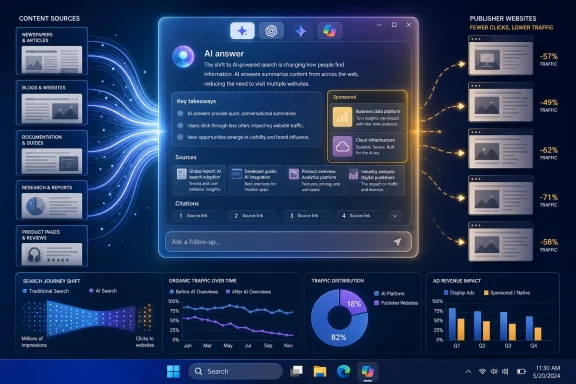 The 40% and 4% figures are not a traffic ledger
OneLittleWeb’s 40.12% figure is the annual growth rate in visits to a selected universe of AI-tool websites. It is not a measured fall in traffic to the open web, a count of searches diverted from publishers, or a calculation of lost advertising impressions.The same study puts all of those AI-tool visits at 4.20% of the 3.44 trillion visits across the 10,173 major sites it tracks. That comparison is useful for showing scale: AI is growing quickly but remained a minority of the tracked web-traffic total for the study period. It does not show a 40%-to-4% pipeline in which user attention disappears from publishers and reappears in chatbots.
Nor does the report establish that only 4% of AI activity is sent back to publishers. MediaPost uses that figure to describe a supposed redirection rate, but the submitted reporting does not identify a OneLittleWeb methodology that measures outbound publisher referrals across Google AI Overviews, ChatGPT, Copilot, Gemini and other answer engines. Browser visits to ChatGPT and clicks from ChatGPT to an individual publisher are separate measurements requiring different data.
That distinction matters for anyone setting budgets. A web-analytics dashboard showing that ChatGPT, Gemini or Copilot referrals are 4% of organic search traffic does not mean AI has “kept” the other 96%; it may mean visitors were never referred, were counted through another channel, used an app rather than a browser, or received an answer without leaving the platform. Those outcomes carry very different implications for ad sales, audience development and attribution.
The claim of a dramatic shift therefore needs to be framed as an observable behavior change, not as a settled global accounting of stolen traffic.
Click evidence shows the direction of travel
The evidence that does exist points in the same direction as MediaPost’s warning. Pew Research Center’s browsing study of 900 U.S. adults found that, in March 2025, search-result pages with a Google AI Overview produced traditional-result clicks in 8% of visits. Pages without an AI Overview produced such clicks in 15% of visits.Pew also found that people clicked a source link within the AI Overview itself in just 1% of visits. Users ended their browsing session after 26% of searches with an AI summary, compared with 16% of searches without one. Around 18% of the Google searches Pew observed generated an AI Overview during that March 2025 sample.
That is the evidence publishers should take seriously. It does not establish that every AI Overview halves a site’s traffic; AI summaries tend to appear more often on longer, question-based searches, which are not identical to ordinary navigational or shopping queries. But it does establish that when Google gives an answer first, the link list beneath it receives fewer clicks.
A new August 2026 research paper examining AI Overview behavior similarly reports that clicks to cited sources are rare, at about 1% of AI Overview visits. The paper is recent academic work rather than a completed peer-reviewed consensus, but it independently aligns with Pew’s observed click pattern.
For sites whose business model depends on informational search — product explainers, troubleshooting guides, software comparisons, documentation, publisher articles and affiliate reviews — the operational threat is not simply lower ranking. A page can still be indexed, cited, and visible in an AI answer while losing the visit that used to generate an ad impression, newsletter subscription, affiliate click or direct conversion.
The real transfer is advertising inventory
MediaPost describes a reinvention of digital advertising. That is already underway, and it is more concrete than the report’s traffic arithmetic suggests.Google has moved commercial inventory into its answer-first search products. Google’s advertising documentation says ads may appear above, below or within AI Overviews, while Google Marketing Live materials confirm testing of formats integrated into AI Mode responses. Google describes the placements as clearly labeled ads and says its systems decide when a commercial query is relevant enough to show them.
OpenAI has followed the same path. Its U.S. ChatGPT ad test began on February 9, 2026, according to OpenAI’s help documentation, and OpenAI later announced buying arrangements with major agency groups including Dentsu, Omnicom, Publicis and WPP. The company says ads are delivered separately from model responses and that advertisers cannot alter or rank the answer itself. That separation is important, but it does not change the business model: the conversational interface is becoming an ad-supported destination.
The commercial consequence is stark. A publisher may supply the source material that makes an answer useful, yet Google or OpenAI can monetize the query before a reader reaches the source. The publisher sees no display impression if the session ends in the answer interface. It may not receive a click even when it is visibly cited.
Google argues that clicks from AI-enhanced search can be higher quality, meaning people who do click may spend more time on sites. That may prove true for some commercial and research-heavy queries. But quality cannot compensate for volume without transparent reporting on clicks, conversion rates and revenue by AI placement. Google does not currently give publishers a clean, universal way to separate traffic and revenue affected by AI Overviews from conventional search behavior.
OneLittleWeb’s figures also undercount the Windows side of AI use
The OneLittleWeb study is explicitly a web-visit study. It measures estimated visits to websites, which makes it a poor instrument for measuring all interaction with AI tools that increasingly live inside operating systems, browsers, mobile apps and enterprise software.That limitation is especially relevant to Microsoft Copilot. A user can invoke Copilot from Windows, Edge, Microsoft 365, Teams or an enterprise environment without necessarily creating a visit to a consumer-facing Copilot website. The same problem applies to ChatGPT’s desktop and mobile applications, Gemini integrations in Android and Google services, and AI features embedded in products such as Canva.
As a result, ChatGPT’s 64.7 billion estimated web visits are best read as a measure of browser demand, not a count of all ChatGPT use. Likewise, the report’s positioning of Copilot alongside web answer engines should not be taken as evidence that browser-visit data captures Copilot’s reach among Windows users and managed-device fleets.
For Microsoft customers, the more immediate question is not whether Copilot appears near the top of a web-traffic ranking. It is whether users are receiving answers in Microsoft-controlled surfaces that bypass internal portals, vendor documentation and public web pages — and whether organizations can identify when that happens.
A Windows administrator who has spent years improving searchability of SharePoint pages, support content or product documentation now needs to measure a different path: prompt, answer, citation, click, action. Traditional SEO reporting stops at the wrong point if the answer is consumed inside Copilot or another assistant.
Publishers need revenue reporting, not another traffic chart
The most defensible takeaway from MediaPost’s report is that AI usage is rapidly concentrating around a small number of platforms. OneLittleWeb says the top 100 tools accounted for 129.6 billion visits, or 89.69% of the AI-tool traffic it tracked. YouGov’s July data likewise found ChatGPT to be the preferred tool among U.S. adults who had used generative AI in the preceding 30 days, with Gemini second and Microsoft Copilot third.Concentration changes the bargaining position of the web. A smaller set of answer engines increasingly decides which sources are cited, which brands are mentioned, whether a user clicks through, and where the paid placement appears. That is more significant than any single month’s referral figure.
Publishers and advertisers should resist the temptation to replace one blunt metric with another. “AI visibility” is not revenue. Being cited is not traffic. A chatbot visit is not necessarily a lost publisher visit. And a high-quality click does not offset a collapsing click volume unless it produces demonstrably higher value.
The ad reality is simpler: the platforms that summarize the web are positioning themselves to sell the attention that used to flow through it. Until Google, OpenAI, Microsoft and other answer-engine operators provide auditable reporting on citations, referrals, conversions and paid placement effects, publishers will be asked to accept a new distribution model without knowing what it costs them.
References
- Primary source: MediaPost
Published: August 6, 2026 at 8:50 PM UTC
Loading…
www.mediapost.com - Related coverage: onelittleweb.com
Loading…
onelittleweb.com - Related coverage: searchengineland.com
Loading…
searchengineland.com - Related coverage: thedailystar.net
Google's AI search summaries are reducing website clicks, study finds
Google's AI-generated search summaries, part of its 'AI Overviews' feature, are significantly decreasing click-through rates to external websites, according to a new study by the Pew Research Center, a US-based think tank. The research, based on 900 US adults' search behaviours, reveals that...www.thedailystar.net - Related coverage: emarketer.com
Google’s AI summaries are ending search sessions, reducing click-through behavior
The news: Google’s AI Overviews feature gets users offline and out of search quickly, making it harder for brands and websites to capture attention and clicks. Only 8% of Google users whose search triggered an AI Overview clicked on a link, per Pew Research. Among those who didn’t see an AI...www.emarketer.com - Related coverage: fortune.com
Google’s AI Overviews are quietly reshaping the internet | Fortune
Google’s AI Overviews are fundamentally changing how users interact with search results, according to new data from Pew Research Center.fortune.com
- Related coverage: onelittleweb.com
Affordable Search Engine Optimization (SEO) Services Agency
Maximize your website’s visibility with our SEO services. Drive traffic, increase rankings on Google & ChatGPT, and improve ROI. Get a free SEO audit now!onelittleweb.com - Related coverage: windowscentral.com
Google's AI overviews are dismantling the web and your brain | Windows Central
A new study reveals that Google users are far less likely to click on a link if an AI summary is part of the response in their search.www.windowscentral.com - Related coverage: pewresearch.org
How Americans feel about AI summaries in search results | Pew Research Center
One-in-five U.S. adults say they find AI summaries in search results extremely or very useful, 52% say they're somewhat useful, and 28% say they're not too or not at all useful.www.pewresearch.org - Related coverage: lemonde.fr
The new era of AI-powered search, which could 'change the web economy'
Since Wednesday, Google has started displaying artificial intelligence-generated responses, known as AI Overviews, for certain queries, rather than the traditional list of links. Website publishers and brands now fear for their visibility and are trying to find ways to respond.www.lemonde.fr