

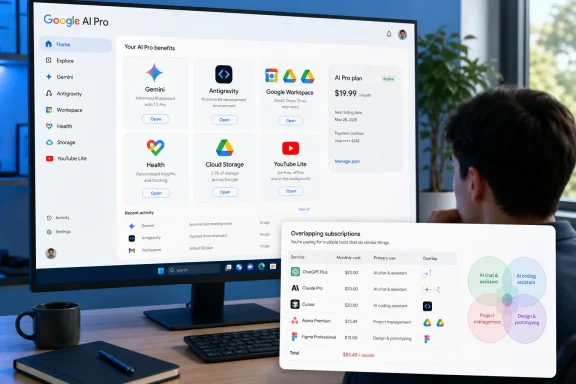
The reviewer’s core complaint is straightforward. Gemini 3.6 Flash was fast, but its writing and reasoning output too often required cleanup; ChatGPT became the default for ideation, research, and writing, while Claude remained the preferred coding tool. Google’s Antigravity coding environment did not displace Cursor, and Gemini’s app integrations did not cover enough of the author’s work in Asana and Figma to justify paying for another assistant.
That is a personal assessment, not a controlled comparison. But the record supports the larger practical point: Google AI Pro’s value depends heavily on whether a user’s work already lives inside Google’s services. Once a workflow crosses into project management, design, specialist development tools, or a different model provider, the bundle can become a collection of overlapping benefits rather than a replacement for anything.
Gemini 3.6 Flash Is Fast, but the Subscription Is Sold as More Than Speed
Google released Gemini 3.6 Flash as a lower-cost, faster model aimed at agentic work, coding, multimodal tasks, and general use. Google’s own materials emphasize improved token efficiency, reduced verbosity relative to Gemini 3.5 Flash, and availability across the Gemini app, AI Studio, Android Studio, Gemini Enterprise, and Antigravity.
That makes Android Police’s complaint more consequential than a preference for one chatbot’s prose style. The reviewer did not describe Gemini as unusable; the problem was that it did not become the tool they opened first. When an AI assistant’s drafts routinely need another pass before they can be sent, the product is losing on the metric that matters to paid users: saved time.
The comparison with GPT-5.6 and Claude Fable 5 should be treated carefully. OpenAI’s published benchmark tables place GPT-5.6 ahead of Gemini 3.1 Pro Preview on several coding-agent evaluations, but benchmark results do not settle whether one assistant writes a better email, understands a company’s terminology, or fits an individual’s workflow. Google is also still preparing Gemini 3.5 Pro; its 3.6 Flash announcement explicitly says the Pro model is forthcoming.
Still, the sequencing exposes Google’s current weakness. Pro customers are being asked to pay for a premium service while Google’s newest broadly available model is a Flash model and its next Pro model remains unreleased. For users who subscribe primarily for difficult reasoning, production-quality writing, or advanced coding, “fast enough” is not a durable answer when competing tools require less correction.
Antigravity Does Not Require a Gemini-Only Workflow
The article frames Antigravity as a Google AI Pro perk that failed to replace Cursor. That is fair as an account of the reviewer’s experience, but Google’s own Antigravity documentation complicates the premise that the decision comes down to Gemini versus competing models.
Antigravity currently lists Gemini 3.6 Flash, Gemini 3.5 Flash, Gemini 3.1 Pro, Claude Sonnet 4.6, Claude Opus 4.6, and GPT-OSS-120B in its model selector for Google AI Pro subscribers. In other words, Google’s coding workspace is already a multi-model product. A developer can use Claude inside Antigravity rather than treating it as a separate Gemini-only IDE.
That does not solve the reviewer’s complaint. Developers who have built muscle memory around Cursor are not shopping for a dropdown of models; they are comparing planning, file edits, terminal access, agent reliability, reviews, extension compatibility, context handling, and how easily they can recover when an agent goes off course. A model menu cannot overcome a weaker editing loop or an environment that feels slower to trust.
There is also a more basic purchasing lesson here for Windows developers and IT teams. A bundled coding agent should be evaluated separately from the consumer assistant that comes with it. Google AI Pro may be economical if Antigravity becomes a primary development environment, but it is poor value if it merely sits beside Cursor, Claude, GitHub Copilot, or another coding subscription without taking over meaningful work.
The report’s conclusion that Antigravity “never became essential” is therefore the relevant one. A bonus tool has little value if it does not consolidate an existing paid service or eliminate a recurring task.
The Health Bundle Was Not Available for the Whole Six Months
The article calls one of the benefits “Google Health AI Premium,” but that is not Google’s product name. Google calls it Google Health Premium, formerly Fitbit Premium, and positions Google Health Coach as the AI-powered feature within that service.
More importantly, Google made Google Health Coach publicly available through Google Health Premium on May 19, 2026, and said it would be automatically bundled with Google AI Pro and AI Ultra. Android Police’s article was published on August 11, 2026. That means the health benefit has been part of the plan for fewer than three months, regardless of whether the reviewer had maintained Google AI Pro for six months.
This does not invalidate the cancellation decision. A recently added perk can still fail to persuade a subscriber to stay. But it changes the implied timeline: the health component cannot reasonably be presented as a six-month-tested pillar of the subscription. It was a late addition to a plan the reviewer had already found unconvincing.
The Fitbit Air complaint needs an equally clear boundary. Android Police reports that a tracker recorded thousands of steps during a roughly five-hour drive. No independent evidence in the article establishes whether that was a device fault, a software issue, a configuration problem, or a one-off sensor error. It is a valid reason for that customer to distrust the device, but it is not evidence that Fitbit Air broadly miscounts driving as walking.
For prospective buyers, the consequence is simpler. Google Health Premium has an independent list price starting at $9.99 per month or $99 per year, and Fitbit Air includes three months of it. That benefit has real value only for people who want the Health Coach service and trust the wearable data feeding it. It cannot rescue an AI subscription for someone already considering moving to Samsung Health or another platform.
Gemini’s Connected Apps Are Broader Than the Article Suggests — and Still Narrower Than Many Workflows Need
Android Police argues that Gemini’s third-party support trails ChatGPT and Claude, particularly for work involving Asana and Figma. Google’s documentation shows that Gemini does connect to third-party services, including GitHub, Spotify, WhatsApp, Samsung Gallery, and selected lifestyle and productivity services. Google also supports direct access to its own Gmail, Drive, Calendar, Docs, Maps, YouTube, Search, and other account data.
But Google also makes the limitations plain: Connected Apps vary by country, account type, device, language, and the Gemini surface being used. With Gemini’s activity retention disabled, connected apps are unavailable on the web, iOS, and smartwatches, while Android is restricted largely to utilities, phone, messages, and WhatsApp. WhatsApp itself is limited to calls and messages through the Android Gemini app; Gemini cannot read or summarize the user’s WhatsApp message history.
That is a meaningful constraint for professional use. The useful question is not whether Gemini has some integrations. It is whether the assistant can reach the systems where work is actually created, approved, assigned, and documented.
OpenAI’s official support material says ChatGPT’s Asana app can securely access projects, tasks, comments, tags, custom fields, assignees, and due dates; it now also supports some write actions through MCP. Anthropic, meanwhile, supports remote MCP connectors, including an Asana connector, and its partner tooling has expanded into services such as Figma and Canva.
Google’s strength remains deep access to the information many users already keep in Google Workspace. For a Gmail-and-Drive-centric small business, that can be more useful than a long third-party app directory. For an organization working from Asana tickets, Figma files, Slack threads, and non-Google knowledge systems, Google AI Pro’s integration advantage fades quickly.
There is a governance implication as well. Connecting any AI assistant to project-management data is not a casual convenience setting. Teams should review whether the plan supports their account type, what data is indexed or synced, which actions can write back to a service, what an administrator must approve, and how the provider uses connected data. A missing connector may be frustrating, but an over-permissioned one is worse.
YouTube Premium Lite Is a Discount, Not a Reason to Keep an AI Plan
Google AI Pro now includes YouTube Premium Lite for eligible paid memberships in supported regions, as Google’s support documentation confirms. The benefit is automatic after a free trial ends and the account converts to a paid plan.
The word “Lite” does the important work. Google says ads can still appear on music content, Shorts, and during search and browsing. The plan does not include YouTube Music Premium, and it lacks several full Premium features, including broad background-play and download capabilities for music content and Shorts.
That means YouTube Premium Lite can lower the perceived cost of Google AI Pro for someone who already pays for it or wants fewer interruptions in ordinary videos. It is not equivalent to a full YouTube Premium subscription, and it does not create much value for a user who has no interest in the restricted video tier.
The same principle applies across the bundle. Cloud storage, YouTube Lite, health coaching, coding tools, and Gemini access can look compelling when listed together. They are only savings when they replace services the subscriber would otherwise buy.
Google AI Pro Needs a Primary Job
Android Police’s cancellation is not proof that Google AI Pro fails for everyone. Google has a serious model platform, a multi-model coding environment, strong access to Google Workspace data, and a growing set of consumer benefits. Its official documentation also confirms that Gemini 3.5 Pro is still on the way, so the service is not standing still.
But the review identifies the subscription’s current vulnerability: Google has bundled several reasons to subscribe without ensuring that any one of them becomes indispensable outside Google’s own products. If ChatGPT handles the writing and research, Claude or Cursor handles code, and another health platform handles wearable data, Google AI Pro becomes a monthly charge attached to tools the user already chose not to use.
For subscribers deciding whether to renew, the test is concrete. Keep Google AI Pro only if Gemini, Antigravity, Workspace integration, storage, Health Premium, or YouTube Premium Lite replaces a tool or expense already in the budget. If the plan only adds another chatbot and another coding workspace to an already crowded desktop, cancellation is the rational outcome.