
Safari was a distant second at 7.09%, followed by Firefox at 4.72%, Samsung Internet at 4.66%, Microsoft Edge at 1.34%, and Opera at 0.99%. Chrome’s 73.59-percentage-point gap over Safari is the practical measure of the market: an Azerbaijani web service that works only in Chrome can reach most observed traffic, but it is still excluding roughly one in five page views from the browser leader itself.
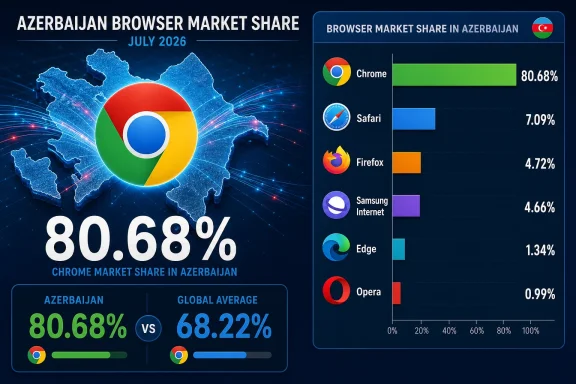 Chrome gained share in July, rather than simply retaining it
Statcounter recorded Chrome at 80.33% in Azerbaijan in June 2026. July’s 80.68% result is a 0.35-percentage-point gain month over month, small enough to avoid treating it as a major migration but large enough to invalidate the softer “maintains dominance” framing.
The ranking beneath Chrome also stayed remarkably stable. Safari gained from 7.05% to 7.09%, Samsung Internet increased from 4.55% to 4.66%, and Firefox slipped from 5.02% to 4.72%. Firefox remained in third place, but only 0.06 percentage points ahead of Samsung Internet; that is the only meaningful contest among the top four browsers.
Microsoft Edge fell from 1.50% in June to 1.34% in July, while Opera declined from 1.05% to 0.99%. Neither movement changes the central finding, but it does underscore how limited Edge’s observed all-platform reach is in this country compared with the attention Microsoft gives the browser inside Windows 11.
Chrome’s July share was also higher than it was a year earlier. Report.az, using Statcounter figures for July 2025, reported Chrome at 78.28% across computers, mobile devices, and tablets. On the same measurement basis, Chrome is up 2.40 percentage points year over year, while Safari has moved sharply lower from 10.11% in July 2025 to 7.09% this July.
That is a more consequential pattern than a single monthly reading. Chrome has held a commanding lead for years, but the latest figures show the lead did not erode as Safari, Firefox, Samsung Internet, and Edge competed for the remaining traffic.
Azerbaijan sits well above Chrome’s global average
Statcounter’s worldwide figure for July 2026 puts Chrome at 68.22% across all platforms. Azerbaijan’s 80.68% result is therefore 12.46 percentage points higher than the global average.
The contrast is clearest with Apple’s browser. Safari held 16.47% of global browser traffic in July, more than twice its 7.09% share in Azerbaijan. That suggests Apple-device web traffic has a smaller relative weight in Statcounter’s Azerbaijani sample than in the worldwide rollup, while Chrome’s presence on Android and desktop systems gives it an unusually dominant combined position.
Microsoft Edge moves in the opposite direction. Edge accounted for 5.37% of worldwide traffic in July but only 1.34% in Azerbaijan’s all-platform result. That does not establish the number of Windows PCs or managed endpoints running Edge: the country figure combines desktop, mobile, tablet, and console traffic. It does show that Edge is not converting Windows’ default-browser position into a comparable share of observed web use in this market.
For Microsoft-focused IT teams, that distinction has operational value. Windows 11 can place Edge at the center of the desktop experience, including links opened from system surfaces and Microsoft 365 integrations, without making it the browser users choose for general web activity. A browser default affects a device; browser-usage share measures where traffic actually appears.
The 80.68% figure is traffic, not an installed-base count
The number should be read precisely. Statcounter does not count browser licenses, active installations, corporate seats, or unique people. It analyzes page views recorded across a network of more than one million sites and assigns the browser category from information supplied with each web request.
Statcounter says its Global Stats service processes more than three billion page views each month, and its country dashboards are intended to show usage rather than software ownership. A person who uses Chrome for hundreds of page loads and Firefox once contributes far more Chrome traffic to the result. That approach is useful for publishers, web developers, advertising teams, and service operators deciding where compatibility failures will hurt the most. It is not a census of Azerbaijan’s browser users.
That caveat is more important now because browser identity is getting less clear. Statcounter’s own FAQ says that Perplexity Comet, The Browser Company’s Dia, and OpenAI’s ChatGPT Atlas currently identify themselves as Chrome. Until those browsers present distinct identifiers, Statcounter records their traffic under Chrome.
So 80.68% means traffic classified as Chrome, not a verified count of Google Chrome installations alone. The classification issue is unlikely to overturn the finding that Chromium-derived web technology dominates this market, but it means the reported percentage should not be reused as evidence that four out of five people installed Google’s browser.
Statcounter also says it removes Chrome prerendering requests that were not actually viewed where it can identify them. That avoids inflating Chrome’s count with background page loads, though browser telemetry remains an observational measurement rather than a direct audit of every device in the country.
What the data means for Windows application testing
For teams shipping Windows desktop software with embedded web content, internal portals, SaaS front ends, or public support sites, Chrome’s share makes Chromium compatibility the first testing priority in Azerbaijan. That is partly because Chrome itself leads by a wide margin, and partly because Edge and Opera are Chromium-based browsers that share a large part of the underlying web platform.
But Chrome-first cannot sensibly mean Chrome-only. Safari plus Firefox plus Samsung Internet represented 16.47% of Azerbaijani page views in July. Add Edge and Opera and the non-Chrome portion reaches 19.32%. A login flow, WebAuthn prompt, payment page, enterprise policy page, or browser extension that fails outside Chrome can therefore affect a material share of traffic even in a market where Chrome looks unassailable.
Firefox’s 4.72% also deserves more attention than its distant third-place rank might imply. It is the leading major non-Chromium desktop browser in the July all-platform table, and it remains important for testing standards compliance, privacy controls, extension behavior, and rendering assumptions. Samsung Internet’s nearly identical 4.66% reinforces the mobile side of that requirement: Android testing cannot be reduced to a single Chrome build.
The July data provides no device-by-device breakdown in Trend’s report, no estimate of the number of users behind the traffic, and no explanation for the month’s modest shifts. It therefore cannot prove that people actively switched browsers in July, nor can it attribute Chrome’s strength to a particular handset vendor, Windows deployment, or Google product change.
What it does establish is simpler and more useful: Chrome-classified traffic in Azerbaijan remained exceptionally concentrated in July 2026, rose slightly from June, and stood well above the browser’s global share. Any organization serving Azerbaijani users can make Chrome its primary compatibility target—but treating the remaining fifth of traffic as negligible would be a deployment mistake.
