
For Windows users managing corporate sites, community channels, or product documentation, the practical value is consolidated visibility: performance data can sit alongside traditional site properties rather than being split across each social platform’s analytics dashboard.
 Google still will not define which metadata wins
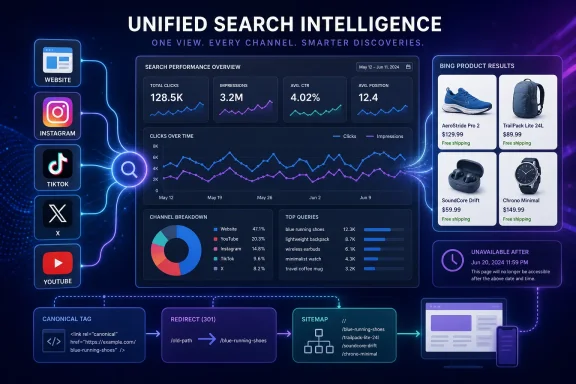
Google’s John Mueller has again said that Google Search does not publish — and likely will not publish — a fixed hierarchy for resolving conflicting metadata signals. Search Engine Roundtable highlighted the familiar example: a URL redirects from page A to page B, while page B declares A as its canonical target.
That is an operational warning for web administrators. Canonical tags, redirects, sitemaps and other indexation signals should align; treating one as a guaranteed override is risky when Google’s reconciliation process is intentionally opaque.
unavailable_after remains a blunt expiry tool
Google supports the unavailable_after meta directive to remove a page from results after a specified date and time, but changing that deadline later may not work as neatly as expected. If Google does not recrawl the URL before the original expiry time, it may never discover the revised date.
The directive may suit genuinely disposable content, but it is a poor fit for pages that might be extended, revived, or republished. A server-side redirect, authentication control, or deliberate removal workflow is safer when a page’s availability is uncertain.
Bing tests price labels directly on product imagery
Microsoft is reportedly testing price information over product-image thumbnails in Bing’s organic search results. The experiment could make shopping results more scannable, although it also means merchants need accurate product structured data and up-to-date feeds to avoid displaying stale pricing.
Google Ads also added a Budget Panel for Performance Max and Demand Gen campaign reviews, plus a visual Lead Journey Mapping tool. Target CPA and Target ROAS now appear as explicit bidding-strategy choices in the Ads interface.
The common thread is less about new dashboards than more automated interpretation of publisher and advertiser data. For administrators, the response is straightforward: keep metadata, feeds, redirects and conversion signals consistent before relying on any platform’s automation to resolve the gaps.
