

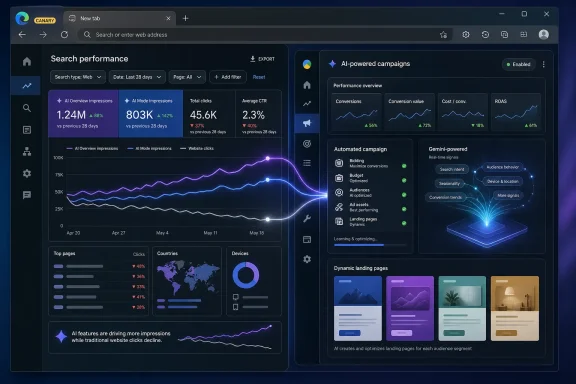
That matters for publishers, SEO teams, and organizations trying to reconcile Search Console numbers with falling referral traffic from Google. The report separates impressions from AI Overviews and AI Mode, with breakdowns by page, country, device, and date. It does not turn AI search into a fully auditable traffic channel: the report is based on Web Search data, is subject to the familiar Search Console row and aggregation limits, and its public documentation describes impressions—not a query-level record of every generative answer or a clean attribution path for AI-driven visits.
Search Engine Roundtable’s observation that the report now appears widely may reflect a significant expansion in the rollout. But “fully live” suggests universal availability, and Google has not made that claim. Administrators who do not see the report should not spend time re-verifying properties, changing DNS records, or assuming an indexing defect; the absence may simply be the rollout gate.
For Windows-focused publishers and IT vendors, there is a more uncomfortable practical consequence. The new report tells you whether a page was displayed as a linked source in Google’s generative features, but it cannot tell you whether Google’s answer satisfied the user without a click. A rise in AI impressions alongside flat or declining clicks is therefore possible—and should be interpreted as a distribution change, not automatically as successful organic growth.
Google’s AI measurement arrives with an opt-out switch
Google has paired the new Generative AI performance report with a Search Console control that lets verified site owners include or exclude their content from Google Search generative AI features. The control applies to AI Overviews, AI Mode, and generative features in Google Discover, according to Google’s help documentation.
The operational point is easy to miss: excluding a site from these features does more than remove a citation link. Google says the site’s content will not be eligible to appear to users in those generative features or to ground AI responses and previews. The change does not block ordinary Google Search indexing, does not itself act as a ranking signal elsewhere in Search, and does not control model training; Google directs publishers that want to address training to the separate Google-Extended control.
That puts the decision in the hands of publishers, but with incomplete evidence. A site can measure AI-feature impressions once it receives the report, yet Google has not provided the same level of visibility into the exact AI answers, prompts, or citation positions that produced them. The controls are clear; the business case for using them remains less so.
The timing is especially relevant for technical sites whose content is routinely used to answer configuration questions. A Windows troubleshooting article may be visible in an AI Overview, improve brand recognition, and still lose the page view that historically supported advertising, subscriptions, documentation funnels, or support deflection metrics. The Search Console report is useful precisely because it can expose that gap, but it cannot resolve it.
Google Ads’ August story is really a May product rollout still moving through tests
The recap also bundles several Google Ads and Google Analytics AI announcements into an apparent August release cycle. Google’s primary announcements show a more qualified picture. Many of the headline products were introduced around Google Marketing Live in May 2026, with language such as “testing,” “coming soon,” “beta,” or limited pilot rather than broadly completed rollout.
Google has announced Gemini-based formats for Search and AI Mode, including Conversational Discovery ads, Highlighted Answers, AI-powered Shopping ads, and Business Agent for Leads. It has also expanded its Direct Offers pilot with planned promotion bundling, native checkout for eligible Universal Commerce Protocol merchants, and travel-deal placements. These are substantial changes, but they are not one switch flipped for every advertiser.
The distinction matters because ad teams are being asked to hand more decisions to Google’s automation at the same time that Google is adding fewer transparent, manually controlled surfaces. AI Brief, for example, is Google’s mechanism for letting advertisers describe messaging, matching, and audience boundaries in natural language. It is a steering tool, not a contractual guarantee that generated ads, landing-page selection, or query expansion will always behave as a human campaign manager intended.
Google’s own AI Max documentation makes the trade-off explicit. Final URL expansion can select what Google regards as the most relevant destination page, while AI-generated creative and broader matching seek additional demand. That can help an advertiser reach long-tail queries that a conventional keyword structure misses. It can also send a user to a page that is technically relevant but commercially wrong, particularly on sites with dense knowledge bases, regional product pages, support articles, and multiple conversion paths.
For organizations running Microsoft, Windows, security, or enterprise software campaigns, the appropriate response is not to reject AI Max outright. It is to treat it like a production automation change: isolate tests, preserve a baseline campaign structure, inspect search-term and landing-page reporting, and validate lead quality downstream in CRM data rather than accepting platform conversions at face value.
Google is also pushing measurement products toward that same downstream view. Its newly announced journey-aware bidding is designed to let Search campaigns learn from biddable and non-biddable conversion goals across a longer lead-to-sale process. That may be useful for enterprise sales cycles, but Google currently describes the feature as beta. It requires sound offline conversion imports and disciplined definitions of qualified leads; no bidding model can repair incomplete CRM stages or a sales team that does not feed final outcomes back into the ad platform.
Search Campaigns for Travel consolidate the controls—and the dependency
Search Engine Roundtable also notes that Google will migrate Travel campaigns into Search campaigns for Travel. Google announced the product in April, positioning it as a unified destination for travel feeds and formats that had previously been managed through separate campaign types and interfaces.
The immediate benefit is administrative. Google says advertisers can bring travel formats, AI Max capabilities, bidding controls, feed data, and reporting into a single Search campaign environment. For a hotel group, booking engine, online travel agency, or ticket seller, that reduces fragmented reporting and makes it easier to manage campaigns across formats.
But consolidation has a cost: it moves more travel advertising logic into an AI Max-led campaign design. Google frames the change as full feature parity and unified reporting, while its broader AI Max strategy depends on automated creative, expanded matching, and dynamic landing-page choices. Travel advertisers do not merely receive a simpler interface; they inherit more of Google’s automation layer.
The recap does not identify a migration deadline, eligibility rules, or the treatment of existing campaign configurations. Google’s April announcement similarly emphasizes the upgrade path and benefits rather than publishing a hard universal cutoff in the material reviewed here. That is a material omission for advertisers with seasonal inventory, strict feeds, negotiated rate rules, or agency-managed accounts. They should not assume that a marketing announcement is an instruction to migrate a profitable live campaign during a high-demand period.
Google’s earlier April materials also make clear that travel is part of the company’s wider AI Max expansion, alongside Shopping campaigns. The long-term direction is evident: Google wants advertisers to manage a broader range of inventory through fewer campaign types, with more of the matching and creative logic determined by Gemini-backed systems.
The reported ad-header test raises an old disclosure problem in a new format
According to Search Engine Roundtable, Google Ads is testing site-name and favicon summaries at the top of ads. Google has used site names and favicons in organic mobile results for years, and Search Engine Land previously reported Google’s intent to make the advertiser identity and ad treatment more prominent in mobile Search. A new summary treatment in ads would therefore fit an established design direction, even though Google has not published a broad product announcement for this specific test.
The risk is not that advertisers receive a favicon. The risk is that ad creative increasingly borrows the visual grammar of organic results while Google simultaneously inserts AI-generated explainers, conversational ad units, offers, and product guidance into Search. The clearer the sponsorship label and advertiser identity, the better. A site name, favicon, and generated summary can improve recognition, but they can also make the paid placement feel more like a trusted editorial result if the “Sponsored” disclosure is visually subordinate.
This is one reason advertisers should capture Search-result screenshots when testing new formats. Google Ads reporting can tell an account manager that an impression occurred; it will not necessarily preserve how the surrounding result page made the ad appear to a user at that moment.
Edge AI Mode remains a Canary signal, not an enterprise deployment target
The recap’s Microsoft item, reported by Windows Report, says that Microsoft Edge AI Mode has received an “AI Search” name in Canary. The narrow wording matters. Edge Canary is Microsoft’s early development channel, where names, controls, and feature placement can change before they reach Dev, Beta, Stable, or managed enterprise builds.
For Windows administrators, a renamed Canary feature does not establish a new browser capability that should be enabled across an organization. It is a signal of product direction: Microsoft continues to position Edge as an AI-assisted search and browsing client, competing for the same user attention that Google is trying to retain inside AI Mode and AI Overviews.
The practical controls remain familiar. Keep Canary separate from production browser policy, review any AI or Copilot-related data-handling settings before pilots, and validate whether features respect work-account boundaries, Microsoft 365 compliance settings, and existing browser-management policies. A product name change does not answer those questions.
Google’s August 11 search-forum roundup is therefore less a list of isolated feature updates than a snapshot of a broader transfer of control. Search Console is adding enough visibility to show whether AI Search displays a site, while Google Ads is asking advertisers to place more matching, creative, budgeting, and landing-page decisions inside automated systems. The report worth watching is not whether an AI feature appears in a dashboard; it is whether the organization can still connect that appearance to qualified visits, qualified leads, and revenue.