
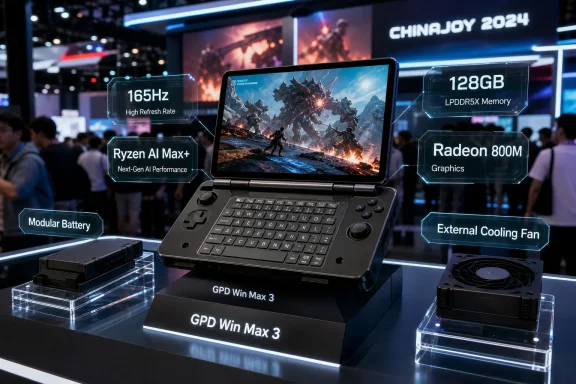
GPD announced the ChinaJoy showing in a July 30 social-media post, describing the Win Max 3 as a “handheld gaming laptop” and confirming that the prototype is at booth S392 during the July 31 through August 3 event. Retro Handhelds first highlighted the announcement for English-language handheld fans, while earlier reporting from IT Home, VideoCardz, HotHardware, and Notebookcheck had already outlined much of the device’s unusual specification sheet.
This is not a retail launch. GPD has not published final configurations, pricing, an Indiegogo campaign date, or a confirmed shipping schedule. But the public prototype means the Win Max 3 has moved beyond the leaked-listing stage, and it gives prospective buyers a clearer reason to hold off on another refreshed Win Max 2.
 The Win Max Becomes a Smaller, More Powerful Machine
The biggest change is not simply the processor. GPD is shrinking the nominal display size from the Win Max 2’s 10.1-inch panel to a 9.06-inch OLED while moving to a much more powerful Strix Halo-class AMD platform. At 2,400 x 1,504, the smaller screen works out to roughly 313 pixels per inch, providing a noticeably denser image than the 10.1-inch 2,560 x 1,600 IPS panel used on recent Win Max 2 revisions.
That trade-off matters because the Win Max line has always been closer to a compact laptop than a conventional controller-first handheld. It combines a physical QWERTY keyboard, a touchpad, built-in game controls, and a broad selection of ports in a clamshell chassis. The Win Max 3 appears to preserve that identity, although early photos and reports suggest a tighter keyboard layout than the Win Max 2.
The OLED panel is listed with 60Hz, 120Hz, 144Hz, and 165Hz modes, HDR10 support, and a claimed 1,050-nit peak brightness figure. Those peak-brightness claims should be treated carefully until independent testing establishes whether they apply to small HDR highlights rather than full-screen desktop use. Still, OLED’s contrast response and 165Hz ceiling are a major upgrade for a machine expected to spend time running Windows 11, desktop software, emulators, indie games, and full PC titles.
For Windows users, the high resolution presents an immediate usability advantage and a performance complication. Text, UI controls, and creative applications should look unusually crisp for a device this small. Yet many current games will not be realistic candidates for native 2,400 x 1,504 rendering at high settings, even with Radeon 8060S graphics. Windows scaling, AMD FSR, in-game resolution scaling, and the selectable lower refresh modes will be central to getting a sensible experience rather than treating 165Hz as a universal gaming target.
Strix Halo Is the Reason This Exists
The Win Max 3 is built around AMD’s Ryzen AI Max+ 388 and Ryzen AI Max+ 395, two members of the “Strix Halo” family that blur the line between an integrated-graphics laptop chip and a compact workstation platform. AMD lists the Ryzen AI Max+ 395 with 16 CPU cores, 40 Radeon 8060S graphics compute units, a 256-bit LPDDR5X memory interface, support for up to 128GB of memory, and a 50 TOPS NPU.
GPD’s choice of the lower Ryzen AI Max+ 388 is potentially more interesting for gaming-focused buyers. Reporting from VideoCardz and HotHardware indicates that it retains the same 40-CU Radeon 8060S integrated GPU while reducing CPU-core count relative to the 395. If the final power profiles and prices reflect that arrangement, the 388 model could offer most of the graphics capability of the flagship configuration without paying for CPU resources many handheld buyers will not fully use.
The 395, however, makes the Win Max 3 much more than a portable game machine. A 128GB unified-memory option could appeal to users who want a compact Windows PC for virtual machines, local AI work, code compilation, media work, or GPU-memory-hungry workflows that mainstream gaming handhelds cannot accommodate. That does not turn a nine-inch device into an ideal workstation; the keyboard, screen size, thermals, and ergonomics still impose real limits. But docked to external displays, keyboards, Ethernet, and storage, it could be a remarkably capable small-form-factor Windows system.
AMD officially supports Windows 11 on the Ryzen AI Max+ 395, along with native USB4 and PCIe 4.0 connectivity. That underpins much of the appeal here: this is still a full x86 Windows machine, not a gaming appliance with a desktop-like interface layered on top. Users can install Steam, Battle.net, Epic Games Launcher, Visual Studio, Hyper-V-compatible tools, standard desktop applications, and enterprise clients, subject to the usual limitations of a compact personal device.
GPD Is Externalizing the Parts That Create Heat and Weight
The more radical Win Max 3 decision is its modular layout. The base unit is reported to measure 207 x 147 x 34 mm and weigh about 815 grams. Add the 97Wh removable battery module and the figure rises to roughly 1,220 grams; attach the external fan module and it lands around 985 grams.
That makes the word “handheld” technically accurate but practically incomplete. At over a kilogram with its battery fitted, the Win Max 3 is less a Steam Deck rival than a tiny clamshell PC intended to be held occasionally, used on a table, or placed on a lap with a gamepad-like control scheme available. The benefit is flexibility: users who want the lightest travel setup can separate the battery, while users who want maximum performance can accept additional bulk.
GPD and retailers have described the external cooler as a 110W module intended to support the device’s highest performance mode. Notebookcheck reported that GPD expects the AMD version to reach buyers during the third quarter of 2026, though the company has not yet set a precise date. The physics behind the add-on are straightforward: Strix Halo can deliver far more graphics performance with additional power, but a 34mm-thick mini laptop does not have the cooling volume of a conventional gaming notebook.
The removable battery creates its own caveat. A 97Wh capacity is just below the 100Wh threshold commonly associated with easier airline carry-on treatment, but travelers should still check the policy of their specific airline. More importantly, 97Wh does not guarantee all-day mobile use when the system is allowed to draw 45W to 110W. It is a large battery for a handheld PC, not a loophole in power consumption.
Ports and Storage Keep the Laptop Ambition Intact
The early Win Max 3 specification lists are unusually strong on expansion. GPD is expected to include USB4 Type-C, a second USB 3.2 Gen 2 Type-C port, two USB 3.2 Gen 2 Type-A ports, HDMI 2.1, a 3.5mm audio jack, and DC power input. Storage is reported to include M.2 2280 and M.2 2230 slots, plus support for the tiny Mini SSD 1517 format.
That setup is meaningful for Windows enthusiasts who want one device for travel and a desk setup. USB4 should make fast external SSDs, docks, and display adapters viable, while HDMI 2.1 and the additional USB-A ports reduce the need to carry a hub for basic peripherals. AMD lists DisplayPort 2.1 capability and support for up to four displays on the Ryzen AI Max+ 395 platform, though the final number and behavior of external displays on the Win Max 3 will depend on GPD’s finished board design and firmware.
The omission that may concern some GPD veterans is OCuLink. The Win Max 2 line has been attractive partly because of its external-GPU flexibility, but the Win Max 3 port lists published so far do not include OCuLink. USB4 remains useful for eGPU enclosures, but it does not offer the same direct PCIe proposition. Until GPD publishes a final technical manual, buyers should not assume an OCuLink port will appear later.
The Price and the Keyboard Are Still the Real Unknowns
The Win Max 3’s specifications are ambitious enough that price will decide whether it becomes a cult favorite or an exceptionally expensive curiosity. GPD has said nothing official about retail cost. Earlier third-party reporting correctly noted that a Ryzen AI Max+ system, high-refresh OLED, 64GB or 128GB of memory, multiple SSD options, and modular cooling are not ingredients for a mainstream-priced handheld.
The second unresolved issue is input. A compact keyboard is useful for Windows maintenance, game launchers, command-line work, messaging, and quick edits, but it can become a liability if keys are too narrow or oddly arranged. ChinaJoy hands-on coverage should begin to answer whether the Win Max 3 retains the practical “mini laptop” character that made its predecessors stand out.
For now, the important development is concrete: the GPD Win Max 3 is no longer just a circulating leak. Its prototype is being shown publicly through August 3, 2026, and GPD’s next move needs to be final configurations, pricing, and a shipment timetable—not another vague promise that the machine is coming “soon.”
Update: GPD publishes early 75W gaming figures and signals sub-$1,499 pricing (August 7, 2026)
GPD has now shared early game-performance results for the Win Max 3, reportedly testing the system at power levels of up to 75W. According to TechNetBooks, GPD’s figures show 190 fps in Apex Legends and 98 fps in Forza Horizon 5 at 1,920 x 1,080 with high settings, while Cyberpunk 2077, Baldur’s Gate 3, Shadow of the Tomb Raider, and Borderlands 3 were said to remain above 70 fps.
These results are promising but should be treated as vendor-supplied numbers. GPD did not clearly identify the processor configuration used, nor whether FSR or other image-upscaling techniques were enabled—details that can substantially affect both frame rates and image quality.
TechNetBooks also reports that GPD has indicated the Win Max 3 will cost less than the $1,499 starting price of the Intel Arc G3 Extreme-based OneXplayer 3. That is not a final price commitment, and GPD still has not published model-by-model configurations or regional pricing.
Contrary to the earlier third-quarter expectation cited by Notebookcheck, the new report says the system is expected to go on sale by October. Until GPD confirms a campaign or retail date directly, prospective buyers should regard that as a reported target rather than a firm launch schedule.
