
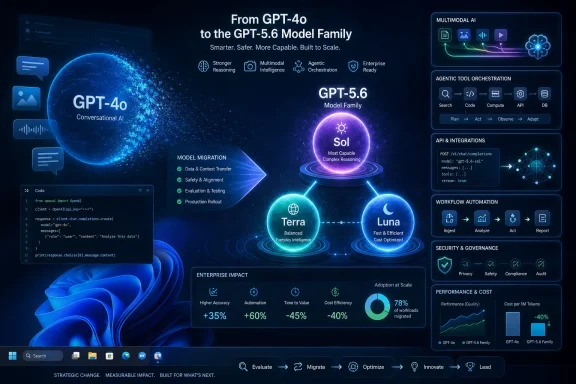
The practical story is still consequential for Windows users, developers, IT leaders, and organizations that built workflows around GPT-4o’s conversational feel and multimodal versatility. OpenAI is betting that its next growth phase will not be defined by one familiar all-purpose model, but by a portfolio: GPT-5.6 Sol for top-end work, GPT-5.6 Terra for balanced everyday workloads, and GPT-5.6 Luna for speed and cost efficiency. OpenAI’s GPT-5.6 launch announcement positions the three tiers as durable capability bands rather than merely smaller and larger versions of the same experience.
That is an enterprise strategy, but it is not an enterprise-only strategy. GPT-5.6 is available across ChatGPT, Codex, and the API, with broader consumer access to Sol than early reports implied. The real transformation is not that OpenAI has walked away from every individual user; it is that the company is increasingly designing its most valuable systems around managed work, agentic execution, integration, and governance.
 GPT-4o’s Retirement Was Real, but It Was Not a Total Disappearance
The retirement of GPT-4o understandably carried emotional and operational weight. GPT-4o had become a recognizable model name because it represented a major step toward real-time, multimodal interaction: a system people associated with natural conversation, voice, image understanding, and flexible everyday assistance.
OpenAI announced in January that it would retire GPT-4o, GPT-4.1, GPT-4.1 mini, and OpenAI o4-mini from ChatGPT on February 13, 2026. The company explained that it had previously restored GPT-4o access after hearing from Plus and Pro customers who valued its creative ideation support, warmth, and conversational style, and that those lessons informed improvements in later GPT-5 releases. OpenAI’s announcement is notable because it openly acknowledges that model retirement is not merely a benchmark-driven decision; user preference and interaction style matter.
However, the phrase “GPT-4o is gone” needs qualification.
ChatGPT retirement and API availability are different events
For ChatGPT users, GPT-4o is no longer a selectable model. For developers, the model’s status is different: OpenAI’s support guidance says the retired ChatGPT models continue to be available through the API, with advance notice promised for future API retirements. OpenAI’s support article therefore draws a critical product-boundary line between the consumer-facing ChatGPT interface and the developer platform.
That distinction matters particularly for Windows software teams. A desktop application, internal support tool, Power Automate workflow, Azure-connected service, or line-of-business application using API calls does not necessarily need a forced GPT-4o migration simply because ChatGPT’s model picker changed. Organizations should verify their actual integration points rather than infer API deprecation from the ChatGPT retirement.
Custom GPTs were migrated, not left without any route forward
The initial disruption narrative also misses an important operational detail. OpenAI says chats and projects that used retired models default to newer GPT-5 equivalents, while GPTs using retired models are automatically moved to the nearest GPT-5.3 Instant, GPT-5.4 Thinking, or GPT-5.4 Pro equivalent. OpenAI’s retirement FAQ describes an automatic transition rather than a complete absence of migration support.
That does not mean the experience will be identical. A “nearest equivalent” cannot guarantee the same:
- Tone and conversational cadence
- Response length and formatting habits
- Tool-selection behavior
- Safety refusals and edge-case handling
- Creative ideation style
- Latency and cost profile
- Performance on proprietary prompts and internal documents
For enterprises, a model swap is best understood as a production change, not an invisible platform maintenance event. Teams should rerun acceptance tests, compare outputs on representative prompts, retest grounding and retrieval flows, and inspect downstream automation for brittle assumptions.
Sora’s shutdown is related strategically, but separate operationally
OpenAI also discontinued the Sora web and app experiences on April 26, 2026, while the Sora API is scheduled to be discontinued on September 24, 2026. Users can export created Sora content through OpenAI’s sunset process, and the company says data associated with Sora use will be permanently deleted after any final export period. OpenAI’s Sora discontinuation guidance makes the deadlines and data-export implications explicit.
The connection between GPT-4o’s ChatGPT retirement and Sora’s closure is strategic rather than technical. Both demonstrate a willingness to streamline high-profile products while steering investment into newer platforms. But organizations should not treat them as one deprecation event. Their data, contracts, APIs, content libraries, and migration requirements differ substantially.
GPT-5.6 Is a Three-Tier Product Family, Not a Single Replacement
The centerpiece of OpenAI’s new direction is GPT-5.6, a model family released after a limited preview. The names matter: the flagship is Sol, not “Saul”; Terra is the balanced lower-cost tier; and Luna is the fastest and most affordable member of the family. OpenAI’s launch post explicitly defines the three roles.
This naming structure is not cosmetic. It reflects a maturing model market in which organizations are expected to match capability and cost to workload rather than send every request to a single frontier system.
The three GPT-5.6 models at a glance
| Model | OpenAI positioning | Best-fit enterprise use cases |
|---|---|---|
| GPT-5.6 Sol | Flagship model for the most demanding work | Complex coding, high-value analysis, computer use, multi-step agents |
| GPT-5.6 Terra | Balanced capability and cost for everyday work | Internal copilots, document workflows, broad employee access |
| GPT-5.6 Luna | Fastest and most cost-efficient tier | High-volume automation, classification, extraction, lightweight agent tasks |
OpenAI says its model selection is available in different ways depending on the product. Sol is accessible in standard ChatGPT conversations for qualifying paid tiers, while ChatGPT Work and Codex provide access to the broader Sol, Terra, and Luna lineup for eligible users. API developers can call all three. OpenAI’s availability and pricing details show that the deployment model is more nuanced than a simple “enterprise versus consumer” split.
For IT departments, that segmentation is useful. A help-desk assistant processing thousands of short internal requests does not necessarily need Sol. Conversely, an engineering agent expected to inspect a large repository, formulate a plan, invoke tools, validate test results, and prepare a pull request should not be limited to the lowest-cost tier merely because it has a chat-like user interface.
Pricing reinforces the workload-placement strategy
OpenAI lists GPT-5.6 API pricing per one million tokens as:
- Sol: $5 input / $30 output
- Terra: $2.50 input / $15 output
- Luna: $1 input / $6 output
The company also introduced a 30-minute minimum cache life and explicit cache breakpoints, while maintaining a 90% cached-input discount. OpenAI’s pricing documentation in the launch post suggests that prompt reuse and predictable context management are core parts of the value proposition.
For a Windows-centric enterprise, this has practical implications. A Microsoft 365 document assistant may repeatedly pass role instructions, policy text, style guidance, and workflow definitions. Prompt caching can make those repeated system-level inputs less expensive, but it also encourages better architecture: stable instructions should be separated from dynamic user data, and sensitive content should be handled according to a documented retention and access policy.
The Real Enterprise Play: Tool Calling, Agents, and Managed Workflows
GPT-5.6 is not being marketed simply as a better chatbot. OpenAI emphasizes software work, tool use, and coordinated execution. In the Responses API, Programmatic Tool Calling allows GPT-5.6 to write and run in-memory programs that coordinate tools and process intermediate results; OpenAI also describes a beta multi-agent capability that can run concurrent subagents and synthesize results in one request. OpenAI’s API overview frames the family as infrastructure for structured work rather than only text generation.
That is a significant evolution for business deployment.
From answers to actions
Earlier enterprise AI projects often stopped at retrieval-augmented chat: search internal documents, summarize findings, perhaps generate an email or a report. The next stage is more operational. A system may be asked to:
- Read a ticket from a service-management platform.
- Identify its category and urgency.
- Search approved knowledge sources.
- Draft a resolution.
- Create a follow-up task or route the issue for human approval.
- Record an auditable summary of the decision path.
This is why the value of AI increasingly depends on integration quality. A model can be highly capable in isolation and still fail in production if it has weak identity controls, ambiguous tool permissions, stale source data, or no reliable human-review mechanism.
Why Windows environments are well positioned
Windows organizations already operate in environments rich with business systems: Microsoft 365, SharePoint, Teams, Dynamics, SQL Server, Power Platform, Intune, Active Directory or Microsoft Entra ID, and innumerable internal applications. GPT-5.6’s emphasis on programmatic tools could make it attractive where teams need to connect AI to these systems without treating every task as an open-ended conversation.
The opportunity is especially strong in areas such as:
- Developer productivity: repository analysis, test generation, debugging assistance, build-log triage, and release-note preparation.
- IT operations: ticket summarization, KB retrieval, incident timeline drafting, change-review assistance, and endpoint-policy interpretation.
- Knowledge work: long-document synthesis, proposal drafting, requirements comparison, and spreadsheet or report analysis.
- Security operations: enrichment of alerts, investigation notes, remediation checklists, and controlled analysis of logs.
- Project management: status updates, dependency tracking, risk-register maintenance, and meeting follow-up generation.
But every one of these use cases requires explicit boundaries. An AI that can call tools is not merely generating language; it can influence operational systems. The distinction is fundamental.
Performance Claims Look Strong, but Benchmark Reading Requires Discipline
OpenAI reports that GPT-5.6 Sol sets strong results across coding, professional work, science, cybersecurity, and computer-use evaluations. Among the company’s published figures, Sol reaches an 80 score on the Artificial Analysis Coding Agent Index and a 64.6% result on SWE-Bench Pro, while Terra and Luna also post competitive coding results. OpenAI’s benchmark tables offer a detailed comparison across the family.
These numbers are useful signals, particularly because OpenAI reports performance by tier rather than only showcasing its flagship. Still, they should not be treated as a purchasing decision by themselves.
Benchmark leadership is not workflow validation
A benchmark generally measures a defined skill under specific conditions. Production environments introduce variables that a public score often does not capture:
- Incomplete or contradictory enterprise source material
- Unique coding conventions and legacy dependencies
- Tool/API failures
- Permission boundaries
- Vendor-specific data formats
- Latency and rate-limit constraints
- Human escalation needs
- Compliance obligations
- Cost volatility from long-context and agentic loops
A coding benchmark can indicate that a model is promising for software engineering. It cannot demonstrate that the same model will safely update a Windows deployment script, correctly interpret a proprietary PowerShell module, or handle a complex enterprise change-control process without supervision.
OpenAI itself identifies elevated risk domains
The GPT-5.6 launch is accompanied by unusually direct safety disclosures. OpenAI categorizes all three models—Sol, Terra, and Luna—as High capability under its Preparedness Framework for both cybersecurity and biological/chemical risk, while stating they are below the High threshold for AI self-improvement. The GPT-5.6 system card also says Sol and Terra can find vulnerabilities and pieces of exploits, although its testing did not show autonomous end-to-end attacks against hardened targets.
That disclosure should be read in two ways.
First, it is evidence that OpenAI sees the models as materially more capable in high-risk domains. Second, it is a reminder that organizations should not equate stronger security reasoning with a green light for broad autonomous access to production environments. Capability gains must be matched by permission design, monitoring, approval gates, and incident-response procedures.
Google’s “Omni” Move Shows How the Market Is Segmenting
OpenAI’s product transition has opened space for competitors to define “omni” or multimodal AI in their own way. Google’s Gemini Omni Flash is one of the clearest examples. Google describes it as a model that can create and edit from text, images, audio, and video inputs, beginning with high-quality video creation and conversational editing. Google DeepMind’s model card places generative media and broad multimodal interaction at the center of the product.
Google has also rolled Gemini Omni Flash out through the Gemini app, Google Flow, and YouTube Shorts, reinforcing a distribution strategy that reaches creators and consumers through established products rather than isolating the technology in a developer-only destination. Google’s Gemini Omni announcement describes that rollout.
The contrast with OpenAI is meaningful, though it should not be overstated. OpenAI still offers ChatGPT and multimedia-capable systems; Google still has enterprise ambitions. The difference is one of product emphasis:
- OpenAI’s GPT-5.6 messaging foregrounds coding, agent coordination, tool use, controlled tiers, and enterprise-grade operational work.
- Google’s Gemini Omni messaging foregrounds video, conversational editing, and accessible multimodal creative output.
This divergence may be healthy for buyers. It reduces the expectation that one general-purpose AI product must dominate every category. Organizations can increasingly choose based on the workflow they need to improve: creative media generation, collaborative knowledge work, software delivery, structured automation, or domain-specific analysis.
What Developers and IT Leaders Should Do Next
The GPT-4o transition offers a useful lesson: model names and availability can change faster than enterprise systems are designed to absorb. The right response is not panic, nor blind loyalty to any replacement model. It is disciplined portability.
Build a model-transition plan
Teams that previously relied on GPT-4o should document precisely where and how it was used. That inventory should include direct API calls, Custom GPTs, internal copilots, embedded chat features, Power Platform connectors, automated prompts, and analyst workflows that depended on the ChatGPT interface.
A practical migration checklist should include:
- Map dependencies. Identify every product, script, service, and business process that references a specific model.
- Create an evaluation set. Use real but properly sanitized examples: tickets, documents, code tasks, policy questions, and common failure cases.
- Compare behavior, not just accuracy. Evaluate format stability, tone, refusal behavior, tool decisions, latency, and total cost.
- Test tool permissions. Ensure agentic systems cannot trigger destructive or irreversible actions without appropriate approval.
- Measure output quality over time. A one-day pilot is not enough for workflows affected by model updates, new prompts, changing retrieval sources, or usage spikes.
- Maintain a fallback design. Where possible, preserve a way to route critical work to a lower-risk workflow, a second model tier, or human review.
Avoid a false choice between premium intelligence and low cost
GPT-5.6’s Sol, Terra, and Luna family makes model routing more important. A sensible architecture may use Luna for triage and metadata extraction, Terra for most employee-facing knowledge tasks, and Sol only for high-value engineering, planning, or multi-step agent jobs.
This approach can deliver better economics and better governance. Less capable models may have narrower permission scopes, while premium models may be reserved for workflows where their added reasoning capability has demonstrable business value.
Treat consumer UX and enterprise AI as complementary markets
The broader competitive landscape is not cleanly divided into “consumer AI” and “enterprise AI.” Employees are consumers, and they bring expectations shaped by mobile apps, video tools, chat interfaces, and real-time creative software into the workplace. Likewise, enterprise controls increasingly affect the tools that individuals can use safely with company data.
OpenAI’s move toward structured, tiered, agent-capable models may prove commercially powerful because businesses need more than compelling demos. They need predictable costs, integration hooks, administrative control, data protections, and repeatable outcomes. Google’s push around Gemini Omni Flash shows why the consumer-facing multimodal market remains strategically valuable: the next generation of workplace tools will still be judged by how intuitive and expressive they feel.
A More Mature AI Market Is Emerging
The retirement of GPT-4o from ChatGPT is not simply a story of one popular model being replaced by another. It is a sign that frontier AI is entering a more mature, more fragmented, and more operationally demanding phase.
OpenAI’s GPT-5.6 family shows the direction clearly. Sol, Terra, and Luna turn model choice into an architectural decision about capability, speed, expense, tool access, and safety exposure. The company’s investment in programmatic tool calling and multi-agent workflows makes the platform potentially more useful for real business processes, while its safety documentation underlines that greater capability brings higher stakes.
For Windows developers and enterprise IT teams, the most important takeaway is not to chase every new model release. It is to build AI systems that can survive them. Portable prompts, robust evaluation suites, controlled integrations, tiered model routing, audited permissions, and human escalation paths will matter more than allegiance to GPT-4o, GPT-5.6, Gemini Omni Flash, or any future headline model.
The era of one AI assistant for every task is giving way to a portfolio era. The winners will be the organizations that recognize that change early—and engineer for it.
