
gpt-5.6-luna will not resolve on the live OpenAI API, and that readers should replace it with gpt-4o before running the examples. That advice is wrong. OpenAI’s current model catalog lists gpt-5.6-luna as a live API model, and the identifier is valid.The error is more consequential than a stale introduction. The tutorial describes Luna as a future flagship with native multimodal generation, then builds its code samples around an older Chat Completions pattern. OpenAI’s own documentation positions Luna very differently: it is the lowest-cost, high-volume member of the GPT-5.6 family, alongside the more capable Sol and mid-tier Terra models. Developers using SitePoint’s article as a setup guide could unnecessarily downgrade to an older API model, choose the wrong model tier for serious work, and miss the pricing rules that make a million-token prompt far more expensive than the headline rate suggests.
OpenAI announced general availability for the GPT-5.6 model family on July 9, 2026. The company’s current API documentation and its ChatGPT help material both independently confirm that Luna exists and that
gpt-5.6-lunais the model ID. The SitePoint article, published more than a month after that launch, appears to have retained hypothetical copy that directly contradicts the rest of its own code.
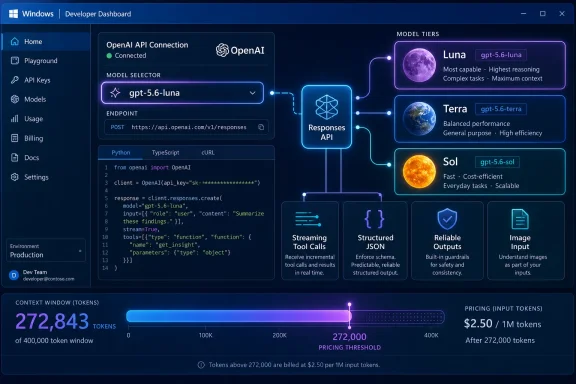
gpt-5.6-luna is valid, but it is not the flagship
The central correction is simple: do not replace
gpt-5.6-lunawith
gpt-4omerely because SitePoint says Luna is fictional. OpenAI identifies Luna as a deployed GPT-5.6 model with a 1.05 million-token context window, support for reasoning tokens, streaming, function calling, structured outputs, and the Responses API.
What Luna is not is the general flagship model portrayed in the guide. OpenAI’s model guidance directs developers to
gpt-5.6-solfor the highest capability,
gpt-5.6-terrafor a capability-cost balance, and Luna for efficient, high-volume work. The company says Luna roughly maps to the nano tier used in earlier GPT-5 families.
That changes the recommendation behind SitePoint’s code-review mini-project. A CLI that reviews a small Python file can be a reasonable Luna workload if it is processing many files and each review has validation around it. But a security-sensitive repository review, complicated architecture assessment, or multi-step debugging workflow is not automatically a Luna job simply because the model accepts a large context. Context capacity and task quality are separate variables.
OpenAI’s published benchmark table also shows why the distinction matters. Luna remains capable, but it generally trails Sol and Terra on coding-agent, scientific, computer-use, and cybersecurity evaluations. For a Windows admin automating ticket triage, extracting device inventory data, classifying logs, or drafting routine PowerShell explanations, Luna’s throughput and price can be the point. For a script that will alter production Group Policy, rewrite Intune deployment logic, or recommend a remediation path for an active incident, teams should test Terra or Sol against representative tasks instead of assuming the cheapest model is interchangeable with the flagship.
The practical issue is that a model slug may be technically valid while still being an inappropriate production default. SitePoint correctly encourages developers to measure cost, latency, tool reliability, and output quality, but its description of Luna obscures the most important selection criterion: Luna is designed to scale routine workloads cheaply, not to replace the highest-capability model in every workflow.
The tutorial’s multimodal claim confuses inputs, tools, and outputs
SitePoint says Luna can accept text, image, and audio in a single chat-completion call and return any combination of those modalities, eliminating the need for separate image and audio services. OpenAI’s Luna model page does not support that claim.
The official capability matrix lists text input and output, plus image input. It explicitly lists audio and video as unsupported. Luna can use image generation as a built-in tool through the Responses API, but that is not the same thing as a Chat Completions request natively returning generated images or audio in the response object. The distinction affects application architecture, billing, error handling, and the way developers parse results.
A Windows desktop app that submits a screenshot for diagnosis can send that image to Luna alongside text and receive a textual analysis. A helpdesk tool that needs the model to create a banner image, invoke web search, inspect files, or work with a hosted shell should be designed around the Responses API and its tool events. An app that needs text-to-speech or audio transcription still needs a compatible audio endpoint or model; Luna is not the all-in-one audio model described by SitePoint.
This is more than terminology. Treating a tool invocation as ordinary output encourages brittle integrations. A developer may write code expecting
message.contentto contain an image payload, then discover that image generation occurs through a separate tool flow with different objects, status states, and potentially different charges. Production applications should model text, tool calls, and generated assets as distinct response types.
One million tokens carries a surcharge after 272,000
SitePoint is right that Luna has a context window around one million tokens. OpenAI currently specifies 1.05 million tokens of total context and up to 128,000 output tokens. But the guide’s cost discussion stops before the billing condition that matters most to anyone tempted to send an entire repository, tenant export, or document archive into one request.
According to OpenAI’s current Luna model page, prompts exceeding 272,000 input tokens are billed at twice the input rate and 1.5 times the output rate for the full request. The current listed prices are $0.20 per million input tokens, $0.02 per million cached input tokens, and $1.20 per million output tokens. Cache writes cost 1.25 times the ordinary uncached input rate.
Those figures also expose a recent documentation shift worth watching. OpenAI’s original GPT-5.6 launch announcement listed Luna at $1 per million input tokens and $6 per million output tokens. Its current API catalog lists one-fifth of those rates. Axios reported a large Luna price reduction in late July, and OpenAI’s live model page is the record developers should use for budgeting today. A tutorial that says only that pricing is “per-token” does not give readers enough information to calculate whether broad-context processing is financially sensible.
The 272,000-token threshold means a full-context call is a deliberate premium feature, not simply a larger version of ordinary prompting. At the present list price, a 500,000-token request with a 20,000-token answer would be billed under the long-context multiplier rather than at Luna’s standard headline price. It may still be inexpensive in absolute terms, especially compared with larger models, but the correct comparison is against retrieval, chunking, caching, or a smaller context—not against the nominal $0.20-per-million input price.
For a code-review service, start with a repository map, changed files, dependency manifests, relevant tests, and retrieval over symbols or error traces. Send the complete repository only when cross-file reasoning is genuinely necessary and when the extra prompt cost, latency, and data exposure are justified. A one-million-token window is useful capacity; it is not a mandate to fill it.
Chat Completions still works, but OpenAI recommends Responses for the work SitePoint demonstrates
The Python and TypeScript calls in SitePoint’s guide use
client.chat.completions.create(). That endpoint remains supported for Luna, so the samples are not invalid merely because they use Chat Completions. Structured outputs, streaming, and function calling are also supported capabilities.
However, OpenAI’s current GPT-5.6 migration guidance tells developers to use the Responses API for reasoning, tool-calling, and multi-turn workflows—the precise scenarios SitePoint emphasizes. The newer API exposes GPT-5.6-specific features including persisted reasoning across turns, explicit prompt-cache control, programmatic tool calling, and a beta multi-agent facility. The guide’s traditional loop—ask for a tool call, execute it, append a tool result, make a second completion request—can still be useful for custom functions, but it leaves readers with the older integration shape and none of the migration guidance for the latest family.
There is a second operational gap: GPT-5.6 reasoning has real latency and control implications. OpenAI supports reasoning settings from
nonethrough
max, with
mediumas the documented default. Its guidance recommends evaluating the current setting and one lower when migrating, rather than hard-coding a single configuration. For high-volume Luna applications,
noneor
lowmay be an appropriate baseline; for tool use or a difficult classification decision, a higher setting may improve quality but changes cost and time-to-first-token.
SitePoint’s streaming advice remains sound in principle—stream interactive answers and use non-streaming calls where a complete object simplifies backend processing. But developers should plan for an additional GPT-5.6 behavior that the tutorial omits: OpenAI says real-time cyber and biology safeguards can pause generation during streaming and can occasionally affect legitimate defensive or research requests. A UI needs timeout, cancellation, and partial-result behavior that accounts for more than ordinary network delays.
A corrected starting point for Windows developers
The tutorial’s security basics are still useful: keep API keys out of repositories, validate user-controlled inputs, treat model output as untrusted, and enforce schemas before an automated workflow acts. The mini-project’s path restriction and JSON schema are better production instincts than simply asking a model to “review this code” and printing its answer.
But its most prominent instruction must be inverted. Use
gpt-5.6-lunawhen Luna fits the workload; do not replace it with
gpt-4obecause a disclaimer says it does not exist. For new GPT-5.6 work involving reasoning, tools, or multiple turns, begin with the Responses API, select the model tier based on measured task quality, explicitly set and test reasoning effort, and budget for long-context pricing before deploying a repository-scale prompt.
The immediate consequence for anyone who copied SitePoint’s examples is straightforward: the model identifier can remain, but the project should be re-evaluated against OpenAI’s current API documentation before it reaches production. Luna is real. The guide’s account of what Luna is for—and what its API can actually return—is the part that needs replacing.
